
What topics are covered in the warehouse racking installation training curriculum?
Warehouse racking installation training covers installation planning, interpreting layout drawings and manufacturer instructions, identifying components, safe assembly, anchoring, personal protective equipment, and site risk controls. It also addresses load notices, inspection and handover requirements, defect reporting, relevant safety standards, and best-practice procedures for completing installations safely and compliantly.
Warehouse racking installation training covers the knowledge and practical skills needed to plan, assemble, secure, inspect and hand over storage systems safely. The curriculum normally combines installation methods, component identification, drawing interpretation, workplace risk control, equipment use, inspection requirements and the legal and technical standards that apply to the work.
Installation planning and preparation
Training begins with the information required before work starts. This includes reviewing the approved layout, installation sequence, site rules, manufacturer’s instructions, delivery details and the intended load requirements. Trainees learn how to confirm that the work area is suitable, identify access restrictions, coordinate with other contractors and ensure that the correct components and tools are available.
The course also explains how to prepare suitable risk assessments and method statements. Typical considerations include vehicle and pedestrian movements, work at height, falling objects, manual handling, unstable components, drilling operations, lifting activities and interaction with live warehouse operations. Good planning should define exclusion zones, emergency arrangements, supervision requirements and the checks needed before installation progresses.
Understanding components and layout drawings
Participants learn to identify the main parts of the storage system and understand their purpose. Depending on the system, this may include frames, beams, bracing, footplates, anchors, safety locks, row spacers, guards, decking and other accessories. Correct component identification is essential because visually similar parts may have different load, connection or installation requirements.
Drawing interpretation is another core topic. Training covers how to read plan views, elevations, dimensions, bay arrangements, clearances, aisle widths and component schedules. Trainees learn to compare the drawing with the physical site and to stop and escalate discrepancies rather than making unapproved changes. This helps prevent incorrect positioning, unsuitable clearances and installation errors that could affect stability or operational use.
Safe assembly and installation techniques
The practical element demonstrates how to assemble the system in the specified sequence and maintain stability as work proceeds. It may cover frame erection, beam fitting, bracing, locking mechanisms, decking and the installation of protective accessories. Instruction focuses on using the correct tools and methods, avoiding damage to components and checking that connections are fully engaged.
Where drilling or anchoring is required, trainees learn how to position and install anchors in accordance with the design and manufacturer’s instructions. The curriculum can include checking the substrate, selecting the specified fixing method, maintaining edge distances, cleaning drilled holes and recording installation checks. Anchors should never be substituted or repositioned without suitable technical approval.
Training also addresses temporary stability. Partially assembled structures may require temporary supports, controlled erection sequences or restrictions on access until the installation is complete. Operatives are taught not to leave incomplete work in an unsafe condition and to secure the area when the installation team is not present.
Personal protective equipment and work equipment
The curriculum covers the selection and correct use of personal protective equipment, such as safety footwear, head protection, gloves, eye protection, high-visibility clothing and suitable fall protection where required by the risk assessment. PPE is treated as one part of a wider control system, rather than a replacement for safe planning or physical safeguards.
Participants also learn pre-use checks and safe operation of relevant work equipment. This may include hand tools, torque tools, drilling equipment, access equipment and lifting aids. The training reinforces the need to use equipment only within its intended limits, report defects promptly and follow site controls for charging, storage and maintenance.
Manual handling, lifting and work at height
Installation work can involve long, heavy or awkward components. Training therefore includes assessing manual handling tasks, using team lifts and mechanical aids appropriately, planning routes and communicating clearly during movement. It also covers the risks created by suspended or raised loads and the importance of keeping people outside exclusion zones.
Where installation involves elevated work, trainees learn how to select suitable access equipment, maintain three points of contact where applicable and prevent tools or components from falling. The correct approach depends on the task, the duration of the work, the working environment and the findings of the site risk assessment. Rescue and emergency arrangements should be understood before work at height begins.
Quality checks and installation tolerances
A competent installer must know what to check, when to check it and what to do when a result is outside the approved tolerance. Training commonly covers alignment, verticality, beam engagement, bracing, anchor installation, damaged components, clearances and the correct positioning of accessories. It also explains why components must not be bent, drilled, cut or modified unless the change has been authorised by the appropriate technical authority.
Checks should be completed progressively rather than left until the end. This makes it easier to identify the source of an error and prevents defects being concealed by later stages of assembly. Trainees are shown how to record findings clearly and how to obtain technical guidance when the drawing, specification and site conditions do not agree.
Load information and safe use requirements
Installation training explains the importance of displaying accurate load information once the system is ready for use. Trainees learn how the intended configuration, beam levels, bay arrangement and component selection relate to the stated working loads. They are also taught that changing beam positions, adding accessories, altering the layout or using different components may affect the design capacity.
The course highlights the need to communicate restrictions to warehouse operators and to prevent unauthorised alterations. It may also cover load notices, operating instructions, protection against impact and the reporting of overloading, instability or damage.
Inspection, defect reporting and handover
A complete curriculum includes the checks required before handover. This involves inspecting the finished installation, confirming that specified components are present, removing installation debris, verifying protection measures and ensuring that outstanding issues are recorded and controlled.
Trainees learn how to recognise defects such as bent frames, damaged bracing, displaced beams, missing locking devices, loose or unsuitable fixings, impact damage and inadequate protection. They are taught to classify concerns according to their seriousness, make unsafe areas secure and report defects through the agreed process. Installation records, inspection sheets, photographs, drawings and certificates may form part of the handover documentation.
The course also distinguishes between installation checks and subsequent user inspections. Once the system is operational, it requires ongoing monitoring and formal inspection arrangements appropriate to its use and condition. Training may explain how installers support the handover process, while making clear that operational inspections and repairs must be carried out by suitably competent people.
Legal requirements, standards and manufacturer guidance
Relevant health and safety duties are incorporated throughout the course rather than treated as a separate theory exercise. Topics may include the Health and Safety at Work etc. Act, the Management of Health and Safety at Work Regulations, the Provision and Use of Work Equipment Regulations, the Work at Height Regulations and the Construction (Design and Management) Regulations where applicable to the project.
Training can also introduce the principles of recognised technical guidance for the design, installation and safe use of storage systems, including the importance of following the current manufacturer’s instructions and any project-specific engineering information. The applicable requirements depend on the system, location, scope of work and contractual arrangements, so trainees should know when to seek advice rather than rely on assumptions.
Communication, supervision and professional conduct
Safe installation depends on clear communication between installers, supervisors, site managers, designers and the customer. Training covers toolbox talks, handover briefings, stop-work procedures, reporting unsafe conditions and confirming changes before they are implemented. It also reinforces the installer’s responsibility to work within their competence and to ask for assistance when a task falls outside their training or authorisation.
In practice, the most valuable outcome is not simply knowing the assembly sequence. It is being able to recognise an unsafe or non-conforming situation, control the immediate risk, document the issue and obtain the correct technical decision. Practical exercises and assessment are therefore used to confirm that participants can apply the curriculum on site, not just recall its terminology.
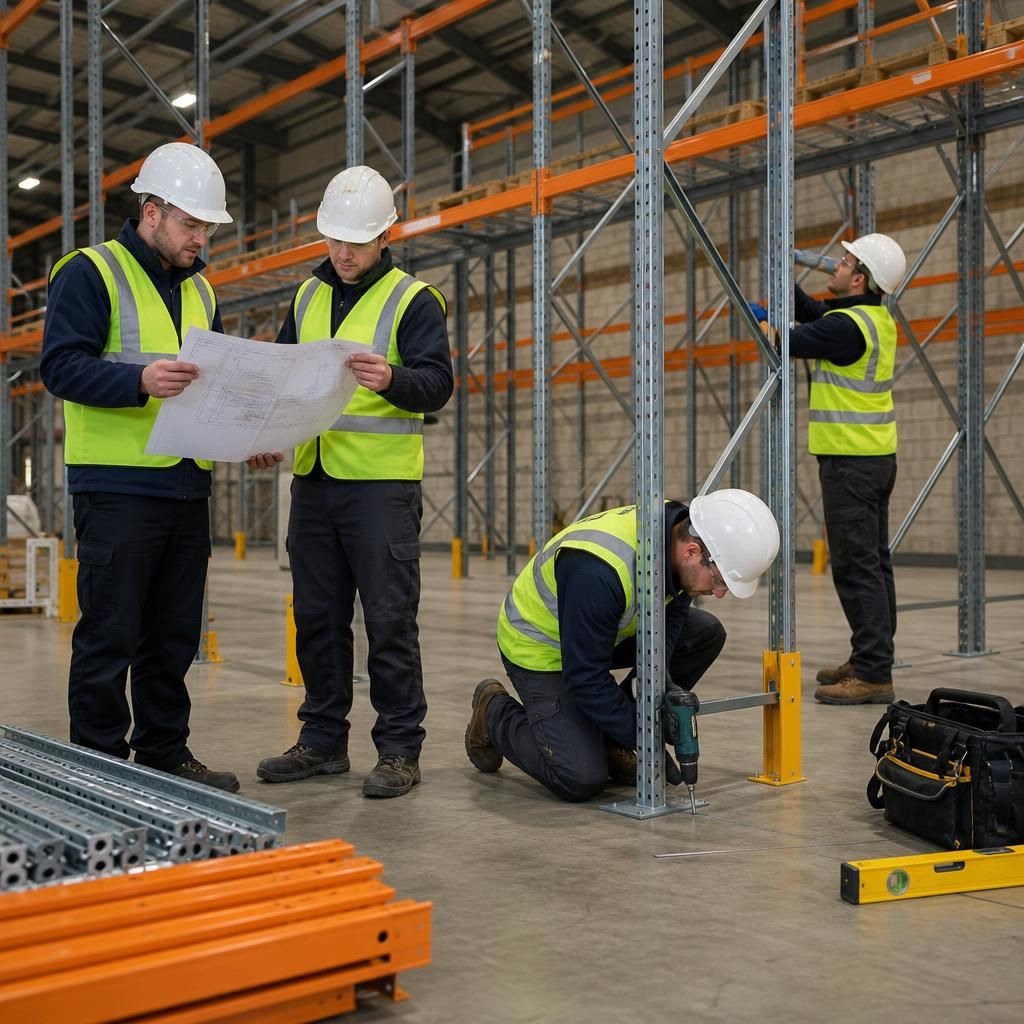
Practical assessment is a key part of warehouse racking installation training, confirming that trainees can apply the correct methods safely rather than simply recall theory. It typically covers interpreting the approved layout, identifying components, assembling frames and beams, fitting bracing and accessories, installing specified anchors, and maintaining stability throughout the work.
Assessment also includes progressive quality checks, such as alignment, verticality, beam engagement, locking devices, fixings and protection. Trainees must recognise damaged or unsuitable components, stop when site conditions differ from the approved information, and report issues through the correct process. Before handover, they should be able to complete installation records, communicate outstanding defects and confirm that load information and safe-use requirements are available.
Discuss your warehouse racking installation training requirements
Discuss your warehouse racking installation training requirements with Able Racking to identify the right course content, practical assessment and site-specific safety considerations for your team.