
How does Able Racking ensure compliance in warehouse racking repairs?
Able Racking ensures compliance in warehouse racking repairs by assessing damage against current safety requirements, specifying appropriate remedial work and documenting every inspection, repair and follow-up check. Experienced technicians use controlled repair methods and provide clear records, helping you demonstrate that your storage system has been made safe and remains suitable for use.
Able Racking ensures compliance in warehouse racking repairs by controlling the complete process from initial damage assessment through to remedial work, inspection and record keeping. Each repair is assessed against the condition of the warehouse racking, the intended loading arrangements, relevant guidance and the site’s own safety procedures. This provides a clear basis for deciding whether the affected warehouse racking can remain in service, must be restricted or requires immediate isolation.
Compliance starts with a competent inspection. An experienced Able Racking technician examines the damaged components and the surrounding warehouse racking, rather than treating an isolated defect in isolation. The assessment considers issues such as:
- Damage to uprights, frames, beams, bracing, footplates, guards and connections.
- Whether the damage affects the stability or load-carrying capacity of the warehouse racking.
- Signs of repeated impact, overloading, poor installation or movement of components.
- The condition of adjacent bays and any risk that damage may have spread.
- Whether the warehouse racking still matches its design, load notices and operating conditions.
Where damage presents an immediate risk, the affected area can be identified for isolation or controlled use while the repair is arranged. This prevents warehouse racking being used beyond its safe condition and ensures that operators understand any temporary restrictions. A repair is not treated as compliant simply because a visibly bent component has been straightened or made to look acceptable.
Repairs are specified against recognised safety requirements. Able Racking considers the principles set out in relevant British and European standards, including BS EN 15635 for the use and maintenance of storage equipment, together with applicable Health and Safety Executive guidance, manufacturer information and site-specific risk controls. Where SEMA guidance or manufacturer-approved methods apply, these are also considered as part of the technical assessment. The correct reference depends on the type of warehouse racking, the damage and the proposed remedial method.
This approach helps distinguish between damage that can be repaired using an approved method and damage that requires replacement. Some components cannot be safely restored by welding, heating, drilling, straightening or improvised reinforcement. If a repair would alter the designed behaviour of the warehouse racking or leave uncertainty about its capacity, replacement or a more extensive engineering solution is normally the safer and more appropriate option.
The repair method is selected to protect the original design. Before work begins, the technician confirms the required components, access arrangements, isolation measures and installation sequence. Repairs are completed using suitable materials, fixings and techniques for the specific warehouse racking system. The work is carried out by experienced operatives who understand how structural components, connections and load paths work together.
Good compliance also depends on controlling the work environment. The repair plan may require the affected warehouse racking to be unloaded, an exclusion zone to be established, lifting equipment to be controlled and nearby warehouse activities to be managed. These precautions reduce the risk of further impact or injury while the repair is in progress. The exact controls are determined by the site risk assessment and the nature of the damage.
Every repair is supported by clear documentation. Records typically identify the location and type of damage, the findings of the inspection, the risk controls applied, the repair or replacement work completed and any recommendations that remain outstanding. Photographs, component details and follow-up requirements may also be included where they help demonstrate the condition of the warehouse racking before and after the work.
These records provide useful evidence for the person responsible for warehouse racking safety. They can support internal checks, future inspections, contractor coordination and discussions with insurers or enforcing authorities. They also create a history of recurring damage, which can reveal problems with vehicle routes, loading practices, operator training or warehouse layout.
Completion checks confirm that the work has achieved its purpose. After a repair, Able Racking checks that the correct components have been installed, connections are secure, protection is in place where required and the warehouse racking is suitable for its intended use. Any affected load notices, inspection labels or site records should be updated when necessary. If the warehouse racking cannot safely return to its previous loading arrangement, that restriction must be communicated clearly and reflected in the site’s operating controls.
Compliance does not end when a damaged component has been replaced. The warehouse racking should continue to be managed through regular visual checks, formal inspections by a technically competent person and prompt reporting of new damage. Employees should know how to identify and report defects, while drivers and other warehouse users should understand the controls intended to prevent repeat impact.
Able Racking’s practical compliance process therefore combines:
- Competent assessment of damage and surrounding warehouse racking.
- Risk-based decisions on isolation, restriction, repair or replacement.
- Repair methods selected with regard to relevant standards and manufacturer requirements.
- Suitable components, controlled installation and experienced operatives.
- Completion checks and clear communication before the warehouse racking returns to service.
- Inspection and repair records that provide an auditable history.
- Practical recommendations to reduce repeat damage and maintain safe operation.
This combination helps demonstrate that warehouse racking repairs have been considered, carried out and verified systematically. It also gives the responsible person a practical route to maintaining safe, efficient and compliant warehouse racking after the immediate defect has been resolved.
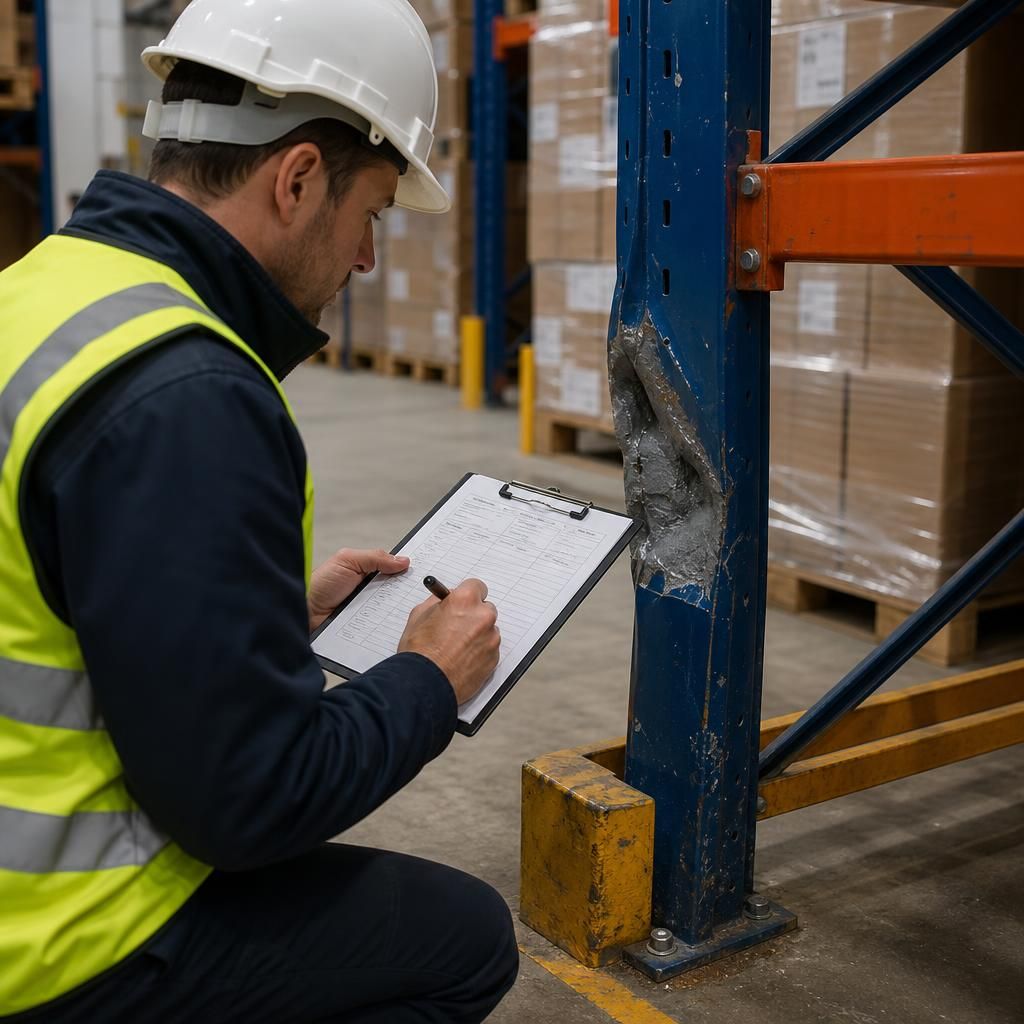
Compliance in warehouse racking repairs is demonstrated by a clear record of what was found, what action was taken and how the completed work was checked. Able Racking documents the damage assessment, any isolation or loading restrictions, the repair or replacement carried out and the condition of the warehouse racking after completion.
These records help the person responsible for warehouse racking safety confirm that the repair followed a controlled process. Photographs, component details and follow-up recommendations can also provide an auditable history, supporting future inspections and helping identify recurring problems such as vehicle impact, overloading or unsuitable operating practices.
Arrange a compliance-focused warehouse racking repair assessment
Arrange a compliance-focused warehouse racking repair assessment with Able Racking to review damage, required controls and the appropriate remedial work. We will provide clear recommendations and records to support the safe return of your warehouse racking to service.