
What is the role of a warehouse racking inspector in emergency situations?
A warehouse racking inspector responds to an emergency by assessing damage, identifying immediate risks to people and stock, and advising on isolating unsafe areas or unloading affected sections. They document the findings, specify urgent repairs or replacement requirements, and support a safe, compliant return to use.
A warehouse racking inspector responds to an emergency by assessing immediate hazards, helping the site isolate unsafe areas, identifying damage and specifying the action needed to protect people, stock and operations. The inspector does not replace the site’s emergency procedure or emergency services. Their role is to provide competent technical advice on the condition of the warehouse racking and support a controlled, evidence-based response.
Typical emergencies requiring an urgent inspection
An emergency inspection may be required after a forklift or other vehicle impact, partial collapse, falling components, unexpected movement, fire, flooding, significant water damage or any event that may have affected the stability of the warehouse racking. An urgent assessment is also appropriate when a member of the warehouse team reports a serious defect, such as a visibly bent upright, displaced beam, damaged connection or leaning section.
The inspection should take place before the affected area is returned to normal use. A warehouse racking inspector will first establish what happened, which sections may have been involved and whether the incident could have affected adjacent bays or connected runs.
Immediate control of the area
The first priority is preventing further exposure to danger. The inspector will normally advise that people, vehicles and stock are kept away from the affected area until its condition has been assessed. Depending on the circumstances, this may involve:
- stopping access to the damaged warehouse racking and surrounding aisles;
- preventing loading, unloading or repositioning of stock in the affected section;
- creating a clearly marked exclusion zone;
- isolating equipment or traffic routes that could cause another impact;
- unloading a section only where this can be done safely and under suitable control; and
- protecting people from falling stock, loose components and unstable structures.
A damaged section should not be used simply because it appears stable from floor level. Removing stock can change the load distribution, and entering an unstable area to investigate may create additional risk. The site’s responsible person must coordinate the isolation arrangements and any emergency response activity.
Assessment of damage and wider risk
Once the area is controlled, the warehouse racking inspector examines the affected components and the surrounding installation. The assessment may include:
- uprights, frames, bracing and baseplates;
- beams, beam connectors, locking devices and support locations;
- guards, end barriers and other protective equipment;
- floor fixings, slab condition and signs of movement;
- the position, condition and security of stored loads;
- evidence of distortion, twisting, cracking, buckling or displacement; and
- damage to neighbouring bays that may not be obvious at first sight.
The inspector also considers the likely cause of the incident. For example, impact damage may indicate a problem with vehicle routes, visibility, loading practices or protection around the warehouse racking. Fire and flooding may affect materials, fixings, floors and stored goods beyond the area where the incident was first noticed.
Deciding what action is required
The response depends on the severity and location of the damage. The inspector may advise that a section can remain in service with monitoring, that it must be unloaded and repaired, or that it must remain isolated until replacement or dismantling is completed. Where the stability of the warehouse racking cannot be confirmed, it should be treated as unsafe until a competent assessment establishes otherwise.
Emergency advice may include temporary controls, but temporary measures should not be treated as a permanent repair unless they have been properly specified and approved. Straightening damaged components on site, welding without appropriate design advice or reusing visibly compromised parts can create further risk and may affect the intended capacity of the installation.
Reporting the findings
An emergency inspection report should clearly record the affected location, the observed damage, the apparent cause where known, the risks identified and the actions required. It should distinguish between immediate controls and permanent remedial work. Clear photographs, marked-up locations and component descriptions can help the site team and repair specialists understand what must be addressed.
A useful report should also state whether areas outside the initial incident zone were examined, any limitations on the inspection and the conditions that must be met before the warehouse racking is returned to use. If further investigation or engineering input is needed, this should be stated rather than assumed.
Supporting urgent repairs and safe recovery
Following the inspection, the warehouse racking inspector can help define the required repair or replacement work. This may involve identifying damaged components, confirming suitable replacement parts, advising on unloading requirements and checking that the proposed work addresses the underlying problem. Repairs should be carried out by appropriately competent operatives using compatible components and suitable methods.
After repairs, a follow-up inspection is needed to verify that the affected warehouse racking has been restored correctly and that the surrounding installation remains suitable for use. The site should not rely solely on the completion of physical work; the repaired area should be checked before loads and normal vehicle movements are reintroduced.
Preventing a repeat incident
An emergency response should also identify practical preventive measures. Depending on the findings, these may include improving traffic management, reviewing load-handling procedures, replacing inadequate protection, correcting loading arrangements, refreshing operator training or increasing the frequency of routine checks. The warehouse racking inspection schedule may also need to be reviewed if the incident exposed a recurring hazard or a change in site conditions.
Warehouse teams should continue to carry out regular in-house visual checks and report defects promptly. These checks do not replace a formal inspection by a competent warehouse racking inspector, particularly after an impact or other event that may have affected structural integrity.
What the site should do during an emergency
- Follow the site emergency procedure and contact the relevant emergency services where necessary.
- Stop activity around the suspected hazard and prevent unauthorised access.
- Do not touch, unload or attempt to repair damaged warehouse racking unless this has been assessed and controlled.
- Record what happened, including the location, vehicle or equipment involved and any immediate changes observed.
- Arrange an urgent inspection by a competent warehouse racking inspector.
- Keep the affected area isolated until the inspection, repairs and return-to-use checks are complete.
The inspector’s role is therefore both immediate and preventative: to help control the hazard, assess the condition of the warehouse racking, provide clear repair advice and support a documented, safe return to operation. A prompt professional response reduces the risk of secondary damage and helps the site make decisions based on the actual condition of the installation rather than assumptions.
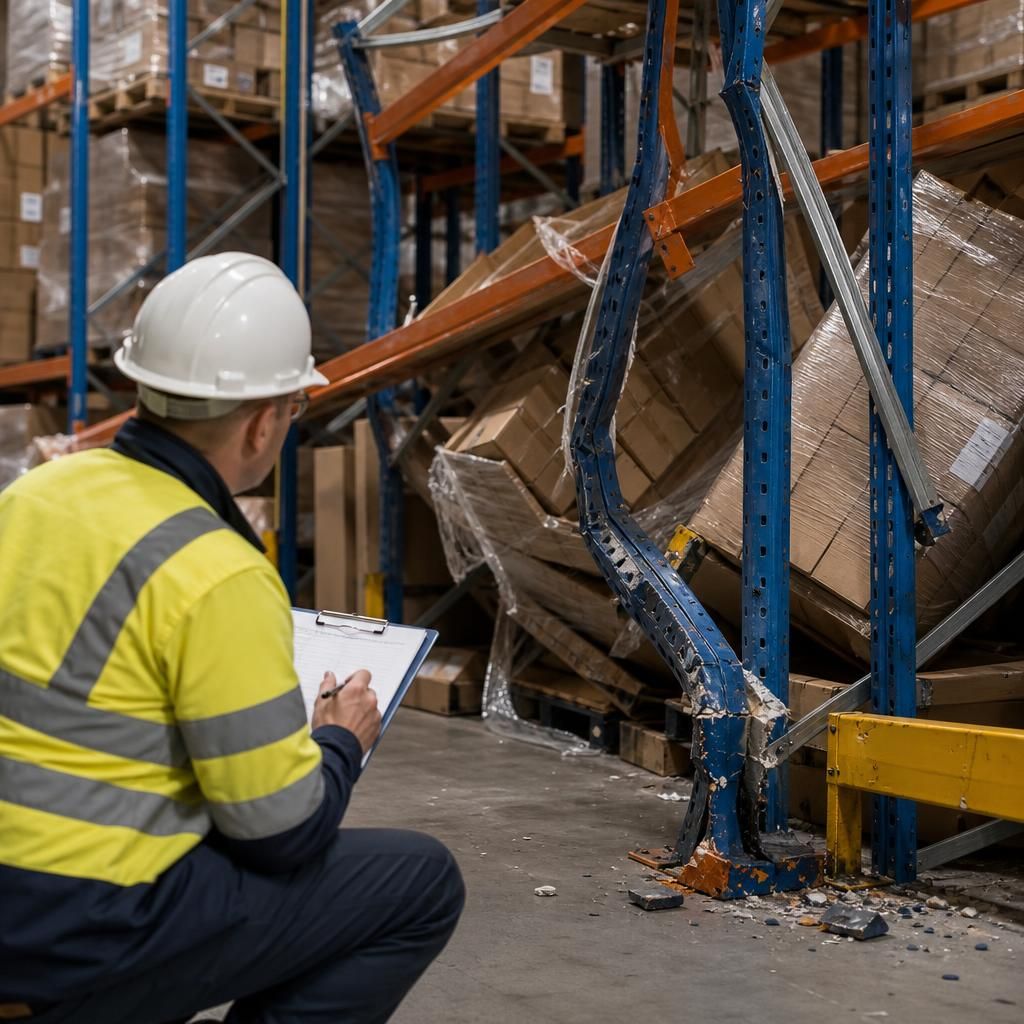
In an emergency, a warehouse racking inspector’s immediate role is to help control the hazard before assessing damage. The affected warehouse racking and nearby aisles should be isolated from people, vehicles and stock until a competent assessment confirms they are safe.
The inspector then examines structural components, connections, floor fixings, stored loads and adjacent bays for impact damage, movement or instability. Their findings identify whether the area requires monitoring, unloading, urgent repair or continued isolation, providing the site team with clear evidence for a safe and controlled return to use.
Arrange an Emergency Warehouse Racking Inspection
Contact Able Racking to arrange an urgent warehouse racking inspection following an impact, collapse, fire, flooding or other event that may have affected safety. Our competent inspectors will assess the damage and provide clear advice on isolation, repairs and a safe return to use.