
What are the consequences of neglecting HSE warehouse racking inspections?
Neglecting HSE warehouse racking inspections can allow damage, overloading, instability and other defects to go unnoticed, increasing the risk of falling goods, structural failure, serious injury and costly operational disruption. Regular inspections identify problems early so they can be repaired, isolated or managed before they compromise warehouse safety, legal compliance or the performance of the storage system.
Neglecting HSE warehouse racking inspections allows damage, overloading, instability and other defects to remain unidentified. The consequences can include falling goods, partial or complete structural failure, serious injury, enforcement action, damaged stock, operational disruption and substantially higher repair costs. A planned inspection regime identifies defects early, allowing affected areas to be repaired, unloaded or isolated before they create a greater risk.
Warehouse racking is a work equipment system and must be maintained so that it remains safe to use. Employers have duties under UK health and safety law to assess risks, provide suitable equipment and maintain safe working arrangements. HSE guidance also supports regular visual checks by trained staff, prompt reporting of damage and periodic expert inspections by a competent person. The inspection itself does not replace day-to-day care: it forms part of a wider warehouse racking safety system.
The main consequences of neglect are:
- Undetected physical damage: Forklift impacts can bend uprights, dislodge beams, damage guards or affect connections. Small defects may worsen through continued loading and everyday movement of goods.
- Falling goods: Damaged components, unsuitable pallets, poor load placement or overloading can cause stored items to fall into working areas. This can injure employees, contractors and visitors, as well as damage stock and handling equipment.
- Instability or collapse: Missing components, inadequate anchoring, uneven floors, altered layouts and unapproved modifications can reduce the stability of warehouse racking. A local defect may affect connected bays and create a wider structural risk.
- Overloading: If load notices are missing, inaccurate or ignored, users may place loads above the system’s safe capacity. Repeated overloading can affect beams, frames and connections without producing an obvious warning before failure.
- Interrupted operations: Unsafe warehouse racking may need to be unloaded, cordoned off or taken out of service at short notice. This can delay picking, goods-in and despatch, and may require temporary storage arrangements.
- Higher repair and replacement costs: Early damage may be dealt with through a straightforward repair or component replacement. If inspections are missed, deterioration can spread and result in larger repair work, stock losses or replacement of whole sections.
- Legal and enforcement consequences: Where an incident occurs, investigators may examine the inspection, maintenance and training arrangements in place. Failure to control known or foreseeable warehouse racking risks can lead to improvement requirements, prohibition action, prosecution or civil claims, depending on the circumstances.
- Insurance and liability concerns: Insurers and other parties may ask for evidence that warehouse racking was inspected, maintained and used correctly. Incomplete records or an inconsistent inspection process can make it more difficult to demonstrate that reasonable precautions were taken.
- Loss of confidence: A preventable warehouse racking incident can affect employees’ confidence, customer relationships and the organisation’s reputation for safe operations.
Why visual damage can be misleading
Not every unsafe condition is immediately obvious. A warehouse racking inspection should consider the condition of frames, beams, bracing, connections, baseplates, anchors, guards, load signs and surrounding floors. It should also consider how the system is being used. Changes to pallet sizes, load weights, vehicle routes, aisle arrangements or storage methods can introduce risks even where the warehouse racking appears undamaged.
Some defects are also cumulative. Repeated minor forklift impacts, loose fixings or poorly positioned pallets may gradually reduce the system’s safety margin. An inspection by a competent person provides a structured assessment rather than relying on assumptions that the warehouse racking is safe because no incident has yet occurred.
What should happen when a defect is found?
- Report the damage or concern to the person responsible for warehouse racking safety.
- Assess whether the affected bay or area needs to be unloaded, restricted or isolated immediately.
- Arrange an assessment by a suitably competent warehouse racking inspector where the severity or cause is uncertain.
- Complete repairs using appropriate components and a method suitable for the warehouse racking system.
- Record the action taken and do not return the area to service until it has been confirmed as safe.
- Investigate the underlying cause, such as vehicle movement, poor housekeeping, unsuitable pallets, inadequate training or changes in loading practice.
Simply painting over damage, straightening a component without technical assessment or continuing to use an affected bay can conceal the problem rather than resolve it. Repairs should be proportionate to the defect and completed in accordance with the system manufacturer’s requirements or an appropriate engineering assessment.
How to reduce the risk of neglect
- Appoint a person with responsibility for coordinating warehouse racking inspections and corrective actions.
- Train warehouse staff to recognise impact damage, displaced components, missing safety features and unsafe loading.
- Carry out routine visual checks at a frequency appropriate to the working environment and record significant findings.
- Arrange periodic expert warehouse racking inspections in line with HSE guidance and the risks identified by the employer’s assessment.
- Keep inspection reports, photographs, repair records, load information and follow-up actions together and accessible.
- Review warehouse racking safety after layout changes, alterations, unusual loading, vehicle incidents or changes in working methods.
- Make sure load limits are displayed clearly and that employees understand the limits and the correct loading arrangements.
Inspection records should show the date, areas examined, defects identified, risk classification, recommended action, responsible person and completion status. A report that is filed but not acted upon does not control the risk. The value of an HSE warehouse racking inspection comes from completing the corrective work and verifying that the warehouse racking is safe to use afterwards.
Regular inspections cannot prevent every incident, but they provide an essential opportunity to detect deterioration before it becomes a failure. Maintaining a documented programme of visual checks, competent expert inspections, prompt repairs and suitable user training is the practical way to protect people, stock and business continuity while demonstrating that warehouse racking risks are being actively managed.
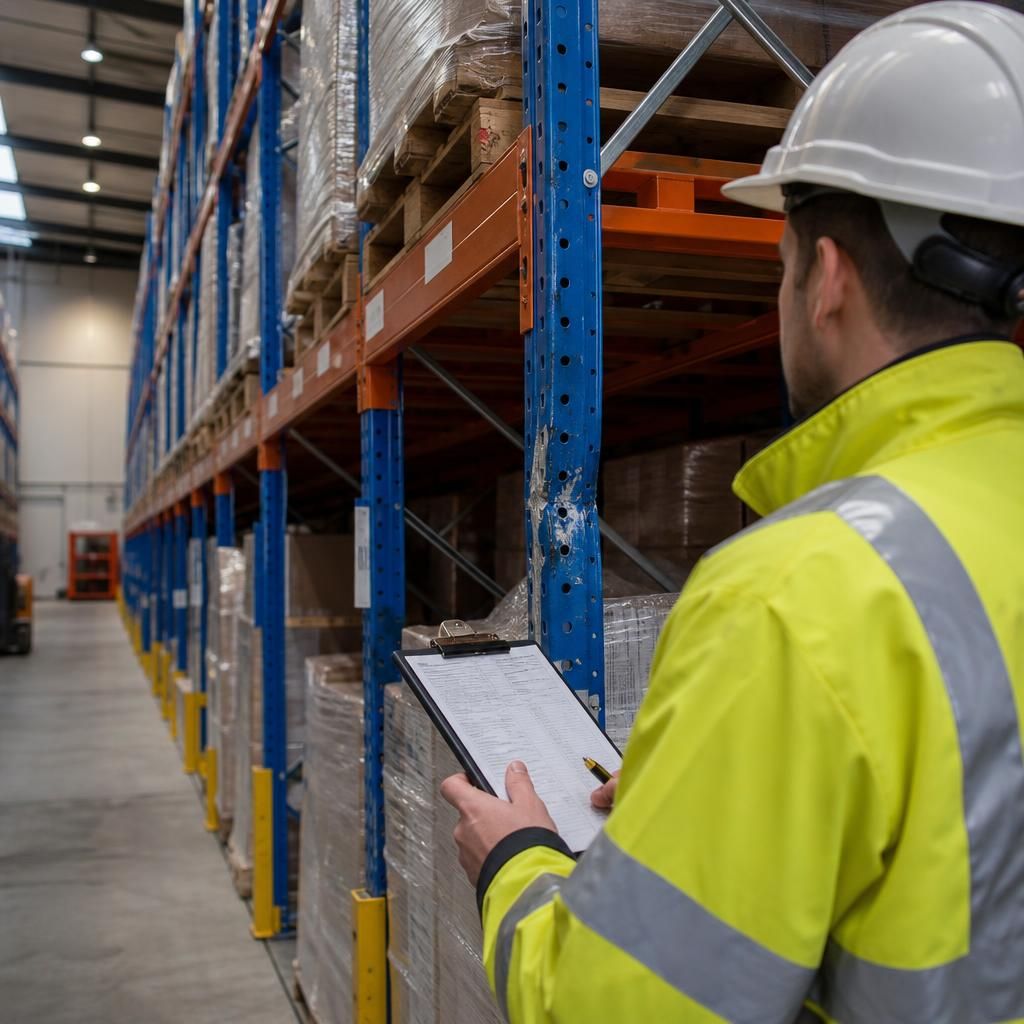
Neglecting HSE warehouse racking inspections allows damage, overloading and instability to remain undetected until they cause falling goods, structural failure or operational disruption. An inspection provides a planned opportunity to identify defects early and determine whether an affected area should be unloaded, isolated or repaired.
The inspection report should record the condition of the warehouse racking, the location and seriousness of each defect, and the action required. Its safety value depends on prompt follow-up: responsible staff should complete the recommended repairs, retain evidence of the work and confirm that the affected area is safe before it returns to use.
Arrange your HSE warehouse racking inspection
Arrange your HSE warehouse racking inspection with Able Racking to identify defects early and confirm that your storage system remains safe, compliant and fit for use.