
What are the benefits of choosing a shuttle racking system for high-density storage needs?
A shuttle racking system is a high-density warehouse racking solution in which a powered pallet shuttle moves along storage lanes, reducing the need for forklift travel within the structure. It can increase usable storage capacity, improve loading and retrieval efficiency, and support safer, more controlled warehouse operations.
A shuttle racking system is a high-density warehouse racking solution in which a powered pallet shuttle moves along dedicated storage lanes, placing and retrieving pallets without requiring a forklift to travel into each lane. This arrangement makes better use of available floor space and storage height, while improving handling efficiency, stock control and safety when the system is correctly designed, operated and maintained.
Greater storage capacity
The main benefit of shuttle racking is its ability to store more palletised goods within a given warehouse footprint. Pallets are held in deep storage lanes, so the system requires fewer access aisles than selective warehouse racking. The space that would otherwise be allocated to forklift manoeuvring can therefore be used for additional storage.
Storage capacity can also be improved vertically, subject to the building, load requirements, fire protection arrangements and safe working limits. This makes shuttle racking particularly suitable where floor space is restricted, land costs are high or a warehouse needs to increase capacity without relocating.
Efficient use of deep storage lanes
A pallet shuttle carries loads into the lane and positions them against the next available storage location. It can then return to the front of the lane or remain in position for the next task, depending on the operating method and system design. Forklift movements are concentrated at the face of the warehouse racking rather than taking place throughout the storage structure.
This reduces unnecessary travel and allows the warehouse layout to be planned around productive loading and retrieval points. It is especially effective for operations storing significant quantities of the same product or product batches, where deep-lane storage can be used without compromising the required stock rotation method.
Faster loading and retrieval
By moving pallets within the lane, the shuttle can carry out storage and retrieval movements with less forklift travel. Forklift operators can place or collect pallets at the lane entrance while the shuttle completes the internal movement. This can reduce waiting, simplify traffic flows and help the warehouse process more work during busy periods.
Actual performance depends on factors such as lane depth, pallet condition, travel distances, battery management, operator procedures and the number of available shuttles. A properly planned system nevertheless provides a more controlled material-handling process than relying on forklifts to enter every deep storage lane.
Improved forklift productivity
Forklifts remain important, but their role changes. Instead of repeatedly travelling into warehouse racking, operators can focus on transporting pallets between receiving areas, dispatch areas and the front of the storage lanes. This can reduce travel distances, limit congestion and make forklift utilisation more predictable.
Reduced forklift movement within the storage structure may also help limit contact with upright frames, guide rails and pallet supports. It does not remove the need for competent forklift operation or regular inspections, but it can reduce exposure to some of the common causes of warehouse racking damage.
Better separation of storage and handling activities
A shuttle racking layout can provide a clearer division between storage lanes, forklift operating areas and pedestrian routes. This supports more consistent warehouse procedures and makes it easier to identify where particular activities should take place.
Clear separation is valuable for busy warehouses handling regular inbound and outbound movements. It can help reduce conflicting traffic, provided the layout includes suitable barriers, marked routes, visibility controls, loading rules and supervision. The system should be considered as part of the wider warehouse safety arrangement rather than as a standalone safety measure.
Support for different stock rotation methods
Shuttle warehouse racking can be configured to support either last-in, first-out or first-in, first-out operating practices. Last-in, first-out is often suitable for products that do not require strict date rotation, while first-in, first-out can be supported by using separate loading and retrieval sides or an appropriate lane arrangement.
The correct method depends on the product, batch controls, expiry requirements and the warehouse process. Stock rotation should be agreed during the design stage because it affects lane configuration, access arrangements and day-to-day operating procedures.
Improved control in temperature-controlled storage
High-density shuttle racking can be useful in chilled or frozen environments because it allows more storage positions within the insulated warehouse volume. Storing more pallets in the same controlled area may help make better use of refrigeration capacity, although the outcome depends on the building design, airflow requirements, door movements and operating temperatures.
Equipment used in temperature-controlled areas must be suitable for the environment. Battery performance, charging arrangements, condensation, visibility and maintenance access should all be assessed before installation. The racking structure and shuttle equipment must also remain accessible for inspection and repair.
Consistent and controlled pallet handling
Automated shuttle movement follows defined routes within the storage lanes. This can produce more consistent pallet placement than repeated forklift entry, provided pallets are suitable, loads are stable and operators follow the correct controls. Consistent positioning helps protect the storage structure and reduces the likelihood of pallets being left incorrectly positioned.
It is important not to assume that the system will correct poor pallet quality. Damaged pallets, uneven loads, excessive overhang or unsuitable pallet dimensions can affect shuttle operation and may create risks to the warehouse racking. Load standards should be documented and checked routinely.
Potentially safer working practices
Keeping forklifts out of deep storage lanes can reduce the opportunity for impact with internal racking components. Remote shuttle operation can also allow some storage and retrieval tasks to be completed without an operator entering the lane. These benefits depend on suitable guarding, interlocking, emergency stops, access controls and safe operating procedures.
Warehouse racking inspections remain essential. Inspectors should check for damage to frames, beams, rails, guides, protection and other components, as well as signs of displacement or unsafe loading. Any damage should be reported, assessed and repaired through a controlled process. A shuttle system improves the handling method, but it does not replace regular safety inspections or competent maintenance.
Flexibility for high-volume product lines
Shuttle racking is well suited to warehouses that hold large quantities of palletised products, seasonal stock or repeat product lines. Lanes can be allocated according to product type, batch, temperature requirement or dispatch priority. This provides a practical way to organise dense storage while retaining a structured approach to stock control.
It may be less suitable where every pallet is a different product and immediate access to each individual pallet is required. In those circumstances, a more selective warehouse racking arrangement, or a combination of storage methods, may provide better accessibility. The right choice should be based on SKU profile, throughput, stock rotation and available space rather than capacity alone.
Lower operating disruption during expansion
Where the warehouse has suitable clear height and floor capacity, shuttle racking can increase storage capability without requiring a completely new building. Additional lanes, shuttles or control features may be considered as demand changes, subject to the original design and a competent technical assessment.
Any alteration to the warehouse racking, loading arrangements or shuttle equipment should be planned and approved before work begins. Changes can affect structural loads, clearances, fire safety, traffic routes and operating procedures.
Points to assess before choosing shuttle racking
- Available floor area, clear height and floor loading capacity.
- Pallet dimensions, weights, quality and load stability.
- Required stock rotation method and accessibility.
- Inbound and outbound throughput, including peak demand.
- Forklift types, lane access and traffic management arrangements.
- Battery charging, spare equipment and maintenance requirements.
- Emergency access, isolation procedures and recovery arrangements.
- Fire protection, lighting, inspection access and building constraints.
- Operator training, supervision and documented working procedures.
In summary, a shuttle racking system can provide higher-density pallet storage, more efficient forklift use, faster lane operation and better control of warehouse traffic. Its benefits are greatest when the design reflects the products and stock rotation requirements, and when the system is supported by suitable training, planned maintenance and regular warehouse racking safety inspections. This combination helps preserve capacity while keeping the storage operation safe, compliant and dependable.
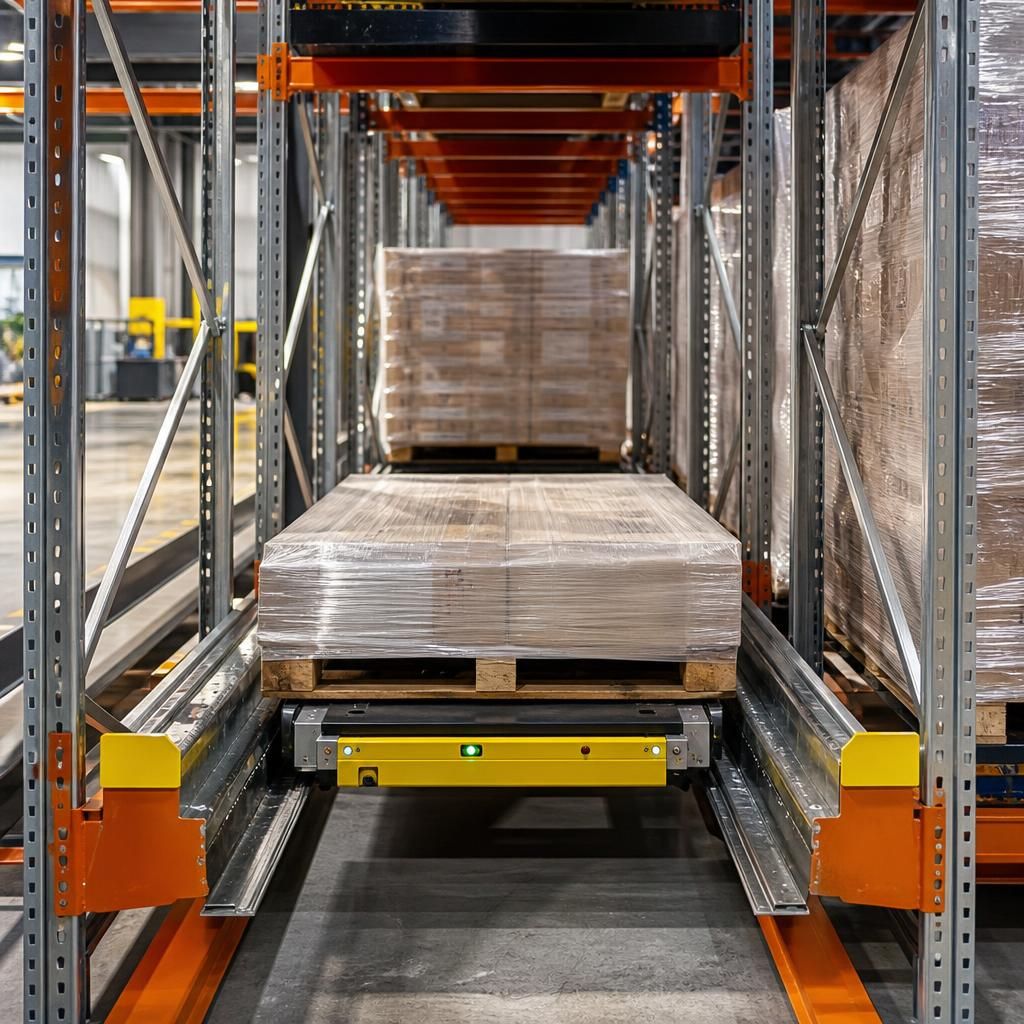
A shuttle racking system increases pallet storage density by using powered shuttles to move loads through deep storage lanes, reducing the number of forklift access aisles required. Forklifts load and retrieve pallets at the lane face, while the shuttle positions each pallet within the warehouse racking.
This arrangement can improve forklift productivity by reducing travel into storage lanes, helping limit congestion and lowering the risk of contact with frames, rails and pallet supports. It is particularly effective for warehouses handling repeat product lines, batch-controlled stock or large volumes of palletised goods.
The capacity and safety benefits depend on suitable pallet dimensions, stable loads, correct lane design and trained operators. Regular warehouse racking inspections and planned maintenance remain necessary to identify damage, displacement or faults before they affect the storage operation.
Arrange a shuttle racking assessment
Arrange a shuttle racking assessment with Able Racking to review storage capacity, pallet suitability, operating requirements and warehouse racking safety. Our experienced team can help identify the most appropriate configuration and inspection requirements for your operation.