
What measures should be taken immediately after detecting warehouse racking damage?
Immediately isolate the affected warehouse racking bay, prevent access and unload it only where this can be done safely. Report the damage to the responsible person, arrange an inspection by a competent warehouse racking specialist, and do not return the area to service until approved repairs have been completed.
Immediately after warehouse racking damage is detected, the affected bay or area should be isolated, clearly marked and taken out of use. Prevent people, lift trucks and stored loads from entering the danger area, report the damage to the person responsible for warehouse safety, and arrange an assessment by a competent warehouse racking specialist. Do not return the warehouse racking to service until its condition has been assessed and any required repairs have been completed and approved.
1. Stop using the affected warehouse racking
Remove the damaged bay from normal operation straight away. Use suitable barriers, warning notices or another effective access-control method so that warehouse operatives and forklift drivers cannot accidentally enter the area. Isolation should cover any adjacent bays that could also be unstable or affected by the impact.
Do not assume that damage is minor because the warehouse racking remains upright. Bent uprights, damaged bracing, displaced beams, loose components and distorted connections can reduce the system’s load-bearing capacity without causing an immediate collapse.
2. Prevent further loading or movement
Stop all loading, picking and forklift movements around the affected warehouse racking until a competent assessment has taken place. Do not add pallets, reposition existing loads or attempt to use the damaged bay for temporary storage.
Where a load is already stored in the affected area, it should only be removed if doing so can be completed safely. Unloading can create additional movement and may place further stress on damaged components. The task should be planned by a suitably competent person, using appropriate handling equipment and exclusion controls. If there is any doubt about stability, leave the load in place and obtain specialist advice.
3. Report and record the damage
Tell the responsible person for warehouse safety, such as the warehouse manager, site manager or designated person responsible for warehouse racking inspections. Record when and where the damage was found, what appears to have caused it, the affected bay or location, the type of damage and the immediate controls applied.
Photographs can support the initial report, provided they are taken from a safe position. Useful information includes the identity of the aisle and bay, visible damage to uprights, beams, bracing, baseplates, anchors, guards and connections, and any signs that loads or components have moved. Photographs do not replace a physical inspection.
4. Arrange a competent warehouse racking inspection
A suitably trained and experienced inspector should assess the damaged warehouse racking and determine whether it is safe to remain isolated, whether loads need controlled removal, and what repair or replacement work is required. The assessment should consider the complete system rather than only the visibly damaged component.
The inspection may include:
- uprights, frames and horizontal or diagonal bracing;
- beams, beam connectors, locking devices and safety clips;
- baseplates, floor fixings and signs of movement or impact;
- pallet supports, decking, wire mesh and other load-supporting parts;
- column guards, end-of-aisle protection and other protective equipment;
- nearby bays that may have been struck, displaced or overloaded; and
- the stated load configuration and whether it remains suitable for the warehouse racking design.
The inspector should also check whether the damage has affected the alignment, stability or clearances of the system. A damaged upright, for example, may affect connected bracing and the behaviour of the whole frame. Similarly, a displaced beam or missing locking device may increase the risk of progressive failure.
5. Apply temporary controls recommended by the inspector
Temporary controls should be based on the condition of the warehouse racking and the risks identified on site. These may include maintaining a complete exclusion zone, restricting access to nearby aisles, removing loads under a controlled method, installing temporary protection or arranging urgent repair work.
Temporary measures should not be treated as a permanent repair. Do not use improvised supports, timber packing, cable ties, unauthorised bracing or other makeshift solutions to keep damaged warehouse racking in service. Any temporary propping or stabilisation should be designed, specified or approved by a suitably competent person.
6. Do not straighten, weld or modify damaged components without approval
Impact-damaged warehouse racking components should not be heated, straightened, drilled, welded or altered on site unless the repair method has been specifically assessed and approved by a competent specialist and is compatible with the system design. Unauthorised alterations can change the strength of the component, invalidate design assumptions and make future inspections more difficult.
Depending on the damage, the appropriate action may be replacement of an upright, beam, brace, connector or fixing rather than an attempted repair. Replacement parts should be compatible with the existing warehouse racking system and installed in accordance with the manufacturer’s requirements or an approved repair specification.
7. Complete and verify the repair
Repairs should be carried out by experienced operatives using suitable components, equipment and safe systems of work. The work should address the cause as well as the visible damage where possible. For example, if a forklift impact caused the problem, the site may also need to review traffic routes, aisle protection, driver practices, visibility, pallet placement and housekeeping.
After repair, the warehouse racking should be checked to confirm that components are correctly positioned, connections and locking devices are secure, anchors are installed as specified, protection is effective and the system is aligned and suitable for its intended load configuration. The repair record should identify what was repaired or replaced, when the work was completed and who verified it.
8. Obtain clear approval before returning the bay to use
The affected warehouse racking should remain out of service until a competent person confirms that it is safe to use. This confirmation should be based on the completed inspection and repair, not simply on the absence of visible damage.
Once approved, remove isolation controls only when the responsible person is satisfied that the information has been communicated to warehouse staff and forklift operators. If the bay has a revised load capacity, configuration or operating restriction, update the relevant notices and ensure that the new requirements are understood.
9. Review the cause and prevent recurrence
Damage should be treated as an opportunity to identify a control failure, not only as a repair task. Review the circumstances, including forklift contact, poor visibility, unstable pallets, incorrect loading, inadequate protection, unsuitable aisle space or changes to the warehouse racking layout.
Corrective actions may include improving corner or end-of-aisle protection, revising traffic management, separating pedestrians and vehicles, repairing damaged floors, improving lighting, retraining operators, checking pallet condition and reinforcing load-placement procedures. Any changes to the warehouse racking arrangement or loading requirements should be assessed by a competent person before implementation.
Keep the inspection, photographs, repair details, approval and corrective actions with the warehouse racking safety records. Continue with the site’s planned inspections and ensure that any new damage is reported immediately. Regular visual checks by trained staff support safe operation, but they do not replace the periodic expert inspection required for the warehouse racking system.
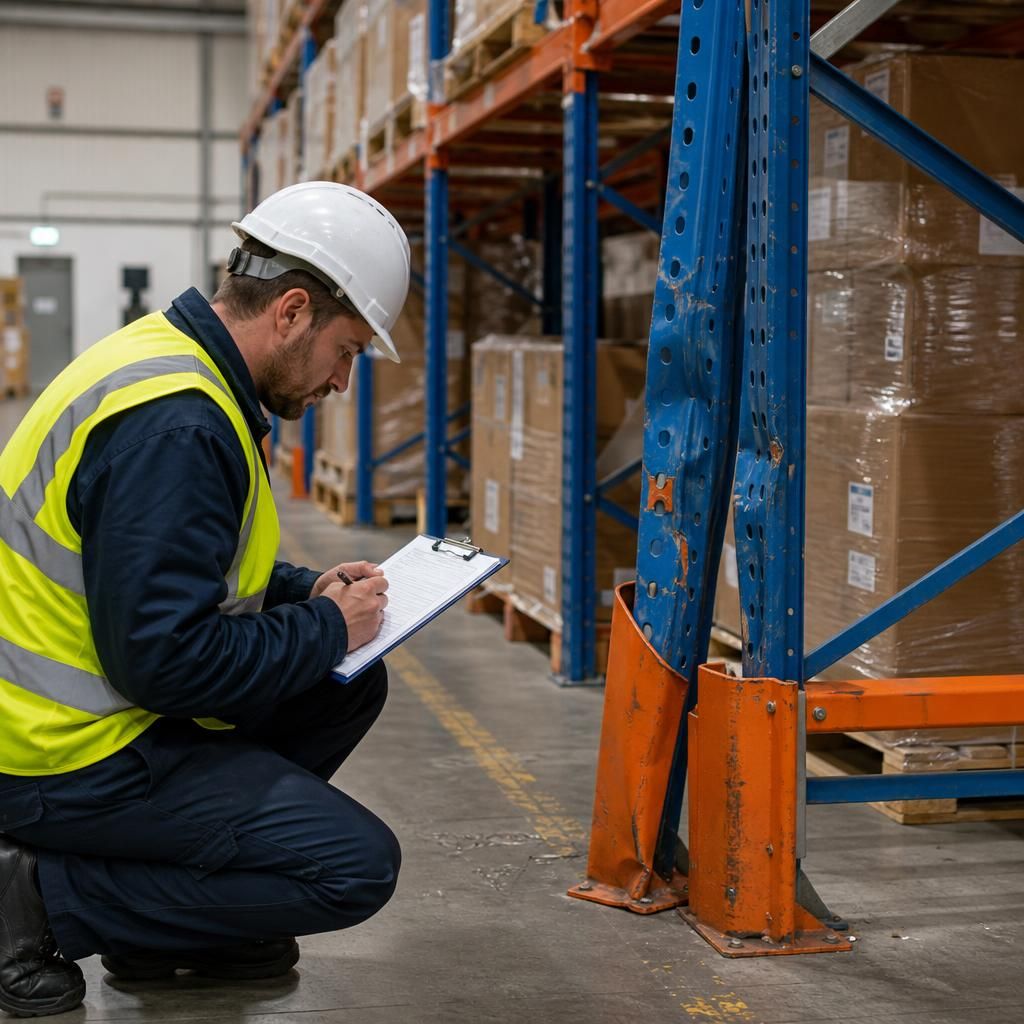
The immediate priority after detecting warehouse racking damage is to isolate the affected area and prevent further loading or vehicle movement. Use suitable barriers and clear warning notices so that warehouse operatives and forklift drivers cannot enter the damaged bay accidentally.
Do not unload stored pallets unless a competent person has confirmed that removal can be completed safely. Moving a load may place additional stress on weakened uprights, beams or connections. If stability is uncertain, leave the load in place, maintain the exclusion zone and arrange an assessment by a qualified warehouse racking specialist.
Arrange an Expert Warehouse Racking Damage Assessment
Arrange an expert warehouse racking damage assessment to establish whether the affected area can remain isolated, requires controlled unloading or needs repair or component replacement. Able Racking can inspect the system and provide clear recommendations before the bay is returned to service.