
What are the essential components involved in pallet racking repairs?
The essential components of pallet racking repairs are a thorough damage assessment, identification of the correct replacement parts, safe repair or replacement by a competent technician, and a final inspection to confirm the warehouse racking is stable, compliant and safe to use.
The essential components of pallet racking repairs are a detailed damage assessment, effective risk control, selection of compatible replacement parts, safe work by a competent technician, and a final inspection. Each stage is necessary to restore the warehouse racking system’s structural integrity, protect employees and confirm that it is suitable for continued use.
Repairs should not be treated as a simple part replacement. Damage may have affected connected components, load capacity or the alignment of the structure. A competent repair process therefore considers the cause and extent of the damage, the manufacturer’s design requirements, the condition of surrounding bays and the way the warehouse racking is being used.
Damage assessment and risk classification
The process begins with a physical assessment by a suitably trained inspector or technician. The inspection should identify the damaged component, record its position and establish whether the damage affects the stability or safe loading of the warehouse racking.
Common points checked include upright frames, bracing, beams, beam connectors, baseplates, anchors, guards and locking devices. The assessment should also look for distortion, impact marks, corrosion, missing components, loose fixings and signs that the warehouse racking has moved out of alignment.
Any immediate danger must be controlled before repair work begins. Depending on the severity and location of the damage, this may involve isolating the affected bay, removing stored goods, applying a clear warning notice or restricting access to the area. Damaged warehouse racking should not be returned to service simply because it appears stable when empty.
Correct identification of the required parts
The replacement part must match the warehouse racking system and its intended load requirements. Uprights, beams, braces, connectors, baseplates and other components are not interchangeable merely because they appear similar. Differences in dimensions, steel profile, connector design, hole pattern, finish and load capacity can affect the performance of the completed installation.
Before parts are ordered, the technician should verify the system details and, where available, consult the original design information or manufacturer’s specifications. The assessment should also confirm whether the existing component is suitable for repair or whether complete replacement is required. Straightening or welding a damaged structural member without appropriate design approval can compromise its strength and may invalidate the system’s technical documentation.
Safe preparation and isolation
Repair work requires a controlled method of work. The affected warehouse racking should be made safe before components are removed, and stored goods should be handled in a way that prevents falling loads, instability or obstruction of the work area.
The repair team should consider access equipment, exclusion zones, personal protective equipment, lifting requirements and the sequence in which components will be removed and installed. Where the damage has reduced stability, temporary support or additional controls may be needed. Employees should be informed of the restrictions and should not use the affected area until it has been formally released.
Repair or replacement by a competent technician
The practical repair is a central component of the process. It should be carried out by operatives with relevant experience in warehouse racking systems and an understanding of structural loads, manufacturer requirements and safe installation methods.
Typical work may include replacing a damaged upright or beam, fitting new bracing, renewing a baseplate or anchor, installing a beam safety lock, repairing protective guards or correcting a connection that has become loose or displaced. The technician should use the specified fixings and install each component in the correct orientation. Unauthorised alterations, improvised parts and repairs that conceal damage rather than remove it should be avoided.
Where the damage resulted from forklift impact, the surrounding structure should be checked as well. A visible mark on one component may be accompanied by hidden distortion, displaced anchors or damage to adjacent bays. Addressing only the most obvious defect can leave the underlying safety issue unresolved.
Verification of capacity and configuration
Following the repair, the warehouse racking should be checked against its intended configuration and load information. Beam levels, frame spacing, bracing, connections and protective equipment must correspond with the approved arrangement. If the repair changes the configuration or the original information is unavailable, a competent person may need to review the design and confirm the applicable load limits.
Load notices should remain visible and accurate. They must not be altered without proper technical confirmation, and goods should not be placed back into the repaired area until the system has been approved for use.
Final inspection and release for use
A final inspection confirms that the repair has been completed correctly. This check should verify that components are secure, frames and beams are correctly aligned, anchors and fixings are installed, safety locks are engaged and guards are positioned where required. The inspector should also confirm that no tools, loose materials or temporary supports have been left in the warehouse racking.
The repaired area should only be released when the competent person is satisfied that it is safe and suitable for its intended use. If further work is needed, the isolation should remain in place and the outstanding action should be clearly recorded.
Records and preventative follow-up
Good repair control includes a written record of the reported damage, inspection findings, risk decision, parts used, work completed and final approval. Photographs can help demonstrate the condition before and after repair, while updated site records make it easier to identify recurring impact points or patterns of misuse.
After repairs, it is sensible to review the cause of the damage. Improvements may include repositioning guards, adjusting traffic routes, protecting vulnerable uprights, reviewing load placement or providing additional operator training. Routine visual checks and scheduled expert inspections then help identify new defects before they develop into more serious warehouse racking repairs.
Using this complete process ensures that a repair addresses both the damaged component and the conditions that caused it. It provides a clear basis for keeping the warehouse racking safe, compliant and operational while maintaining reliable records for future inspections.
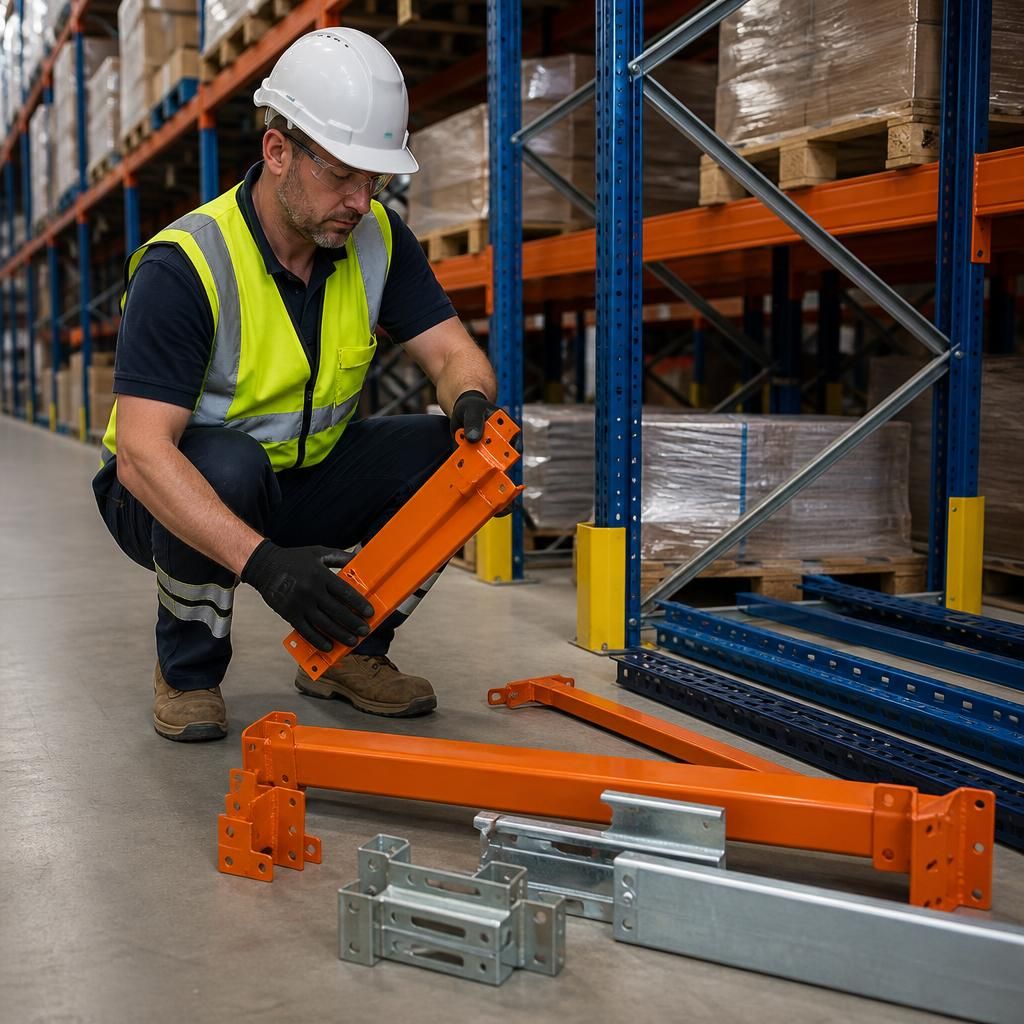
Correctly identifying compatible replacement parts is an essential part of warehouse racking repairs. Uprights, beams, bracing, baseplates, connectors and safety locks must match the system’s dimensions, design and load requirements; a component that looks similar may not provide the same structural performance.
Before ordering a part, a competent technician should check the manufacturer’s specifications, the existing configuration and the extent of the damage. They should also determine whether the component can be repaired safely or requires complete replacement. Improvised parts, unauthorised welding and straightening damaged structural members can compromise the warehouse racking and should not be used without appropriate technical approval.
Once the correct part has been installed, the repaired area should be checked for alignment, secure fixings, engaged safety devices and the correct load information before it is returned to service.
Book Your Pallet Racking Repair Assessment
Arrange a pallet racking repair assessment with Able Racking to identify damage, confirm the correct replacement parts and establish the safest repair approach. Our experienced team can assess the affected warehouse racking and advise on the work needed to return it to safe, compliant use.