
What are the safety considerations when implementing high-density and narrow aisle racking systems?
Safety considerations for high-density and narrow aisle racking systems include correct design and clearances, suitable load capacity, effective impact protection, competent installation, routine inspections and properly trained operators. Warehouse racking must be used in line with its design specification, with damage, overloading and obstruction addressed promptly to maintain a safe and compliant operation.
High-density and narrow aisle warehouse racking systems must be designed, installed and operated around their specific loads, access equipment and working clearances. The main safety considerations are structural capacity, stability, aisle dimensions, impact protection, competent installation, routine inspections, operator training and prompt control of damage or unsafe use. A system that increases storage capacity must not reduce the space needed for safe handling, inspection, evacuation or maintenance.
Confirm the design is suitable for the operation
Safety starts with a design that reflects the building, the storage method and the way goods will actually move through the warehouse. The design should account for pallet dimensions, load weights, load distribution, pallet quality, handling equipment, floor condition, building tolerances and the required operating clearances.
High-density systems such as drive-in, push-back, pallet flow and shuttle warehouse racking can have different loading and unloading procedures. Some systems are designed for last-in, first-out storage, while others support first-in, first-out stock rotation. Using the wrong loading method can create instability, obstruct access or place forces on components that were not designed to receive them.
Narrow aisle warehouse racking requires particular attention to aisle width, vehicle guidance, turning requirements and the relationship between the lifting equipment and the storage structure. Aisles should be wide enough for the specified equipment to operate without striking frames, beams, guards or stored goods. The design should also allow for safe pedestrian movement where people and vehicles work in the same area.
Check load capacity and configuration control
Every warehouse racking system should have clearly defined load limits for its frames, beams, bays, levels and individual storage locations. These limits depend on the actual configuration, including beam spans, upright sections, bracing, floor fixings and the way loads are placed. A capacity label should be displayed where operators can see it, and it should match the installed system.
Loads should be within the stated capacity and positioned centrally, evenly and securely. Pallets must be suitable for the system, in good condition and compatible with the beam or support arrangement. Damaged pallets, unstable loads and goods that overhang into the aisle can cause falls, collisions and restricted access.
Do not alter the height of beams, add levels, replace components or change the storage method without having the system assessed by a competent person. Even a seemingly minor change can affect frame loading, stability, clearances and the suitability of the handling equipment.
Maintain safe clearances and aisle control
Clearances should be established during design and maintained during daily operation. This includes the space between loads, beams, uprights, ceilings, sprinklers, lighting, doors, fire equipment and other structures. Loads must not obstruct sprinkler coverage, emergency routes, fire exits, electrical equipment or access to building services.
In narrow aisle areas, floor markings and traffic controls should make the intended route clear. Speed limits, one-way arrangements, vehicle exclusion zones and pedestrian crossing points should be used where appropriate to the layout and risk assessment. Aisles should remain free from pallets, wrapping materials, waste and temporary stock, as obstructions reduce visibility and increase the likelihood of impact.
High-density warehouse racking can make it harder to see activity within storage lanes. Operators should follow the designated entry and exit procedures for each system, use suitable visibility aids and avoid entering a lane where another vehicle or person may be working.
Use suitable handling equipment
Forklift trucks, reach trucks, turret trucks and other handling equipment must be suitable for the aisle width, lift height, load type and warehouse floor. The equipment should have sufficient capacity at the required lift height and reach, with any attachments included in the assessment.
Equipment must be maintained and operated in accordance with the manufacturer’s instructions. Operators should approach bays at a controlled speed, keep loads stable, avoid sudden braking or turning and ensure the load is fully supported before withdrawing the forks. The truck should not be used to push, pull or reposition warehouse racking unless the equipment and procedure have been specifically designed for that purpose.
Where guidance systems, rails, sensors or other controls are fitted, they should be maintained and used correctly. These controls can reduce the likelihood of contact, but they do not remove the need for competent driving, suitable clearances and routine inspection.
Protect the structure from impact
Impact protection should be provided at vulnerable locations, including frame ends, corners, aisle entrances and areas where vehicles turn or reverse. Protection must be appropriate to the anticipated impact and securely installed without interfering with the structural performance of the warehouse racking.
Protection is not a substitute for safe driving or adequate aisle space. If a vehicle strikes a frame, beam, guard or other component, the affected area should be isolated and assessed. Straightening, welding, drilling or repairing structural components without an approved method can make the damage worse and invalidate the original design assumptions.
Protection systems should also be checked during inspections. A damaged guard may no longer provide the intended protection and may itself create a trip or collision hazard.
Ensure competent installation and commissioning
Installation should be completed by trained and experienced operatives using the approved layout, component specifications and installation instructions. Frames must be plumb, beams correctly secured, bracing complete and floor fixings installed where required. The supporting floor and surrounding building structure should be suitable for the imposed loads.
Before the system is used, it should be checked against the design and any outstanding installation issues should be resolved. Capacity notices, bay identification, operating instructions and relevant protection should be in place. Changes made during installation must be recorded and reviewed rather than treated as informal adjustments.
Commissioning is particularly important where high-density warehouse racking includes moving parts, powered equipment or restricted access lanes. Operators should not begin using the system until they understand the loading method, permitted access, emergency arrangements and reporting process.
Inspect warehouse racking regularly
A responsible person should carry out frequent visual checks for obvious damage, missing components, displaced loads, leaning frames, loose fixings, damaged pallets and obstructions. These checks should be supported by a formal inspection programme completed by a competent person at suitable intervals and whenever there has been a significant event, such as an impact, alteration, relocation or change in use.
Inspections should cover uprights, beams, bracing, connectors, baseplates, floor fixings, guards, guide systems, pallets and the surrounding floor. In high-density systems, particular attention should be given to concealed or difficult-to-access components, loading lanes, support rails and areas where repeated vehicle movement may cause damage.
Findings should be recorded clearly, with damaged areas identified and assigned an appropriate action. Serious damage should result in immediate isolation or unloading where necessary. Lower-risk defects should still be monitored and repaired within a defined timescale. Leaving a known defect in service without control increases the risk of progressive damage and a more serious failure.
Train operators and other warehouse staff
Training should cover the specific warehouse racking system, handling equipment and working practices used on site. Operators need to understand capacity labels, pallet condition, safe loading positions, aisle rules, pedestrian controls, impact reporting and the consequences of unauthorised alterations.
Training should be reinforced with site rules, supervision and refresher instruction when the layout, equipment or storage method changes. Temporary staff, contractors and visiting drivers should receive suitable information before entering operational areas. People working on or near the structure should know how to report damage and who has authority to remove a bay from service.
Where narrow aisle warehouse racking is served by specialised lifting equipment, operators should be trained and authorised for that equipment. Familiarity with a standard forklift does not automatically demonstrate competence to use a different truck, attachment or guidance system.
Control maintenance, alterations and emergency arrangements
Maintenance work should be planned so that people and vehicles are protected from falling objects, moving equipment and partially dismantled structures. Affected aisles or bays should be segregated, and stored loads should be removed where the work could compromise stability.
Emergency arrangements should cover vehicle collisions, falling goods, structural damage, fire, power failure and the safe evacuation of restricted aisles. Staff should know how to raise the alarm, isolate equipment, prevent access to a damaged area and obtain assistance. Fire protection and emergency routes must remain accessible at all times.
Keep design drawings, capacity information, inspection records, repair details, training records and alteration approvals together as part of the warehouse racking safety documentation. Good records help identify recurring damage, demonstrate that controls are being managed and support safe decisions when the operation changes.
Use a practical safety review before operation
- Confirm that the design matches the loads, storage method, building and handling equipment.
- Verify capacities, clearances, floor conditions, fixings and protection before loading the system.
- Keep aisles, fire routes, sprinkler zones and access points clear.
- Use only suitable, well-maintained equipment operated by trained and authorised people.
- Inspect for impact damage, missing components, displaced loads and defective pallets.
- Isolate and report damage immediately rather than continuing to use an unsafe bay.
- Control alterations, repairs and changes of use through a competent assessment.
- Review training, traffic management and emergency procedures whenever the operation changes.
These controls should work together as part of a continuing safety process, not as a one-off check. Regular warehouse racking inspections, clear responsibilities and prompt corrective action help maintain the system’s designed performance and support a safer, compliant warehouse operation.
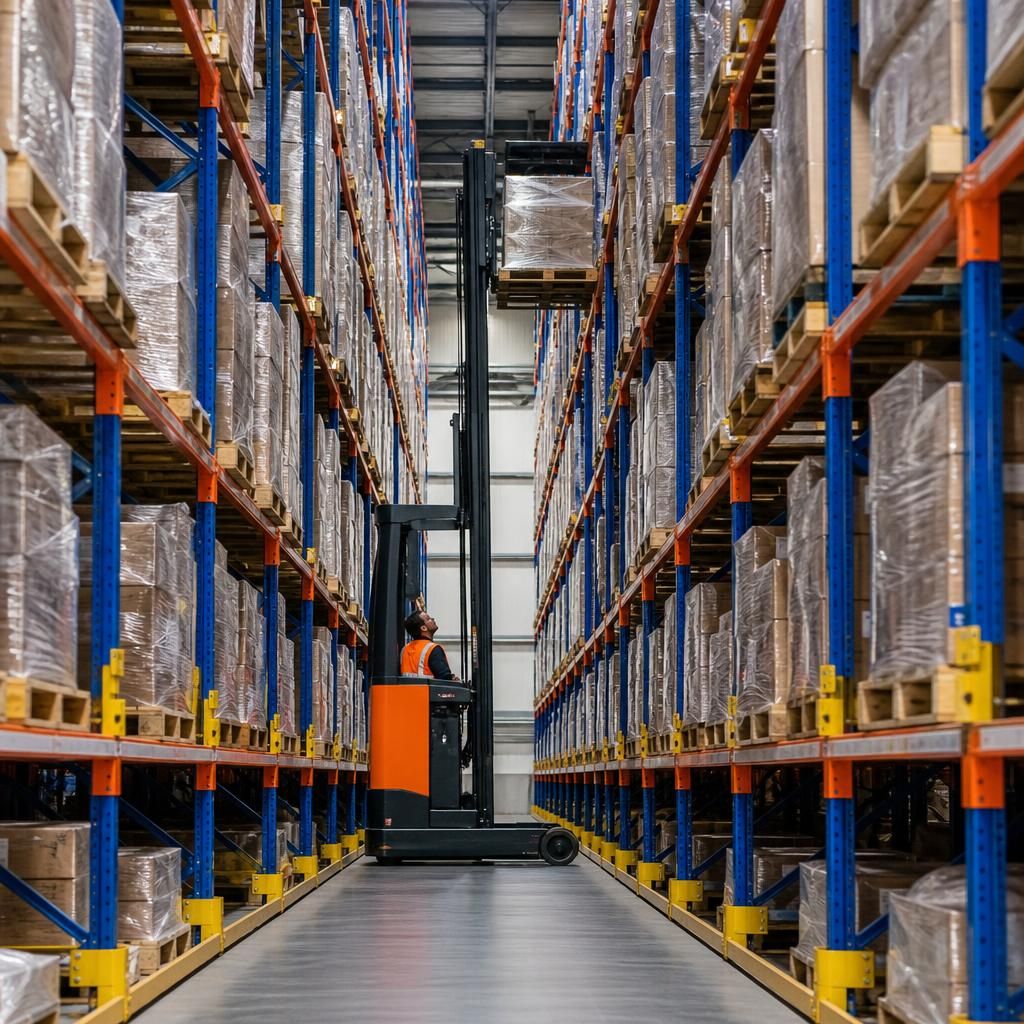
Routine inspections are a key safety control for high-density and narrow aisle warehouse racking systems. They identify impact damage, displaced loads, loose fixings, damaged pallets and obstructions before these defects affect structural stability or safe access.
Visual checks should be supported by competent inspections, particularly after a vehicle collision, alteration, relocation or change in use. Any damaged bay should be isolated where necessary, clearly reported and repaired using an approved method. Continuing to load or operate an unsafe area can allow minor damage to develop into a more serious failure.
Arrange a High-Density Warehouse Racking Safety Inspection
Arrange a professional warehouse racking safety inspection to identify damage, loading issues and compliance risks across your high-density and narrow aisle systems.