
What maintenance routines are essential for Drive-In, Push-Back, and Pallet Flow racking systems?
Essential maintenance for Drive-In, Push-Back and Pallet Flow racking systems includes routine visual inspections, prompt reporting and repair of damage, checks on beams, frames, rails, guides, rollers and restraints, and regular removal of debris. Planned servicing and competent inspections help identify wear, impact damage, misalignment and operational faults before they affect safety, compliance or warehouse efficiency.
Essential maintenance for Drive-In, Push-Back and Pallet Flow warehouse racking systems combines routine operator checks, planned inspections, prompt repairs, component cleaning and accurate records. The aim is to identify impact damage, movement, wear, contamination and operating faults before they compromise stability, pallet support, stock control or safe vehicle movements.
Each system has different working components, so maintenance should cover the shared structural elements as well as the features specific to the storage method. A documented schedule, clear reporting process and competent assessment of defects provide the most reliable approach.
Routine operator checks
Warehouse staff should carry out visual checks as part of normal operations and report defects immediately. The person making the check does not need to diagnose the cause; they should identify anything that appears different from the normal condition and follow the site’s reporting procedure.
- Look for bent, cracked, split or displaced frames, uprights, bracing, beams, rails, guides and protective components.
- Check for signs of impact from lift trucks, including scrapes, fresh dents, damaged paint or components that are no longer straight.
- Observe whether pallets are sitting level, fully supported and in the intended position.
- Report unusual movement, noise, vibration or difficulty when loading and retrieving pallets.
- Keep access routes, loading positions and the area around the installation clear of loose packaging, spilled goods and other obstructions.
- Confirm that load notices remain visible and that the system is being used within its stated configuration and capacity.
Damage should never be ignored because a system still appears usable. A minor impact can alter the alignment or load path of a structural member, while repeated contact can worsen an existing defect.
Drive-In warehouse racking maintenance
Drive-In systems rely on entry lanes, guide rails and support rails to locate pallets within the structure. Maintenance should therefore pay particular attention to components that are exposed to repeated lift truck movement.
- Inspect entry guides and guide rails for bending, looseness, distortion and signs of repeated truck contact.
- Check pallet support rails for damage, displacement, excessive wear or obstructions that could prevent pallets sitting correctly.
- Examine upright frames, bracing, baseplates and floor fixings for impact damage or movement.
- Remove broken pallet timber, wrapping, labels and debris from lanes before they interfere with loading or retrieval.
- Check that lane depths and clearances remain suitable for the pallets being used.
- Review loading practices where damage is recurring, as poor alignment or excessive speed may indicate an operational issue rather than an isolated defect.
Drive-In lanes should not be altered, repaired or cleared using improvised methods. Damaged rails, guides or structural members require assessment by a suitably competent person, followed by an appropriate repair or controlled withdrawal from use.
Push-Back warehouse racking maintenance
Push-Back systems use inclined lanes, carts or nesting frames and guide arrangements to move pallets towards the pick face. Their maintenance routine must confirm that these moving elements operate freely and remain correctly positioned.
- Inspect carts, wheels, rollers, tracks and stops for wear, damage, contamination or displacement.
- Check that carts and pallets move smoothly and do not stick, derail, run unevenly or make abnormal contact with the structure.
- Examine lane guides, beams and end stops for impact damage or misalignment.
- Remove debris that could obstruct wheels, tracks or rollers, following the manufacturer’s cleaning and servicing instructions.
- Check that pallets are suitable for the cart dimensions and are placed centrally and squarely.
- Investigate repeated failures to return pallets correctly, as this may indicate damaged components, unsuitable pallets or incorrect loading technique.
Lubrication should only be carried out where the system design and manufacturer’s instructions require it. Applying lubricant indiscriminately can attract dust, contaminate goods or affect braking and movement. Any replacement cart, wheel or track component should be compatible with the original design and installed by a competent person.
Pallet Flow warehouse racking maintenance
Pallet Flow systems use gravity to move pallets along rollers or wheel tracks, usually towards a pick face. The critical checks are the condition, alignment and cleanliness of the flow equipment, together with the operation of braking and pallet-separation features.
- Inspect rollers or wheel tracks for damage, seized components, uneven movement and accumulated debris.
- Check that brake rollers, speed controllers or other flow-control devices operate as intended.
- Examine pallet stops, separators and retention arrangements for looseness, distortion or excessive wear.
- Confirm that pallets travel smoothly, remain stable and stop within the designed picking position.
- Check lane levels, guides and supports for signs of movement or misalignment.
- Remove damaged pallets and packaging that could catch on rollers or obstruct the lane.
A pallet that accelerates unexpectedly, fails to move, stops short or reaches the pick face with excessive force should be reported and the lane controlled until it has been assessed. Staff should not reach into a moving lane or attempt to release a trapped pallet by striking the equipment.
Planned cleaning and servicing
Cleaning is a maintenance task, not simply a housekeeping exercise. Dust, shrink wrap, timber fragments and spilled product can obstruct moving components, conceal damage and increase the risk of pallets sitting incorrectly. Cleaning should be completed using methods that do not damage finishes, rollers, wheels or protective devices.
Planned servicing should follow the system design, manufacturer’s guidance, operating conditions and the results of previous inspections. It may include checking fixings, floor connections, moving components, protective barriers, load notices and the general alignment of the installation. Where a repair affects the structure or the operation of a lane, the work should be carried out or approved by a suitably qualified and experienced person.
Formal warehouse racking inspections
Routine staff checks do not replace formal inspections. A competent inspector should assess the installation at planned intervals and after events that could have caused damage, such as a significant impact, change of layout, change of load or unusual operating incident. The inspection should consider the entire installation, its environment and the way it is being used.
Inspection findings should classify defects according to their seriousness and state the action required. This may include monitoring, making the location safe, reducing the load, isolating a lane or arranging an urgent repair. Once corrective work is completed, the affected area should be checked again rather than simply marked as closed on a maintenance record.
Damage reporting and repair control
An effective reporting process should identify the exact location, component, type of damage and immediate action taken. Clear labels, an installation layout and photographs can help maintenance teams locate defects quickly. Staff should know who can authorise isolation, unloading, repair and return to service.
Do not straighten, weld, drill or replace structural parts without suitable technical approval. Unauthorised alterations can change the load capacity and may conceal damage rather than resolve it. If a component is damaged, the safest response is to prevent further use where necessary, protect the area from additional impact and obtain an assessment promptly.
Records and preventative improvements
Keep records of operator reports, formal inspections, servicing, repairs, replaced parts, incidents and any changes to the layout or load requirements. Reviewing these records can reveal repeated impact points, problematic lanes, unsuitable pallets or training needs.
Preventative improvements may include replacing damaged column protection, revising traffic routes, improving visibility, separating pedestrians from lift trucks, retraining operators or changing loading instructions. Maintenance is most effective when physical repairs are combined with action to address the reason damage or operating faults occurred.
For Drive-In, Push-Back and Pallet Flow warehouse racking, the essential routine is consistent: check before defects become failures, keep lanes and moving components clean, report damage immediately, use competent inspection and repair arrangements, and verify that every repaired area is safe before returning it to service.
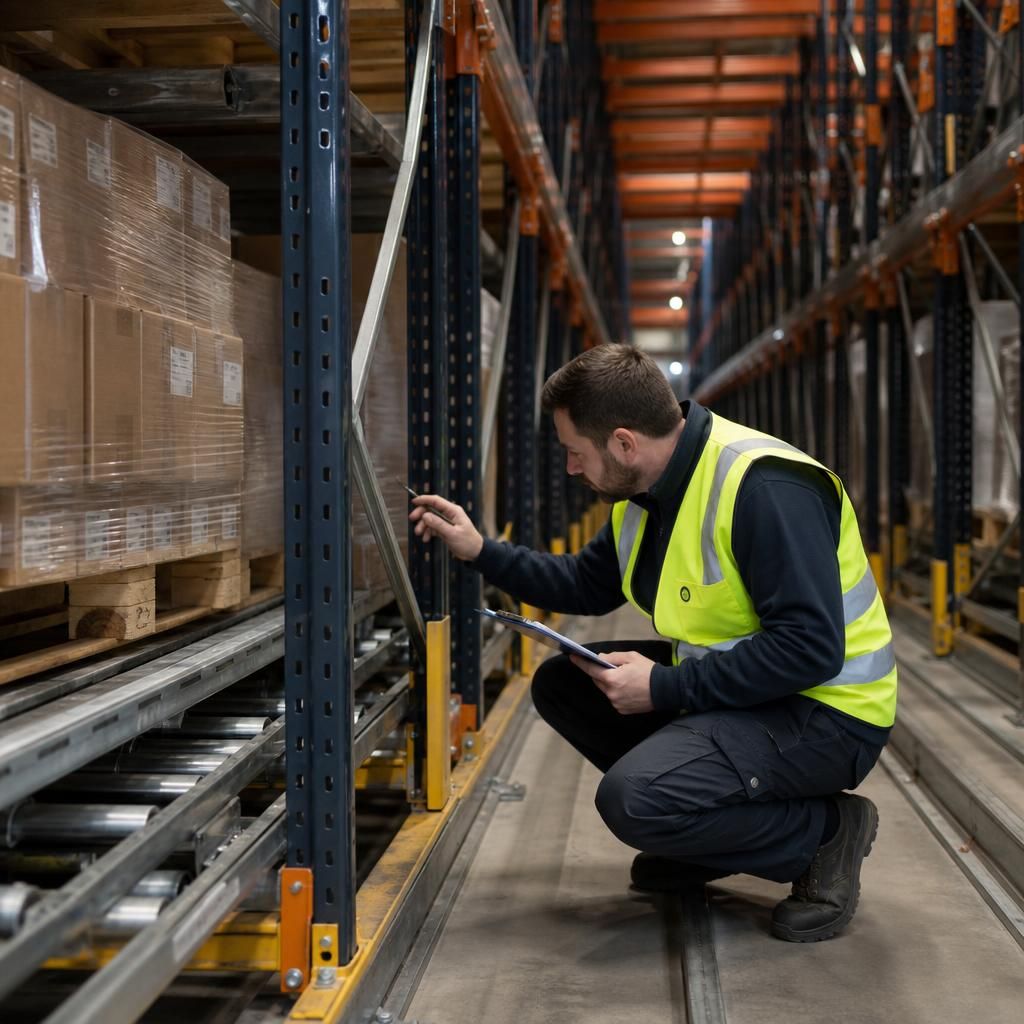
Maintenance for Drive-In, Push-Back and Pallet Flow warehouse racking is a planned process of checking structural components, moving parts and operating conditions, then controlling and repairing defects before the system is returned to use.
One of the most important routines is to reassess any area after impact, unusual movement or a reported operating fault. The affected lane or bay should be made safe while a competent person checks the frames, beams, rails, guides, carts, rollers, stops and floor connections. Repairs should follow the system design and manufacturer’s guidance; straightening, welding or improvised adjustments can create further risks.
- Record the precise location and nature of the defect.
- Isolate or unload the affected area where necessary.
- Use compatible replacement components and competent repair methods.
- Reinspect the repaired area before allowing normal use.
Keeping inspection, servicing and repair records also helps identify recurring impact points, unsuitable pallets or operator practices that need attention. This turns maintenance from a reactive repair task into a preventative process that supports safe, reliable warehouse operations.
Book your Drive-In, Push-Back or Pallet Flow racking inspection
Book your Drive-In, Push-Back or Pallet Flow warehouse racking inspection with Able Racking to identify damage, wear and operating faults before they affect safety or performance. Contact our experienced inspection team to arrange a suitable assessment for your warehouse.