
What are the benefits of integrating advanced safety features in a warehouse racking fit-out?
Integrating advanced safety features into a warehouse racking fit-out helps protect people, stock and equipment while supporting compliance with workplace safety requirements. Measures such as load protection, column guards, safety barriers, signage and inspection access can reduce avoidable damage, improve day-to-day operations and help identify hazards before they lead to an incident.
Integrating advanced safety features into a warehouse racking fit-out improves protection for people, stock and equipment while supporting compliance with workplace safety duties. Features such as load protection, column guards, safety barriers, locking devices, rear protection, clear signage and inspection access help prevent foreseeable incidents and make the storage system easier to monitor and maintain.
The most effective approach is to specify safety measures during the design and installation of the warehouse racking, rather than adding them only after damage or an incident has occurred. The layout, stored loads, handling equipment, building structure, traffic routes and working practices should all be considered through a suitable risk assessment.
Improved protection against impact damage
Forklift and other material-handling equipment can strike upright frames, bracing and end sections during loading, unloading or manoeuvring. Upright guards, end-of-aisle barriers and high-level protection help absorb or deflect impact before it reaches critical structural components. Where protection is installed, it should be suitable for the likely traffic conditions and positioned so that it does not obstruct access, visibility or emergency routes.
Protective measures do not make warehouse racking impact-proof. Any significant collision should still be reported and assessed by a competent person. Damaged components may need to be unloaded, isolated and replaced rather than straightened or repaired without proper approval.
Reduced risk of falling goods
Back mesh, pallet stops, safety gates and other retention measures can help prevent goods from falling into work areas, walkways or adjacent aisles. These features are particularly useful where loads are stored above occupied areas or where pallets may be pushed beyond the rear beam. Their suitability depends on the pallet type, load dimensions, unit weight and the way goods are placed and retrieved.
Load retention should be combined with sound operational controls. Pallets must be compatible with the beams, positioned correctly and kept in suitable condition. Loads should not project into aisles or exceed the stated capacity of the system.
Clearer load control and safer use
Load notices provide essential information about permissible beam levels, bay capacities and configuration-specific restrictions. They should be visible, accurate and updated whenever the warehouse racking is altered. This helps operators and supervisors make safer decisions and reduces the risk of overloading or using an installation outside its original design.
Beam locking devices, correctly fitted safety pins and secure connections help prevent accidental displacement during normal use. These components should be checked as part of routine visual inspections, particularly after an impact or when the configuration has changed.
Better separation between people and vehicles
Safety barriers, guarded crossing points, pedestrian routes, impact protection and suitable signage can reduce interaction between pedestrians and vehicles. The design should take account of sight lines, turning areas, doorways, emergency exits and areas where people regularly pick or inspect stock. Physical separation is generally more dependable than relying on warning signs alone, although signs and floor markings remain useful when they are clear and maintained.
Access points should be positioned so that operators are not encouraged to walk through vehicle routes or reach into active loading areas. Where the work process changes, the traffic management arrangement and associated risk assessment should be reviewed.
Stronger compliance and easier inspections
A professionally specified safety system supports the employer’s duties to provide and maintain safe work equipment and a safe workplace. Warehouse racking should be installed, used and maintained in line with the manufacturer’s instructions, the agreed design and relevant UK guidance, including the principles set out in HSE guidance for storage equipment. A documented inspection regime remains necessary; safety features do not replace regular checks or competent examination.
Inspection access is an important part of the fit-out. Components should be visible enough to assess, identification should be clear and damaged areas should not be hidden behind poorly positioned protection. A planned inspection process can identify bent uprights, displaced beams, missing locking pins, damaged pallets, overloading, corrosion and changes to the surrounding environment.
Fewer interruptions and lower damage costs
Preventing contact with the structure and containing unstable loads can reduce damage to products, handling equipment and the warehouse racking itself. This may also limit unplanned unloading, isolation of bays and disruption to picking or despatch activities. The financial benefit is not only the cost of replacement components; it can also include reduced downtime, less stock loss and fewer emergency arrangements.
Protective equipment should be selected proportionately. An unsuitable guard can transfer impact into the structure, create a trip hazard or interfere with pallet placement. A competent designer or installer should confirm that each feature is compatible with the system and the working environment.
More consistent warehouse operations
Safety features can make correct working methods more obvious. Clearly marked locations, defined access routes, visible load information and standardised protection help operators follow the intended process. This supports safer replenishment, picking and stock checks, particularly where several teams or shifts use the same warehouse racking.
Integrating safety into the layout can also improve housekeeping. When aisles, exclusion zones and loading areas are clearly defined, obstructions are easier to identify and remove. Good housekeeping should still be actively managed; barriers and signage cannot compensate for blocked routes, damaged pallets or poorly stacked goods.
Support for training and preventative maintenance
Advanced safety features provide useful reference points for operator training. Employees can be shown where loads must sit, how protection works, which damage must be reported and when an area must be taken out of service. Training should cover the actual installation and operating procedures rather than relying on generic information alone.
The fit-out should also include a practical maintenance plan. This can set out who completes routine visual checks, how concerns are recorded, who authorises repairs and how replacement components are approved. Regular inspections by a competent person should be supported by prompt action when defects are found.
Important design considerations
Advanced safety features are effective only when they match the risks identified for the site. Before specifying them, consider:
- the type, weight, dimensions and condition of stored goods and pallets;
- the capacity and configuration of the warehouse racking;
- the type and frequency of vehicle movements;
- pedestrian access, crossing points and emergency routes;
- building columns, doors, sprinklers, lighting and other obstructions;
- the need for rear protection, gates, barriers or additional load retention;
- inspection, cleaning, repair and future alteration requirements; and
- operator training, supervision and procedures for reporting damage.
Features should be installed without compromising the structural design or the manufacturer’s instructions. Unauthorised drilling, welding, relocation of components or changes to beam levels can affect the capacity and stability of the warehouse racking. Any proposed alteration should be reviewed by a suitably competent person before work begins.
In practice, the strongest result comes from combining engineered protection with good design, trained operators, disciplined traffic management and regular inspections. This integrated approach helps maintain compliance, reduce avoidable incidents and keep warehouse operations safe and dependable over the working life of the installation.
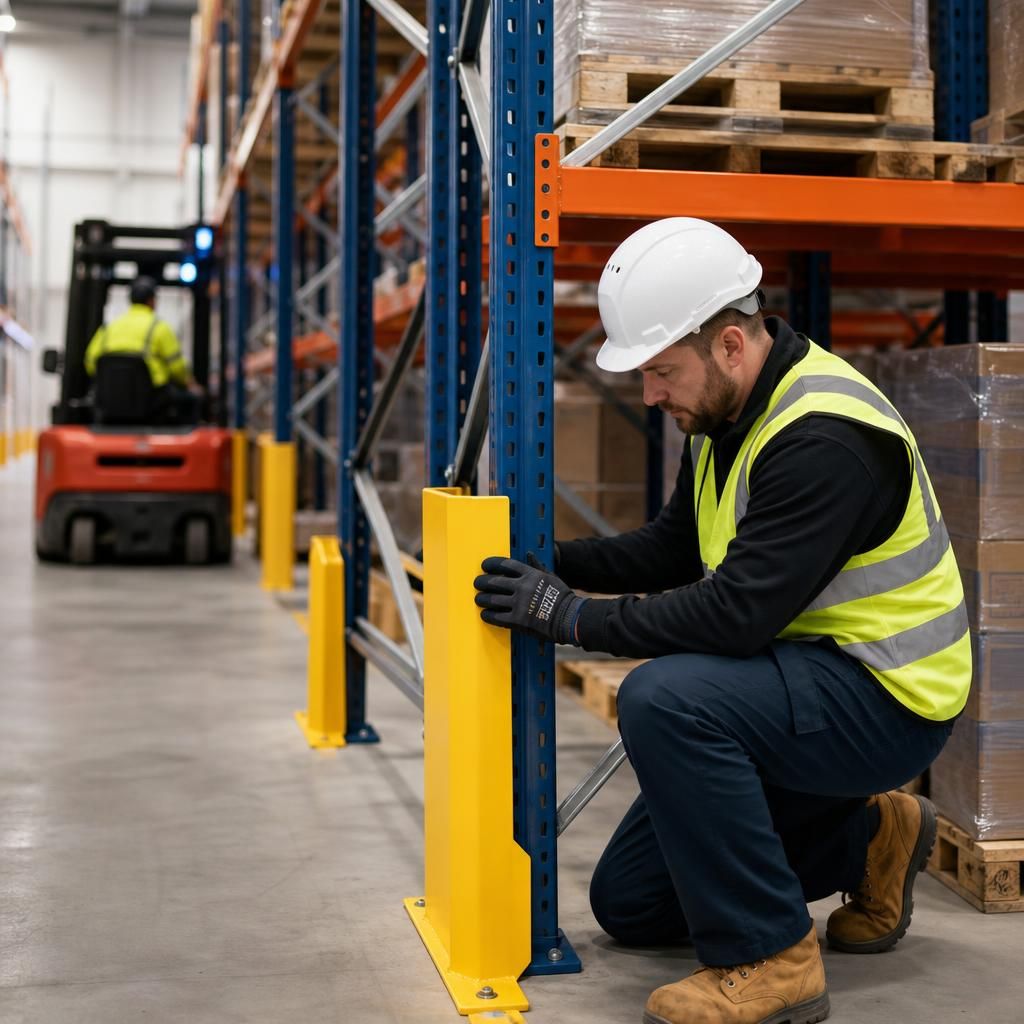
Integrating impact protection into a warehouse racking fit-out helps reduce the likelihood of vehicle contact damaging structural components. Upright guards, end-of-aisle barriers and suitable protection at vulnerable locations can absorb or deflect impacts from forklift trucks and other handling equipment.
Protection must be selected for the site’s traffic routes, vehicle movements and storage layout. It should not obstruct visibility, pallet access, emergency routes or inspection points. Any significant collision should still be reported immediately, with the affected area assessed by a competent person and damaged components isolated or replaced where necessary.
Discuss advanced safety features for your warehouse racking fit-out
Speak to Able Racking about integrating suitable advanced safety features into your warehouse racking fit-out, based on your layout, traffic routes and stored loads. Our experienced team can help review the risks and recommend practical protection, inspection and maintenance measures.