
What are the maintenance requirements for industrial racking systems?
Industrial racking systems require routine inspections, prompt repair of damage, checks on fixings and components, and ongoing compliance monitoring. Maintenance should be carried out by competent professionals and supported by accurate records, ensuring defects are controlled before they affect warehouse safety or operations.
Industrial racking systems require planned inspections, prompt control of damage, checks on structural components and fixings, and documented compliance reviews. Maintenance should be based on a suitable risk assessment and carried out by competent people, with defects recorded, assessed and repaired before the affected area is returned to normal use.
Maintenance is not limited to replacing visibly damaged parts. It includes checking that the system remains suitable for its current loads and layout, that protection and safety accessories are in place, and that day-to-day warehouse activities have not created new risks.
Routine visual checks
Warehouse personnel should carry out regular visual checks as part of normal operations. These checks help identify obvious problems early, including:
- Damage to upright frames, beams, bracing, baseplates or anchors
- Beams that have become displaced, inadequately secured or visibly deflected
- Missing or damaged locking pins and other beam-retention components
- Impact damage caused by forklifts, pallet trucks or other handling equipment
- Overloaded or incorrectly positioned pallets
- Unstable loads, damaged pallets or goods protruding into access routes
- Missing load notices, aisle signs, end-of-aisle protection or other safety equipment
- Obstructions, poor housekeeping or changes that restrict safe access
Staff should know how to recognise common defects and who to report them to. A visual check is an early-warning measure, not a substitute for a formal inspection by a suitably competent person.
Planned inspections by a competent person
A formal inspection should assess the complete warehouse racking installation rather than focusing only on previously reported damage. The inspector will consider the condition of structural members, connections, protection, fixings, load information and the way the system is being used.
HSE guidance and established industry practice require racking to be inspected regularly, with the frequency determined by the risk assessment, operating conditions and history of damage. A technically competent person should complete a more detailed inspection at intervals no longer than twelve months, unless the risk assessment requires a shorter interval. Additional inspections may be necessary where there is intensive forklift activity, frequent layout changes, difficult operating conditions or a repeated pattern of impact damage.
Inspections should also take place after significant events, such as a collision, movement of the installation, changes to loading arrangements or alterations to the warehouse layout. A system should not be assumed to remain safe simply because it has previously passed an inspection.
Damage assessment and repairs
Any suspected damage should be reported immediately and assessed by a competent person. The affected bay or section may need to be unloaded, isolated or clearly marked until its condition has been determined. Continuing to use damaged racking while waiting for a repair can increase the risk of collapse and may cause further damage.
Repairs should follow the original design requirements and the manufacturer’s instructions wherever available. They should be completed using suitable components and approved methods, rather than improvised straightening, welding, drilling or substitution of parts. Where a repair is not technically appropriate, the damaged components may need to be replaced. After repair, the affected area should be checked and formally released for use.
It is important to distinguish between cosmetic damage and damage that affects structural performance. Scratches or minor paint loss may not require the same action as a bent upright, distorted beam connector, damaged bracing member or displaced anchor. This decision should be made by someone with the necessary technical competence, not solely by the person operating the handling equipment.
Checks on load capacity and system configuration
The installation should continue to be used within its designed capacity. Maintenance reviews should confirm that:
- Safe working load notices are present, legible and relevant to the current layout
- Stored loads do not exceed the stated limits or create uneven loading
- Beam levels, bay widths and frame arrangements match the approved design
- Any changes to components, accessories or operating conditions have been assessed
- Pallets and loads are compatible with the beam spacing and storage method
- Clearances, access routes and working areas remain suitable for the handling equipment in use
Relocating beams, adding levels, changing pallet types or increasing load weights can alter the capacity and stability of the system. Such changes should be reviewed before implementation and reflected in the load notices and inspection records.
Protection, fixings and safety accessories
Upright guards, end-of-aisle protection, column protection, back protection and other accessories should be checked for secure attachment and continued suitability. Damaged or missing protection can leave structural members exposed to repeated impact.
Floor anchors and baseplates should be inspected for looseness, damage, corrosion or signs of movement. Connections, locking devices and bracing should also be checked for missing parts or deterioration. The precise checks depend on the type and design of the industrial racking system, so the manufacturer’s technical information should be retained and followed.
Housekeeping and operational controls
Good housekeeping forms part of effective maintenance. Aisles, emergency routes and access points should be kept clear, spillages should be dealt with promptly, and loose packaging should not be allowed to accumulate around frames or bases. Loads should be placed and removed in a controlled manner to reduce impact risk.
Forklift operators and other warehouse staff should receive appropriate instruction on safe loading, unloading, traffic management and damage reporting. Preventative measures such as physical barriers, suitable aisle widths, speed controls and improved operator training can reduce repeated damage and the cost of reactive repairs.
Records and follow-up
Inspection and maintenance records should identify the date, areas inspected, findings, risk classification, actions required, responsible person and completion status. Records should also show when damaged areas were isolated, when repairs were completed and who authorised the system’s return to service.
Keeping an accurate history makes it easier to identify recurring problems, demonstrate that maintenance arrangements are being followed and plan remedial work. Repeated damage in the same location may indicate a wider issue with traffic routes, protection, visibility, training or the suitability of the layout, rather than an isolated component failure.
Who should carry out the work?
Routine user checks can be completed by trained warehouse staff, but formal assessments, damage classification, design changes and structural repairs should be handled by suitably competent professionals. The appropriate level of expertise depends on the task. A person who can identify obvious damage may not have the knowledge required to assess load capacity or specify a safe repair.
A practical maintenance programme therefore combines daily operational awareness, planned inspections, immediate damage reporting, controlled repairs, periodic compliance reviews and proper record keeping. This approach helps keep industrial racking systems safe, supports efficient warehouse operations and provides evidence that defects are being managed responsibly.
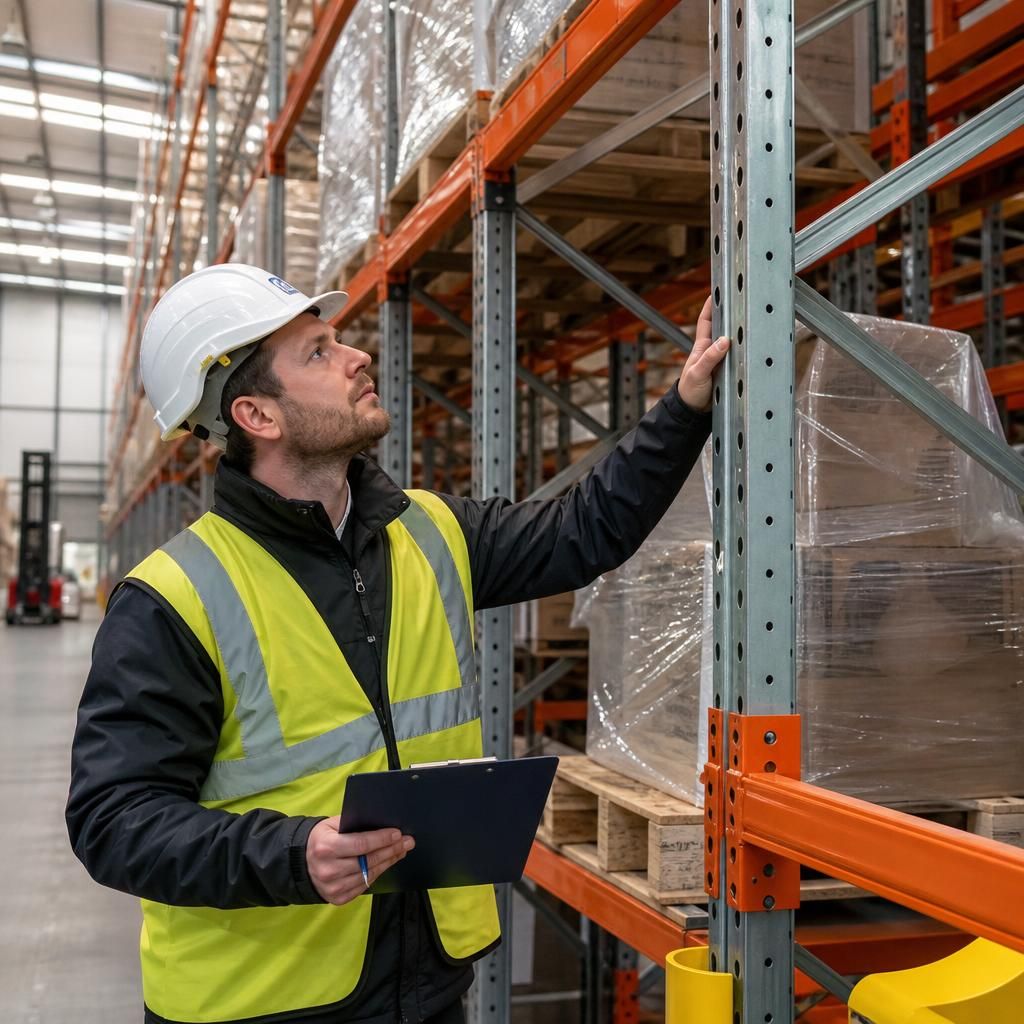
A formal inspection of industrial racking systems should assess more than visible damage. A competent inspector checks uprights, beams, bracing, connectors, baseplates, anchors, protection, load notices and the way the system is being used. Any defect should be recorded, risk-assessed and controlled promptly; the affected area may need to be unloaded or isolated until suitable repairs are completed and the system is confirmed safe to use.
Inspection records should show the findings, required actions, responsible person and completion status. This provides a clear maintenance history and can reveal recurring problems, such as forklift impacts, unsuitable loads or changes to the warehouse layout, allowing preventative measures to be introduced rather than relying only on reactive repairs.
Book your industrial racking maintenance inspection
Book your industrial racking maintenance inspection with Able Racking to identify defects, confirm compliance and keep your warehouse storage system safe to use. Contact our experienced team to arrange a suitable inspection.