
What are the installation requirements for mezzanine sliding gates? Mezzanine sliding gates must be correctly positioned, securely fixed to the supporting structure and installed with suitable guarding, clearances and access controls. Installation should follow the manufacturer’s instructions and applicable UK safety requirements, with the completed gate checked for safe operation before use.
Mezzanine sliding gates must be correctly positioned, securely fixed to the supporting structure and installed with suitable guarding, clearances and access controls. Installation should follow the manufacturer’s instructions and applicable UK safety requirements, with the completed gate checked for safe operation before use.
Mezzanine sliding gates must be designed for the specific opening, securely fixed to the supporting structure and installed with guarding, clearances and access controls that prevent people or materials falling from the platform. The installation should follow the gate manufacturer’s instructions, the design of the mezzanine and applicable UK health and safety requirements. Once fitted, the gate must be inspected, tested and confirmed safe before the area is put into use.
Correct installation starts with a site assessment. The installer should verify the dimensions of the platform opening, the available headroom, the direction of material movement and the position of nearby stairs, walkways, columns and equipment. The assessment should also consider how pallets or other loads will be transferred through the opening and whether the gate can be operated without exposing workers to avoidable risks.
Key installation requirements include:
- Suitable design and sizing: The gate should match the width, height and intended use of the opening. Its design must allow loads to be transferred safely without creating excessive gaps, obstructions or unstable conditions.
- Secure structural fixing: Posts, tracks, frames and other components must be fixed to suitable structural members using the specified fixings. The supporting steelwork, deck and edge protection must be capable of carrying the forces generated during normal operation and accidental contact.
- Continuous edge protection: The gate should integrate with the surrounding guardrails, kickboards or toe boards so that there is no unprotected section when the gate is closed. Openings beneath, beside or above the gate should not allow people, tools or materials to fall through.
- Controlled access: The arrangement should prevent the gate from being opened accidentally or left in an unsafe position. Where necessary, this may involve a self-closing mechanism, latch, interlock or other control that suits the work process.
- Safe clearances: There must be sufficient space for the gate to slide fully and for operators to stand clear of moving parts. The installation should avoid trapping, crushing and shearing points, particularly around the track, rollers, guides, handles and closing edges.
- Level and unobstructed tracks: Sliding tracks need to be aligned, properly supported and protected from impact, debris and unauthorised alteration. The running surface should allow smooth movement without excessive force or sudden stops.
- Compatibility with handling equipment: The gate must work safely with the vehicles, lifting equipment and loads used at the platform. Its position should not force operators to reach across an opening, stand in the path of a load or work beneath a suspended load.
The surrounding platform is part of the installation, not an afterthought. Guardrails and toe boards should remain effective when the gate is open, closed or being operated. If a gate is used to protect a loading opening, the operating procedure should make clear when the opening may be accessed, who controls the gate and how loads are stabilised before transfer. The gate should not be treated as a substitute for suitable lifting controls or a safe system of work.
Installation work should be carried out by competent operatives who understand the gate design and the structure to which it is being attached. Before drilling or fixing, the installer should confirm that the proposed fixing points will not damage structural members, services, fire protection or existing safety equipment. Any deviation from the approved design or manufacturer’s instructions should be assessed and authorised by a suitably qualified person.
Where the gate includes powered movement, additional controls are required. The installation should address isolation, guarding of drive components, accessible emergency controls and protection against unexpected movement. The equipment should be assessed under the Provision and Use of Work Equipment Regulations where applicable, and operators should receive instructions appropriate to the control system.
Following installation, the gate should be examined for alignment, stability, fixing security, smooth travel, reliable closing and correct operation of any latch or interlock. The installer should check that there are no accessible sharp edges, dangerous gaps or points where clothing or body parts could become trapped. A practical operational check should be completed with the type of load and equipment used at the platform, rather than relying solely on a visual inspection.
Completion records should identify the gate, installation location, inspection findings and any limitations on use. Users should be told how to operate the gate, what defects to report and what actions are prohibited, such as forcing the gate, removing guards or using it to restrain an unstable load. Installation information should be retained with the site’s safety documentation so that future inspections and repairs can be carried out accurately.
After handover, the gate should form part of the site’s planned inspection and maintenance programme. The frequency should reflect the intensity of use, the working environment and the consequences of failure. Damage, loose fixings, worn rollers, distorted frames, faulty latches and changes to the surrounding platform should be dealt with promptly. A gate that no longer closes correctly or leaves an exposed opening should be taken out of service until it has been made safe.
For a reliable installation, Able Racking can assess the opening, review the proposed arrangement and identify practical safety issues before work begins. Our experienced operatives can also check the completed installation and provide clear advice on operation, inspection and ongoing maintenance.
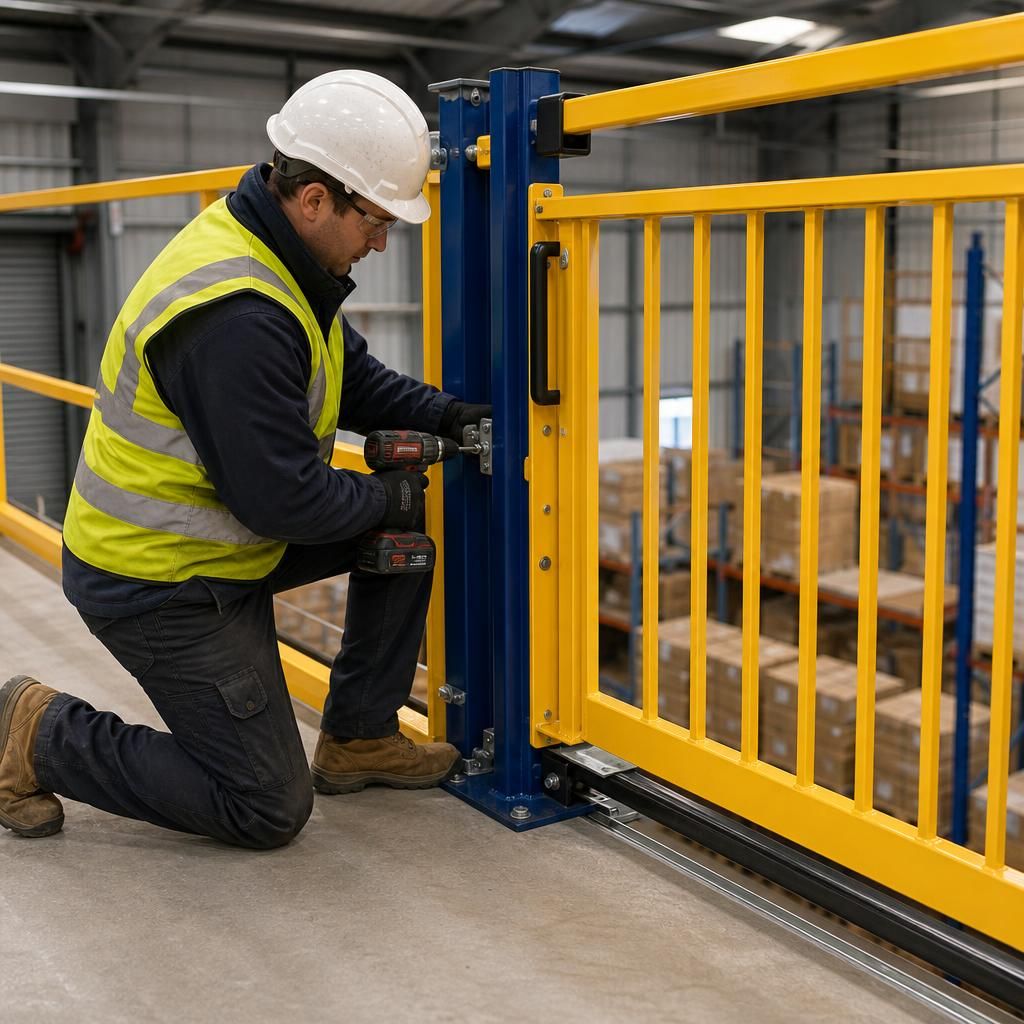
Secure structural fixing is a fundamental installation requirement for a mezzanine sliding gate. The gate frame, posts, tracks and guides must be attached to suitable structural members using fixings specified for the design and supporting structure. Fixing into decking, edge protection or unsuitable steelwork can result in movement, misalignment or failure during normal use.
Before installation, the proposed fixing points should be checked to confirm they will not damage structural members, services, fire protection or existing safeguards. Once fitted, the gate should be checked for stability, smooth travel, reliable closing and safe clearances around moving parts. Any deviation from the approved design or manufacturer’s instructions should be assessed and authorised by a suitably competent person.
Discuss Your Mezzanine Sliding Gate Installation Requirements
Speak to our experienced team to discuss your mezzanine sliding gate installation requirements and arrange practical advice for your site.