
How often should pallet racking safety checks be conducted?
Pallet racking safety checks should include routine visual checks by trained warehouse staff and a documented expert inspection at intervals not exceeding 12 months, or more frequently where the risk assessment requires it. Additional checks are necessary after impact, alterations, instability, or any suspected damage, with unsafe areas isolated until assessed and repaired.
Pallet racking safety checks should be carried out at several levels: routine visual checks by trained warehouse staff, more formal inspections at a risk-based frequency, and a documented expert inspection at intervals not exceeding 12 months. An additional check is required immediately after an impact, alteration, unusual loading event or any report of damage. If a safety concern is identified, the affected area should be isolated until it has been assessed and, where necessary, repaired.
The appropriate inspection frequency depends on the design and condition of the pallet racking, the intensity of use, the type of handling equipment operating nearby and the consequences of a failure. A risk assessment should define the inspection programme rather than relying on an annual visit alone.
Routine visual checks by warehouse staff
Trained employees should look at the pallet racking during normal warehouse operations and report concerns as soon as they are noticed. These checks should focus on visible signs that could indicate an immediate safety issue, including:
- Uprights, frames, beams, bracing or connections that are bent, cracked, split or visibly displaced
- Missing, loose or damaged locking pins and other securing components
- Dislodged, uneven or overloaded pallets
- Loads projecting into aisles or resting incorrectly on beams
- Protective components that have been damaged or moved
- Evidence of impact from forklift trucks or other handling equipment
- Changes in the alignment, stability or general appearance of the installation
These checks are not a substitute for a competent inspection. Their purpose is to identify problems promptly so that damaged pallet racking is not left in service until the next planned visit. Staff should know who to notify, how to identify affected bays and when an area must be taken out of use.
Formal inspections and expert examinations
A formal inspection should be completed at a frequency determined by the site risk assessment. In many working warehouses, this includes a documented visual inspection by a suitably competent person at least weekly, although a different interval may be appropriate where the risk assessment supports it. The inspection should be more frequent where there is heavy vehicle movement, frequent loading and unloading, a history of impacts, difficult operating conditions or a high level of change to the storage layout.
In addition, pallet racking should undergo a documented expert inspection at intervals of no more than 12 months. This inspection should be carried out by a person with suitable knowledge, training and experience in pallet racking safety. The inspector should assess the installation systematically, record defects and assign appropriate action levels according to the seriousness of each issue.
An annual inspection does not mean that defects can remain unresolved until the next annual visit. Damage identified during a routine check or formal inspection should be evaluated promptly. Serious damage may require the affected bay or area to be unloaded and isolated immediately, while less serious defects should still be recorded, monitored and repaired within a defined timescale.
When an immediate additional check is needed
A further pallet racking safety check should take place after any event that could affect the structure or its safe use. This includes:
- A collision or suspected collision involving a forklift truck, pallet truck or other equipment
- Visible damage reported by an operative, contractor or delivery driver
- Changes to beam levels, bay configuration, loading arrangements or protection systems
- Relocation, extension or partial dismantling of the installation
- Loading beyond the stated capacity or use of unapproved pallets
- Evidence of instability, settlement, water damage, fire damage or other environmental effects
- Unexpected movement, noise or distortion during loading and unloading
- A prolonged period of disuse followed by a return to operation
Where the condition of the pallet racking is uncertain, it should not be assumed to be safe because the last planned inspection was satisfactory. The affected location should be made safe and assessed before normal use resumes.
What determines the inspection frequency?
The inspection programme should reflect the way the warehouse operates. Relevant factors include the height and configuration of the pallet racking, the weight and nature of stored goods, the frequency of vehicle movements, aisle width, visibility, operator competence, environmental conditions and the effectiveness of existing protective measures. Previous damage and the quality of maintenance records should also be considered.
Inspection frequency may need to increase where the installation is subject to repeated impacts or where staff regularly change storage positions. It may also need to be reviewed after a layout change, a change in handling equipment or a change to the type of goods being stored. The risk assessment should be updated when these conditions change.
Records and follow-up
Every formal check should produce a clear record showing the date, areas inspected, findings, risk classification, recommended action and person responsible for completion. Records should be retained with evidence of repairs or other corrective measures. A closed inspection process is important: recording damage without confirming that it has been controlled or repaired does not provide effective assurance.
Inspection records should be supported by current load information, installation details and relevant maintenance documentation. Warehouse teams should also have a straightforward reporting process and receive enough instruction to recognise damage and prevent unsafe use.
Able Racking can help establish a practical inspection schedule based on the way your warehouse operates, carry out documented expert inspections and advise on remedial work where defects are found. Regular checks, prompt reporting and properly managed repairs help maintain safe, compliant and efficient pallet racking throughout its service life.
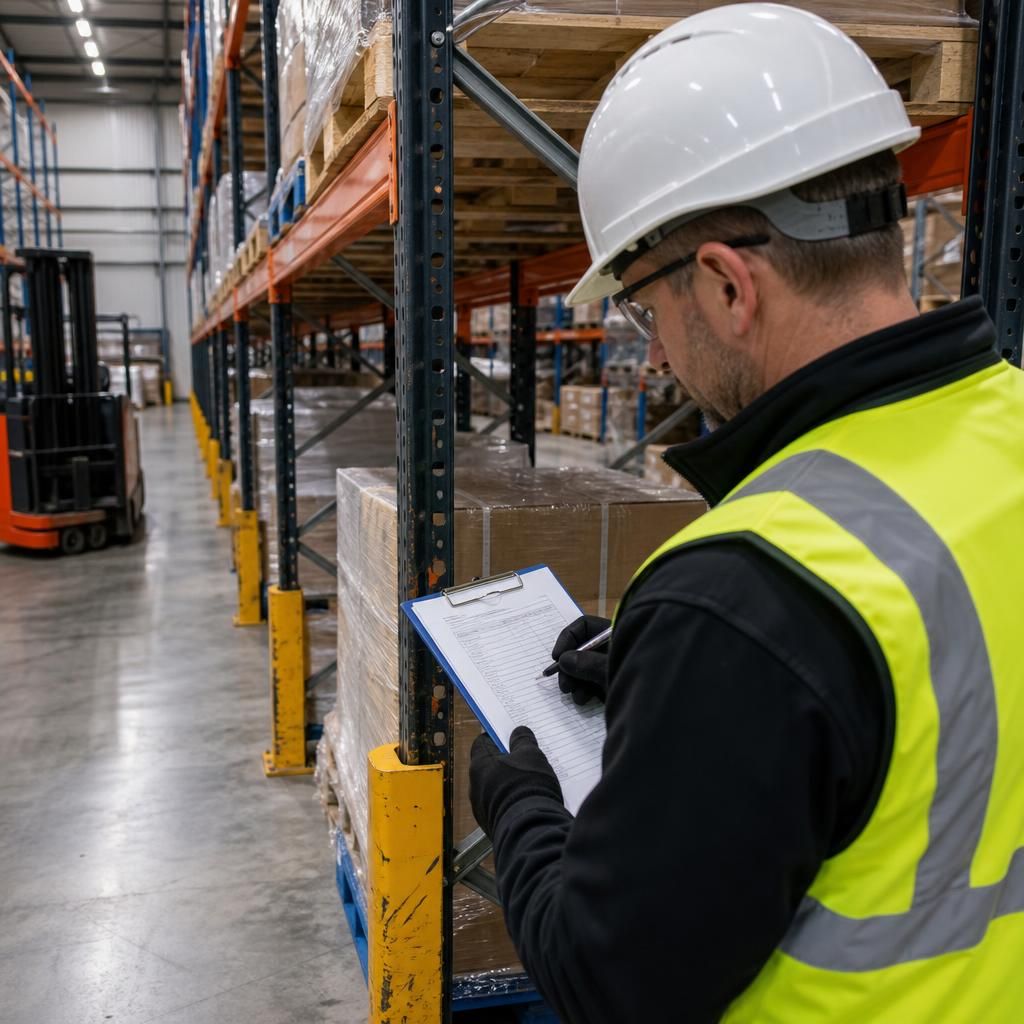
A documented expert inspection of warehouse racking should take place at intervals of no more than 12 months, with the exact programme based on a site-specific risk assessment. This annual inspection does not replace routine checks by trained warehouse staff or additional assessments after damage, alterations or unusual loading.
Inspection frequency should increase where forklift movements are frequent, aisles are narrow, loads are heavy, damage has occurred previously or the storage layout changes regularly. Any suspected impact should be reported immediately, with the affected bay isolated until a competent person has assessed it and confirmed whether repair or further action is required.
Book your pallet racking safety check
Book your pallet racking safety check with Able Racking to confirm that your warehouse racking remains safe, compliant and fit for use. Our experienced inspection team can assess the installation and advise on any required remedial action.