
What are the differences between various types of warehouse racking systems?
Warehouse racking systems differ in their load capacity, storage density, accessibility and suitability for particular goods, from adjustable pallet racking for versatile pallet storage to cantilever systems for long or bulky items. The right choice depends on your warehouse layout, stock dimensions, handling equipment, turnover rates and required access.
Warehouse racking systems differ mainly in how they use available space, how goods are accessed, the loads they support and the stock rotation method they allow. Selective pallet racking provides the widest access and greatest flexibility, while systems such as drive-in, push-back and pallet flow prioritise storage density or stock rotation. Cantilever systems are designed for long, awkward or non-palletised items, whereas mobile and automated systems increase space efficiency through more specialised equipment and controls.
The most suitable option depends on your products, pallet dimensions, load weights, stock turnover, handling equipment, available floor and clear height, required access and operating procedures. A system should not be selected on storage capacity alone. Its design must also allow safe loading, unloading, inspection, maintenance and protection against impact.
Adjustable pallet racking
Adjustable pallet racking is the most widely used pallet storage system because each bay can normally be configured to suit different pallet sizes and load requirements. Pallets are stored on individual beams, with forklift access to each location from the aisle. This gives direct access to stock and makes it straightforward to handle products with varied demand.
Its main advantages are flexibility, relatively simple access and compatibility with many forklift types. It is particularly suitable where stock-keeping units change regularly, individual pallets need to be retrieved without moving others, or both fast- and slow-moving goods are stored in the same area. The trade-off is that aisles occupy valuable floor space, so it may provide less storage density than systems designed for compact block storage.
Double-deep pallet racking
Double-deep pallet racking places one pallet position behind another, reducing the number of access aisles. This can increase storage density, but the rear pallet cannot usually be reached without moving the front pallet. Reach trucks or other suitable handling equipment are generally required, and stock control must account for the reduced direct access.
This arrangement can work well where there are several pallets of the same product and stock rotation is less demanding. It is less suitable where every pallet must be available immediately or where the goods are handled on a strict first-in, first-out basis.
Drive-in and drive-through pallet racking
Drive-in systems allow handling equipment to enter storage lanes and place pallets on supporting rails. Pallets are stored in compact blocks, which minimises aisle space and provides high storage density. Because the last pallet placed in a lane is generally the first removed, the system is normally better suited to last-in, first-out stock rotation and large quantities of the same product.
Drive-through arrangements have access from both ends of a lane. This can support a first-in, first-out sequence when loading and retrieval are managed from opposite sides. Both systems require disciplined forklift operation because the equipment works inside the storage structure. They are most effective where product ranges are limited, pallet loads are consistent and density is more important than unrestricted access.
Push-back pallet racking
Push-back pallet racking uses inclined rails and wheeled carriers or carts. When a new pallet is loaded, it pushes the pallets already in the lane towards the rear. Removing the front pallet allows the remaining pallets to move forward. This creates compact, multi-pallet storage while retaining access from a single aisle.
Push-back systems are often suitable for medium- to high-volume products stored in batches. They generally provide faster access than drive-in systems because the forklift does not enter the storage lane, but they usually operate on a last-in, first-out basis. The carrier arrangement, pallet condition and load consistency must be considered carefully during design.
Pallet flow systems
Pallet flow systems use gravity rollers or wheels so pallets move from the loading side towards the retrieval side. New stock is loaded at the replenishment end and older stock is collected at the opposite end, supporting first-in, first-out rotation. Braking and separation components help control pallet movement.
This type of system is useful for perishable goods, date-sensitive stock and operations that require clear separation between replenishment and picking. It can provide high density and efficient stock rotation, but it is more specialised than adjustable pallet racking. Pallet quality, load stability, lane depth and regular inspection of moving components are important considerations.
Mobile pallet racking
Mobile pallet racking is mounted on powered or manually operated bases that move along floor tracks. The bases can close unused aisles and open an access aisle only where it is needed. This can make better use of the building footprint, although access is slower than with permanently open aisles and the system depends on reliable controls, sensors and safety devices.
Mobile systems can be appropriate where floor space is restricted, storage density is a priority and goods do not all need to be accessed at the same time. They require a suitable floor, carefully planned aisle controls and robust operating procedures. Emergency access, pedestrian safety and equipment isolation must be included in the design and maintenance arrangements.
Cantilever racking
Cantilever racking is designed for long, bulky or irregularly shaped goods that cannot be stored efficiently on standard pallet beams. It uses upright columns with projecting arms, usually with no front posts obstructing the load. Timber, steel sections, pipes, panels, mouldings and furniture components are common examples of suitable goods.
Arms can often be adjusted to suit the load, and the system may be installed as single-sided or double-sided storage. The design must account for the length, weight, centre of gravity and handling method of each product. Loads should be positioned securely on the arms, and protruding goods must not obstruct routes or create a collision hazard.
Longspan shelving and small-parts storage
Longspan shelving is intended for hand-loaded cartons, containers, components and other relatively light goods. It provides accessible storage without requiring forklift access and can be configured with different shelf levels, dividers, bins or decking. It is commonly used for order picking, spare parts and supplies.
Compared with pallet systems, it supports lower loads and relies more heavily on manual handling. The arrangement should provide safe picking heights, stable shelving and clear working aisles. Where goods are transferred to a higher-level platform or incorporated into a larger storage structure, the complete installation requires appropriate design, guarding and access controls.
Carton flow and live picking systems
Carton flow systems use inclined rollers or wheels to move cartons, totes or cases towards a picking face. They support first-in, first-out rotation and can separate replenishment activity from order picking. This reduces the need for pickers to reach into deep storage locations and can make product presentation more consistent.
They are suited to fast-moving small items and case-picking operations. The design should reflect carton dimensions, packaging strength and the required replenishment method. Dividers, end stops and braking features may be needed to prevent cartons from becoming unstable or obstructing the picking face.
Automated storage systems
Automated storage and retrieval systems use machinery, software and defined storage locations to place and retrieve goods. Examples include crane-served pallet systems, shuttle-based storage and automated systems for totes or cartons. These solutions can reduce manual travel, improve inventory control and use building height efficiently.
They are more complex to specify and operate than conventional systems. The assessment must cover software integration, throughput, power supply, fire protection, safe access for maintenance and what happens if the automation is unavailable. Automated equipment does not remove the need for competent inspections or safe working procedures; it adds mechanical, electrical and control-system considerations.
How the systems compare
- Accessibility: adjustable pallet racking usually offers the most direct access to individual pallets. Compact systems improve density by limiting access or requiring pallets to be moved in sequence.
- Storage density: drive-in, push-back, flow, mobile and automated options can reduce wasted aisle space, although the achievable result depends on the building and handling equipment.
- Stock rotation: pallet flow and flow shelving support first-in, first-out handling. Drive-in and push-back arrangements are generally more suited to last-in, first-out storage, while adjustable pallet racking can support either method if locations and procedures are managed correctly.
- Flexibility: adjustable systems are usually easier to adapt when product sizes, pallet types or operational requirements change. Specialised systems may offer better performance but require more consistent loads and processes.
- Handling equipment: aisle width, lift height, turning radius and forklift reach must match the chosen arrangement. A system that cannot be safely served by the available equipment is unsuitable, regardless of its theoretical capacity.
- Cost and complexity: basic shelving and adjustable pallet systems are generally simpler to install and maintain. Mobile, flow and automated options may provide greater space efficiency but involve additional components, controls and maintenance requirements.
Safety and suitability checks
Every warehouse racking installation should be designed for its actual loads and operating conditions. Key checks include the weight and dimensions of pallets, beam and upright capacities, slab condition, aisle clearance, forklift impact risk, building restraints and the effect of any changes to the layout. Load notices should reflect the installed configuration, and damaged components should be taken out of service or assessed promptly by a competent person.
Regular user checks and formal inspections help identify impact damage, displaced beams, bent frames, missing safety components, overloaded locations and changes that may affect stability. Inspections should be followed by a documented repair or risk-control process rather than treated as an isolated administrative exercise. Able Racking can help compare the practical differences between systems, assess existing warehouse racking and identify a configuration that balances access, capacity, safety and long-term operating costs.
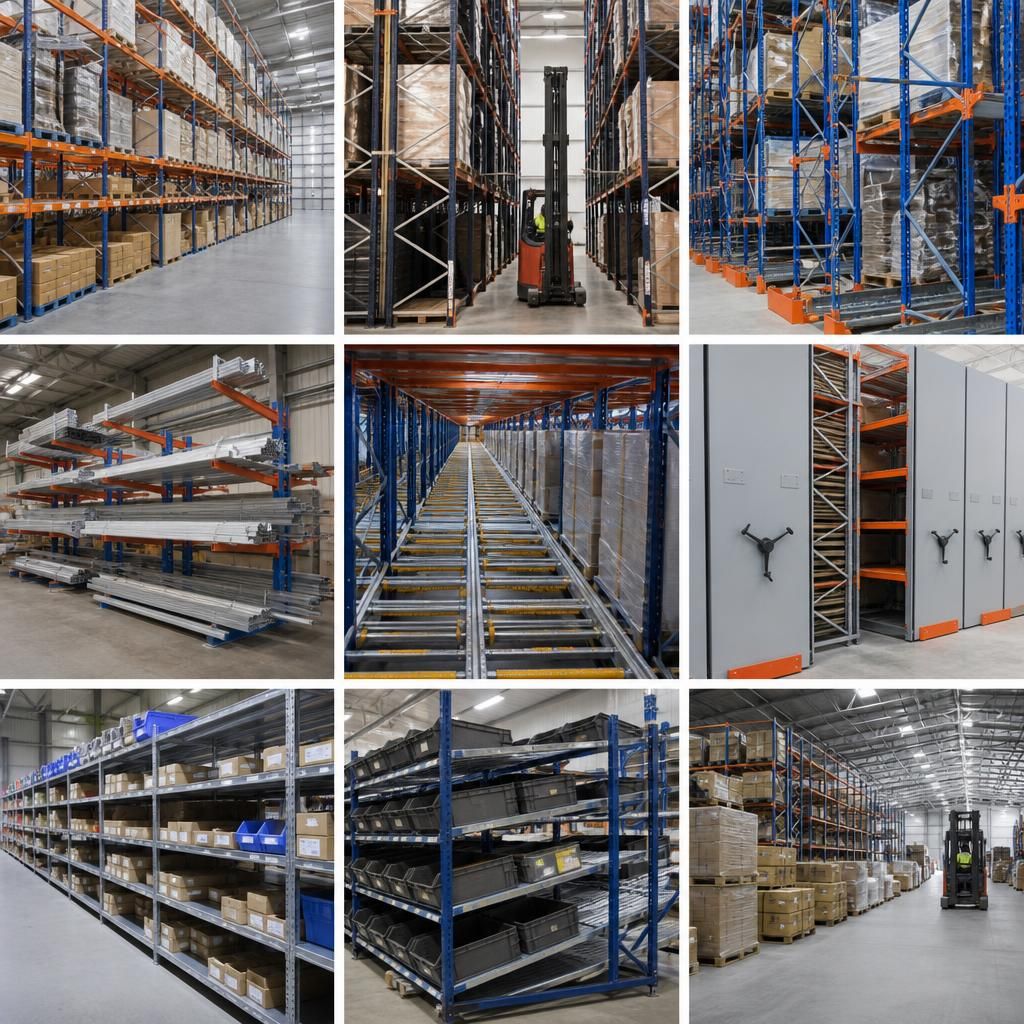
The main difference between warehouse racking systems is the balance they provide between storage density and access to individual loads. Adjustable pallet racking keeps every pallet position directly accessible, while drive-in, push-back and pallet flow systems store more loads in a smaller footprint but require specific loading methods or stock rotation procedures.
Choose the system according to your pallet dimensions, load weights, stock turnover, handling equipment and required access. A denser system is not automatically the most suitable: it must also support safe forklift operation, clear inspection access, stable loads and practical day-to-day stock control.
Choose the right warehouse racking system
Speak to Able Racking for expert advice on selecting, inspecting or maintaining a warehouse racking system suited to your stock, handling equipment and operating requirements.