
What are the main components of an ASRS system and how do they function?
An ASRS system combines automated storage equipment, storage locations, conveyors or other load-transfer equipment, control software and safety systems to store and retrieve goods with minimal manual handling. The warehouse management system sends instructions, while the warehouse control system coordinates each movement and the automated equipment places or collects the required load accurately.
An ASRS system is made up of coordinated storage equipment, load-handling machinery, control software, identification technology and safety systems. Together, these components receive goods, place them in a defined storage location, retrieve them when required and transfer them to the correct workstation or despatch process with limited manual handling.
The exact configuration depends on the load type, throughput requirements, available building height, storage objectives and the way the system must connect with the wider warehouse operation. However, most ASRS installations contain the following core components.
Storage structure and locations
The storage structure provides the physical framework for holding pallets, totes, cartons, trays or other unit loads. It is divided into clearly identified locations, each with a known position within the system. The structure must be designed for the dimensions, weight, stability and handling characteristics of the goods being stored.
Each location has a defined address, normally based on an aisle, level, bay and position. This allows the control system to direct equipment to the correct place and maintain an accurate record of inventory. The structure also has to accommodate equipment clearances, load tolerances, building conditions, fire protection requirements, access arrangements and inspection needs.
Good design is important because small variations in load dimensions, damaged pallets or poorly positioned goods can affect automated movement. Storage locations should therefore be compatible with the loads and checked as part of the system’s ongoing maintenance regime.
Load carriers
A load carrier is the platform or container used to hold goods while they move through the system. Common examples include pallets, totes, trays, bins and purpose-built containers. The carrier must be strong enough for the intended load and sufficiently consistent in size and condition for automated handling.
Where pallets are used, their quality is particularly important. Broken boards, protruding nails, excessive deflection or inconsistent dimensions can prevent safe engagement by automated equipment. Totes and trays must also be suitable for the conveyor, lift or storage mechanism that handles them.
Some systems use standard carriers, while others use specially designed carriers for irregular, fragile or temperature-sensitive goods. The carrier type affects storage density, equipment selection, operating speed and the way goods are presented to operators.
Automated storage and retrieval equipment
The storage and retrieval machine carries loads between the input and storage locations, then retrieves them when instructed. In a pallet-based installation, this may be a stacker crane that travels along an aisle and uses a load-handling device to place or collect a pallet. Other systems may use shuttle vehicles, robotic carriers, vertical lifting equipment or robotic arms.
The machine normally performs several coordinated movements. It travels to the required position, aligns with the storage location, engages the load, checks that the load has been captured correctly and transports it to the destination. Sensors and position controls help confirm that each movement has been completed before the next instruction is carried out.
Different equipment is suited to different applications. Stacker cranes are commonly used where high storage density and precise pallet handling are required. Shuttle-based equipment can move multiple loads within a storage lane. Robotic systems may be appropriate for totes, cartons or goods that need flexible sequencing. The choice depends on load characteristics, storage height, travel distances, order profiles and required access.
Conveyors, lifts and transfer equipment
Conveyors transfer loads between receiving points, storage equipment, picking areas, packing stations and despatch points. They may include roller conveyors, belt conveyors, chain conveyors, vertical lifts, turntables and transfer cars. Each item has a specific role in maintaining a controlled flow of goods.
Conveyors can also provide accumulation, allowing loads to wait safely without blocking the rest of the system. Sensors monitor whether a load is present and whether the next section is available. Diverts and merging points direct loads towards the correct destination.
Vertical lifts move loads between levels where the system serves more than one operating height. Transfer equipment must be correctly aligned with the storage machinery and designed for the carrier being used. Poor alignment, unsuitable speeds or inconsistent load presentation can cause stoppages and place additional strain on equipment.
Input and output stations
Input stations are where goods enter the automated process. An operator or upstream system presents the load, its identity is recorded and checks are carried out before the system accepts it. These checks may include barcode reading, weight verification, dimension checks, carrier condition checks and confirmation that the load is stable.
Output stations are where goods leave automated storage. The system presents the required load at a picking, packing, production or despatch point. The station may include ergonomic handling equipment, scanning technology, operator controls and accumulation space.
Input and output stations are important control points. If a load is incorrectly labelled, overhanging, damaged or outside the permitted dimensions, it should be diverted for investigation rather than allowed to cause a fault deeper within the system.
Identification and tracking technology
ASRS systems need to know what each load is and where it is located. Identification may be provided by barcodes, two-dimensional codes, radio frequency identification or other machine-readable labels. Scanners and sensors capture this information as the load enters, moves through and leaves the system.
Tracking is not limited to reading a label. The system also verifies that the physical load matches the expected movement. Position sensors, occupancy sensors, encoders and equipment feedback help confirm that a load has reached the intended location.
Accurate identification prevents misplacement and supports stock traceability. Labels should be positioned consistently, remain readable during handling and be suitable for the environmental conditions in the warehouse.
Warehouse management system
The warehouse management system, or WMS, manages inventory and warehouse-level decisions. It may determine where goods should be stored, allocate stock to orders, manage batch or expiry requirements and record the status of incoming and outgoing loads.
The WMS typically holds the business information associated with a load, such as its product code, quantity, status and destination. It sends instructions to the automated system and receives confirmation when movements are completed.
A WMS can also apply storage rules. For example, it may direct fast-moving goods towards suitable retrieval locations, keep incompatible products apart or ensure that stock is selected according to an agreed rotation method. These rules must be configured correctly and reviewed when products, processes or operating priorities change.
Warehouse control system
The warehouse control system, or WCS, translates higher-level instructions into the detailed movements required by the equipment. It decides which conveyor route to use, when a machine can move, where a load should wait and how several movements should be sequenced safely.
The WCS communicates with programmable logic controllers and equipment controls. It monitors machine status, detects faults, manages traffic and confirms completed transactions. If a conveyor is unavailable or a storage machine reports a fault, the WCS can stop, reroute or hold affected movements according to the programmed operating logic.
The WMS and WCS have different responsibilities. The WMS is primarily concerned with inventory and warehouse transactions, while the WCS is concerned with real-time equipment control. Reliable communication between them is essential for stock accuracy and consistent operation.
Programmable logic controllers and sensors
Programmable logic controllers, or PLCs, control individual machines and sections of the material flow. They receive information from sensors and issue commands to motors, brakes, drives, actuators and other components.
Sensors may detect load presence, position, speed, alignment, obstruction, door status and equipment condition. Encoders and positioning systems help machines stop accurately at the required location. Safety-rated devices operate separately or with additional safeguards where a hazardous movement must be stopped.
These controls allow the system to verify each stage of a movement rather than assuming that it has happened. This is one of the main differences between a properly integrated ASRS installation and a collection of standalone machines.
Safety systems and guarding
Safety systems protect operators, maintenance personnel, visitors and the equipment itself. They may include perimeter guarding, interlocked gates, emergency-stop devices, light curtains, scanners, access controls, safety mats, audible or visual warnings and safe maintenance modes.
Guarding prevents access to moving machinery during automatic operation. Interlocks stop or inhibit movement when a protected gate is opened. Emergency stops provide a means of bringing equipment to a safe condition when there is immediate danger, although they are not a substitute for normal operational controls or planned isolation procedures.
Safety functions must be designed around the complete system, including interfaces with manual work areas, building access points and adjacent processes. Risk assessments, operating procedures, training and planned inspections remain necessary after installation. Safety devices should be tested at appropriate intervals, and faults should be investigated rather than repeatedly reset without identifying the cause.
Electrical power and communication infrastructure
Motors, drives, sensors, controls and computer equipment require a suitable electrical supply. The installation may also require battery charging, power distribution, uninterruptible supplies for critical controls and protection against electrical faults.
Industrial communication networks connect the WMS, WCS, PLCs, scanners and equipment. Network reliability affects the system’s ability to accept instructions, report status and recover from interruptions. Backup arrangements and controlled restart procedures should be defined so that loads are not lost or duplicated after a power or communication failure.
Human-machine interfaces
Operators and maintenance teams interact with the system through control panels, touchscreens, handheld devices and diagnostic software. These interfaces display equipment status, alarms, task information and fault details.
A useful interface distinguishes between warnings, recoverable operating conditions and safety-critical faults. It should provide enough information for trained personnel to respond correctly without encouraging unsafe access to machinery. Maintenance access, isolation points and reset procedures should be clearly documented and included in training.
How the components work together
- Receipt: A load arrives at an input station, where its identity, dimensions, weight and condition are checked.
- Instruction: The WMS determines the required storage transaction and sends the instruction to the WCS.
- Movement planning: The WCS selects the appropriate route and coordinates conveyors, lifts and storage equipment.
- Storage: The automated machine moves to the assigned location, places the load and confirms successful placement using sensors and position data.
- Inventory update: The completed movement is reported back so that the recorded stock location matches the physical location.
- Retrieval: When stock is required, the WMS issues a retrieval request and the WCS schedules the equipment and transfer route.
- Presentation: The load is delivered to the correct output station for picking, production, packing or despatch.
- Exception handling: If a scan fails, a load is damaged or equipment becomes unavailable, the system holds or diverts the load and generates an alarm for investigation.
The performance of an ASRS system depends on the integration of all these components, not simply on the storage machine. Equipment must be correctly aligned, carriers must meet specification, software records must match physical movements and safety controls must be maintained. Regular inspections, preventative maintenance, fault analysis and competent operator training help preserve accuracy, availability and safe operation throughout the system’s working life.
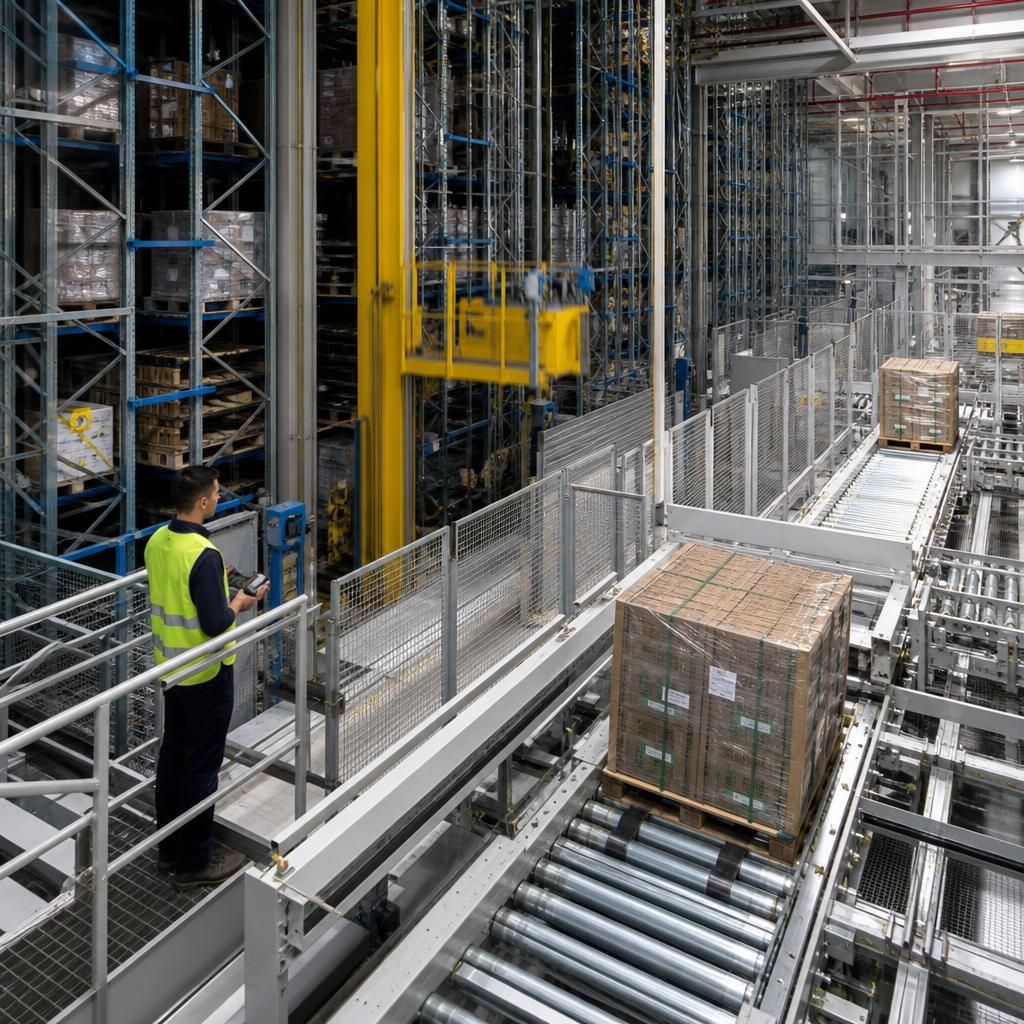
The main components of an ASRS system function as one controlled process: the warehouse management system decides what needs to move, the warehouse control system coordinates the route, and automated equipment carries out the storage or retrieval task.
Scanners and sensors verify the load, its position and each stage of the movement. If a load is incorrectly labelled, unstable or unable to reach its destination, the system can hold the transaction and raise an alarm for investigation. This connection between inventory records, equipment controls and safety devices is essential for accurate stock locations, reliable operation and safe access for trained personnel.
Discuss Your ASRS System Requirements With Our Experts
Discuss your ASRS system requirements with our experienced team for practical guidance on equipment, controls, safety and ongoing maintenance. Contact Able Racking to arrange an expert consultation tailored to your warehouse operation.