
How does a shuttle racking system function to improve warehouse operations?
A shuttle racking system uses a remotely controlled pallet shuttle to move and position pallets within deep storage channels, reducing forklift travel and handling. This improves warehouse operations by increasing storage density, speeding up loading and retrieval, and supporting safer, more consistent stock movements.
A shuttle racking system improves warehouse operations by using a remotely controlled pallet shuttle to move loads along storage channels, rather than requiring a forklift to enter each channel. This reduces internal travel and handling, increases usable storage density, and makes pallet loading and retrieval more consistent.
The system is built around deep storage channels fitted with guide rails. A powered pallet shuttle is placed on the rails and controlled by an operator, usually using a remote control or warehouse control system. The forklift positions the shuttle and pallet at the channel entrance, after which the shuttle moves the load into the channel and places it in the next available position. To retrieve a pallet, the shuttle collects it and returns it to the access point for forklift removal.
It separates transport from storage. Forklifts continue to handle pallets at the front of the system, while the shuttle carries out the repeated movements inside the channel. This can make stock handling more predictable, particularly where large quantities of similar products need to be stored in dedicated lanes.
Higher storage density is achieved because the system uses deep channels and reduces the need for multiple forklift aisles. More pallet positions can therefore be created within the available footprint, subject to the building, load characteristics, access requirements and required fire protection arrangements. The available capacity should be confirmed through a properly designed warehouse layout rather than assumed from the equipment alone.
Faster and more consistent pallet movements are another operational benefit. The shuttle follows a controlled route and can carry out repetitive put-away or retrieval movements without the forklift repeatedly travelling into and reversing out of a storage lane. This may reduce congestion at busy periods and allows forklift operators to focus on transferring pallets between receiving, despatch and storage areas.
The system can support different stock rotation methods:
- Last in, first out (LIFO): pallets are stored and retrieved from the same access point, which suits many bulk-storage applications.
- First in, first out (FIFO): pallets are loaded from one side and retrieved from the other, where the layout and product requirements justify access from both ends.
The appropriate method depends on product shelf life, batch control, replenishment practices and the number of stock-keeping units being handled. A shuttle system is often most effective when each channel contains compatible pallets or a controlled product group. Storing incompatible loads together can create retrieval problems and increase the risk of damage.
Warehouse control is also improved. The operator can select the required operating mode, such as loading, unloading or pallet repositioning, while the shuttle manages movement within the channel. Depending on the system design, sensors can help detect pallet position, channel end points and obstructions. These controls support repeatable movements, but they do not replace competent operation, visual checks or a suitable stock management process.
Safety benefits come from reducing forklift access inside storage channels. Fewer vehicle movements in confined areas can reduce the likelihood of contact with storage components and pallets. However, the system still contains powered equipment, moving loads and potential pinch points. Operators must follow the manufacturer’s instructions, keep people clear of active channels, use agreed pedestrian and vehicle routes, and prevent unauthorised access during operation.
Safe performance also depends on the surrounding warehouse racking being correctly designed, installed and maintained. The structure must be suitable for the pallet dimensions, total load, shuttle equipment and operating conditions. Load notices should remain visible and accurate, damaged components should be reported immediately, and inspections should be completed by a competent person at appropriate intervals. Any impact, distortion, missing component or abnormal shuttle behaviour should be investigated before the affected area is returned to normal use.
Implementation usually requires more than installing the shuttle equipment. The operation should be planned around:
- pallet quality, dimensions and maximum loads;
- channel depth and the required stock rotation method;
- forklift compatibility and access at the channel entrances;
- charging, battery handling and equipment storage arrangements;
- operator training and emergency procedures;
- fire protection, workplace traffic management and pedestrian segregation;
- routine cleaning, servicing and inspection of the shuttle and storage structure.
When these factors are addressed, a shuttle racking system can provide a controlled high-density storage process that uses less forklift travel, supports quicker pallet handling and improves operational consistency. Its effectiveness should be reviewed against the warehouse’s actual throughput, product range, access requirements and safety controls, with ongoing maintenance and racking inspections used to preserve reliable performance.
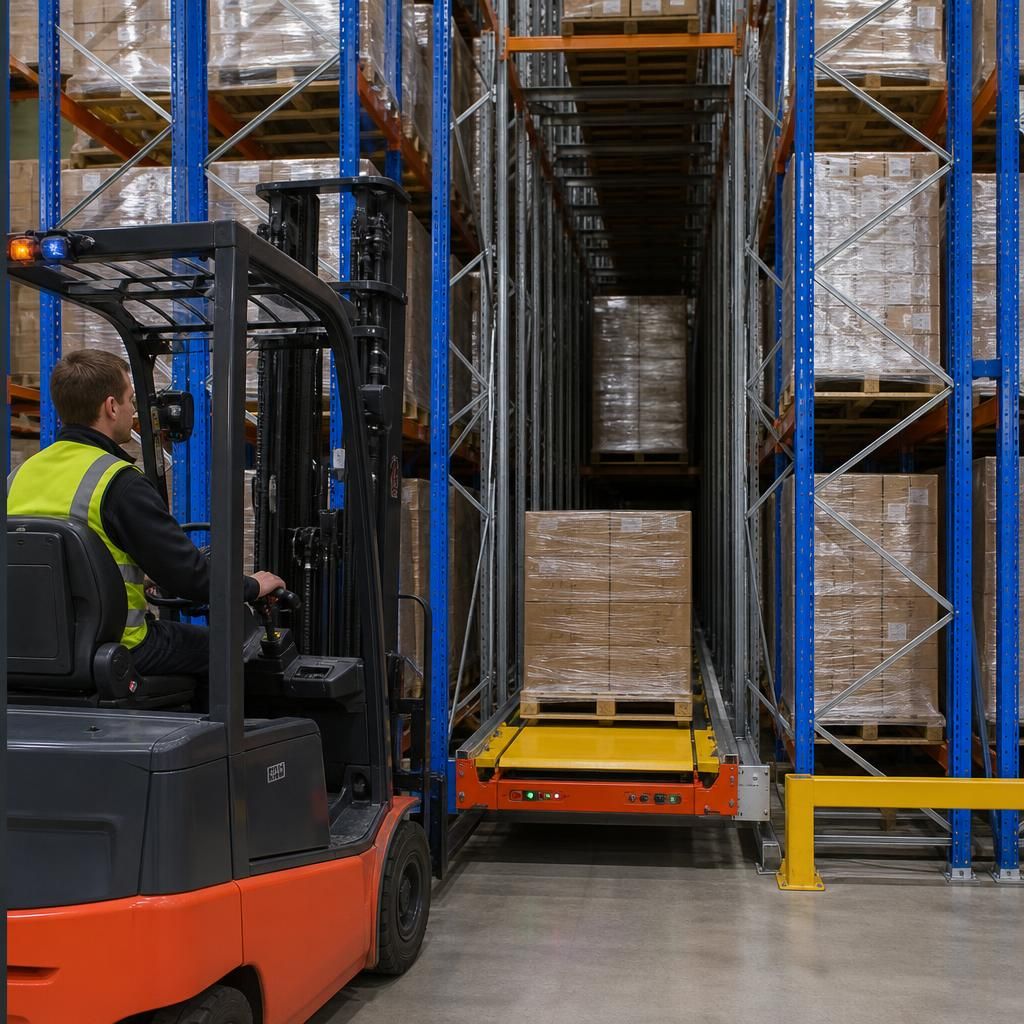
A shuttle racking system improves warehouse operations by using a powered pallet shuttle to move loads through deep storage channels, while the forklift remains at the channel entrance. This reduces forklift travel inside the warehouse racking and creates a more consistent loading and retrieval process.
The shuttle follows guide rails and places each pallet into the next available position, then returns to the access point when stock is required. This can increase storage density, reduce vehicle congestion and help operators handle repetitive movements more efficiently. It also supports either last-in, first-out or first-in, first-out stock rotation, depending on the layout and access provided.
Reliable performance depends on suitable pallet dimensions, compatible loads, trained operators and well-maintained warehouse racking. Clear traffic routes, controlled access to active channels, accurate load notices and regular competent inspections are essential for keeping the system safe and operational.
Discuss Your Shuttle Racking System Requirements
Discuss your shuttle racking system requirements with Able Racking for practical advice on layout, load compatibility, safety controls and ongoing maintenance.