
What are the maintenance requirements for mobile racking systems?
Mobile racking systems require routine visual checks, scheduled inspections, prompt repair of damage and regular servicing of their rails, wheels, drive mechanisms and safety controls. Maintenance should be carried out by competent personnel in line with the manufacturer’s instructions, site risk assessment and applicable warehouse racking safety requirements.
Mobile racking systems require planned preventive maintenance, routine visual checks, periodic technical inspections and prompt repair of defects. Maintenance should be completed by competent personnel in accordance with the manufacturer’s instructions, the site risk assessment and applicable warehouse racking safety requirements. The aim is to keep the structure, mobile bases, rails, drive system and safety controls operating correctly while preventing damage from developing into a safety-critical failure.
Maintenance intervals should be based on the system design, operating frequency, loading conditions and working environment. A powered installation used continuously in a demanding warehouse may need more frequent servicing than a manually operated system used occasionally. The manufacturer’s service schedule should take priority, with additional checks introduced where site conditions or previous defects indicate a higher risk.
Routine operator checks
Before use, trained operators should check that the mobile racking system appears safe to operate. These checks do not replace a competent technical inspection, but they can identify problems early. Operators should look for:
- Visible damage, distortion, impact marks or loose components on the frames, beams, panels and protective equipment.
- Obstructions, debris or damaged floor surfaces around the rails and travel paths.
- Unusual noise, vibration, jerky movement or difficulty opening and closing an aisle.
- Uneven movement between mobile bases or signs that a base is not aligned correctly.
- Faults with warning lights, audible alarms, emergency stops, sensors, interlocks or access controls.
- Missing or unreadable load notices, operating instructions and safety signs.
- Evidence of overloading, poorly positioned loads or goods projecting into the travel area.
Any unsafe condition should be reported immediately. The affected aisle or mobile base should be taken out of service where necessary, clearly identified and isolated until it has been assessed and made safe.
Rails, wheels and mobile bases
The rails and channels guide the mobile bases, so they must remain clean, secure and free from distortion. Maintenance should include checking rail fixings, joints, end stops and the condition of the surrounding floor. Debris can restrict wheel movement or cause uneven travel, while damaged rails may affect alignment and place additional loads on the drive components.
Wheels, bearings, axles and guide components should be checked for wear, damage, contamination and correct tracking. Lubrication should only be applied where specified by the manufacturer and in the correct quantity. Excess lubricant can attract dust and debris, while an unsuitable product may damage seals or other components. Any worn wheel or bearing should be replaced using a compatible part rather than adjusted to conceal the defect.
Mobile bases should be checked for alignment, movement and secure attachment of structural components. A base that stops short, travels unevenly or contacts an adjacent unit may indicate a fault with the rail, wheel assembly, drive system, floor or control settings. It should not continue operating until the cause has been established.
Drive mechanisms and electrical equipment
Powered mobile racking systems require servicing of their motors, gearboxes, chains, couplings, drive shafts and control equipment. Engineers should check for excessive noise, overheating, oil leaks, loose guards, worn drive components and abnormal vibration. Chains and other drive components should be inspected, tensioned and lubricated only in line with the manufacturer’s requirements.
Electrical maintenance should cover cabling, connections, isolators, control panels, motors and protective devices. Damaged cables, exposed conductors, water ingress or repeated tripping must be investigated by a suitably qualified person. Electrical work, alterations and fault finding should not be carried out by untrained warehouse operatives.
Safety devices are particularly important. Emergency stops, presence sensors, light barriers, aisle switches, audible and visual warnings, end-of-travel limits and anti-collision controls should be tested as part of planned servicing. A system should not be operated with a bypassed, damaged or unreliable safety control.
Structural checks and load control
Maintenance must include the warehouse racking structure carried by the mobile bases. Frames, beams, bracing, connectors, decking, guide rails and protective barriers should be examined for impact damage, corrosion, looseness and unauthorised alterations. Loads should remain within the stated capacity, be evenly distributed and be stored in a way that does not obstruct moving aisles or safety equipment.
Repairs should use suitable components and follow the original design requirements. Straightening damaged structural members, welding components without approval or substituting parts can affect the system’s strength and invalidate the manufacturer’s safety assumptions. Where damage is significant or the cause is unclear, the affected section should be unloaded and assessed before further use.
Planned inspections and records
Routine maintenance should be supported by a documented inspection programme. The programme normally includes operator checks, scheduled servicing and a more detailed periodic inspection by a competent person. The inspection frequency should reflect the risk assessment, manufacturer’s guidance, usage and any history of damage or faults.
Inspection and service records should identify the equipment checked, the date, findings, defects, risk classification where used, corrective action, parts replaced and the person completing the work. Records should also show when outstanding actions were closed. Keeping this information helps demonstrate that faults are being controlled and makes it easier to identify recurring problems.
After a repair, the system should be function-tested before being returned to service. Where the repair affects the structure, drive system or safety controls, the test should confirm safe travel, stopping, access protection and correct operation under the relevant conditions. Staff should be briefed on any change to operating instructions or restrictions.
Good maintenance practice
- Follow the manufacturer’s maintenance manual and retain the latest system information on site.
- Keep rails, travel paths and control areas clear of stock, packaging and spillages.
- Use trained operators and competent maintenance personnel for the tasks assigned to them.
- Investigate repeated faults rather than repeatedly resetting controls or replacing symptoms.
- Control access during maintenance and isolate stored energy before work begins.
- Review the risk assessment after layout changes, changes in load, collisions, repairs or control-system modifications.
- Arrange an additional inspection after a significant impact, abnormal movement, flooding, fire or other event that could affect the system.
Effective maintenance is therefore a combination of daily care, planned servicing, structural inspection and disciplined defect management. If a mobile racking system shows distortion, poor alignment, uncontrolled movement, electrical damage or a failure of its safety devices, stop using the affected area and arrange an assessment by a competent specialist before normal operation resumes.
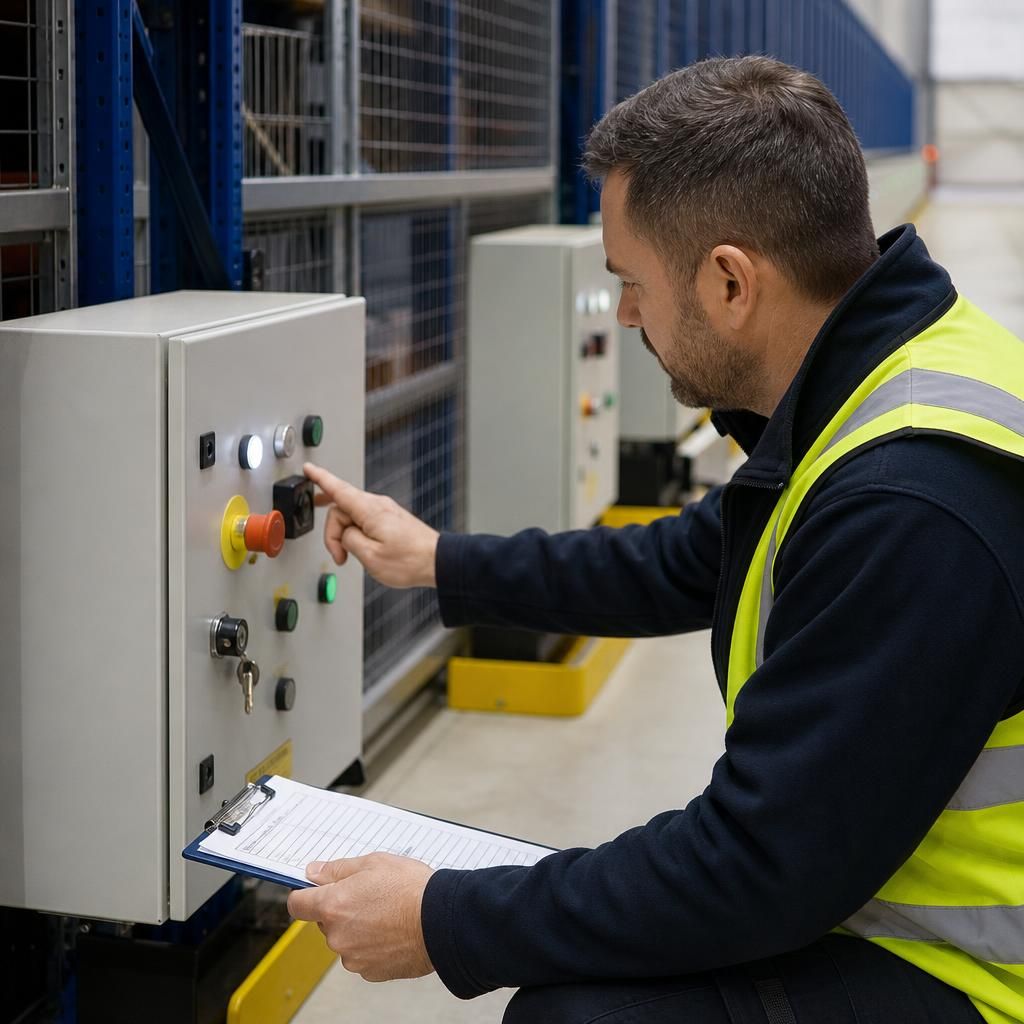
Safety controls require functional testing as part of planned maintenance, not just a visual check. Emergency stops, aisle switches, presence sensors, light barriers, warning alarms and end-of-travel limits should respond correctly and stop or prevent movement when required. Any bypassed, damaged or unreliable device should result in the affected mobile racking aisle being isolated until a competent engineer has investigated and completed the repair.
Book a mobile racking maintenance inspection
Book a mobile racking maintenance inspection with Able Racking to identify defects, check safety controls and confirm that your system remains safe to operate. Our competent specialists can advise on any repairs or servicing required.