
How do cantilever warehouse racking systems manage different load types?
Cantilever warehouse racking systems manage different load types by combining adjustable arm levels, suitable support accessories and load ratings matched to the stored goods. The system can be configured for long, heavy or irregular materials such as timber, steel sections, pipes and sheet products, provided the design, installation and loading arrangements are professionally assessed.
Cantilever warehouse racking systems manage different load types by combining adjustable arm levels, suitable support accessories and load capacities matched to the stored materials. This arrangement is particularly effective for long, bulky or irregular products, including timber, steel sections, pipes, boards and sheet materials, provided the system is designed, installed and used for the intended loads.
The main difference between cantilever warehouse racking and conventional pallet storage is that the arms project from the uprights, leaving the front of the bay clear. Goods can therefore be placed directly onto the arms or onto supporting decks without being restricted by front posts. Arm positions can be adjusted to create storage levels that suit the length, height and handling requirements of each product.
Load type is assessed before the system is selected. Important considerations include the material’s weight, length, shape, rigidity, centre of gravity and how it will be loaded and removed. A long, evenly distributed timber bundle creates different demands from a concentrated steel section or a flexible pack of boards. The design must account for both the total load in a bay and the way that load is distributed between individual arms.
- Timber and timber products: Bundles, boards and lengths of timber are commonly supported on several arms to spread the weight along the product. Suitable arm spacing helps prevent excessive sagging, while end stops or other retention measures can reduce the risk of materials sliding forwards.
- Steel sections and metal products: Steel is dense and can create high point loads. Arms, bases and uprights must be selected for the intended weight and contact points. Support arrangements may need to prevent narrow sections from rolling, twisting or concentrating force in a small area.
- Pipes and tubes: Round products require controls against rolling. End stops, cradles, separators or purpose-designed supports may be appropriate, depending on the diameter, length and bundle arrangement. Individual pipes should not be stored in a way that allows them to escape the storage level.
- Boards, panels and sheet materials: Flat products may be stored horizontally on arms with suitable decking or supports. The design should prevent bowing and should provide adequate bearing along the product’s length, particularly where panels are thin, flexible or easily damaged.
- Irregular or mixed loads: Products with different dimensions should not be treated as interchangeable. A mixed-use system may be suitable, but each storage level needs clear operating rules so that heavier or more concentrated items are placed only where the structure and accessories can safely support them.
Arm selection controls how the load is carried. Arms may vary in length, profile, spacing and capacity. Shorter arms can be appropriate for compact products, while longer arms provide more bearing area for wide or lengthy materials. The selected arm must support the product without creating excessive overhang or an unstable centre of gravity. Where goods extend beyond the arms, the overhang must be considered during the design rather than assumed to be acceptable.
Load distribution is equally important. A product should be supported by enough arms to avoid excessive deflection and localised stress. Loads should normally be positioned so that their weight is shared across the intended supports, rather than concentrated at the end of one arm. Bundles should be stable before they are placed in storage, and loose items should be secured or contained where their shape makes movement likely.
Accessories adapt the system to the product. Depending on the materials being stored, the design may include timber or steel decking, support bars, cradles, dividers, end stops, separators or protective components. These accessories can improve stability, prevent rolling and reduce product damage, but they do not automatically increase the structural capacity of the system. Their suitability must be checked against the load, handling method and manufacturer’s design information.
The loading method also affects performance. Forklift trucks, cranes and manual handling each apply different forces and require different clearances. Forklift operators need enough approach space to place products centrally and avoid striking the arms or uprights. Long loads may require coordinated handling because one end can swing or become unsupported during movement. Where cranes or lifting equipment are used, the lifting plan should consider the product’s balance, attachment points and the possibility of impact during placement.
Every cantilever warehouse racking system should have a documented safe working load based on its actual configuration. This includes the upright type, arm arrangement, bay spacing, base design, anchorage and any accessories that affect the load path. Changing arm positions, adding levels, replacing components or altering the stored materials can change the system’s capacity. Load notices should remain visible and should reflect the current arrangement.
Safe operation depends on following the designed loading pattern. Products should be loaded within the stated limits, kept stable and placed so that they do not obstruct aisles or create hazards for nearby workers. Heavy or dense goods are generally positioned in the most appropriate lower storage locations where this supports overall stability and handling safety. Operators should not overload one arm, use damaged supports or place products on components that were not designed for that purpose.
Inspection is particularly important where loads are long, heavy or difficult to see behind. Routine user checks should look for bent arms, damaged uprights, displaced supports, missing end stops, loose fixings, impact marks and signs that products are unstable. Any suspected damage should be reported promptly, and the affected area should be unloaded or isolated until it has been assessed by a competent person. Formal inspections should examine the structure, protection, loading information and general condition in greater detail.
A professional design assessment should be completed when the product range changes, when storage levels are reconfigured or when the handling equipment is replaced. Able Racking can assess the intended materials, loading pattern and working environment, then advise on suitable cantilever warehouse racking components, protection and operating controls. This helps ensure that different load types are accommodated without relying on assumptions about weight, balance or support.
In practice, cantilever warehouse racking is most effective when the structure, accessories, load notices and handling procedures are considered as one system. Matching the design to the material’s physical characteristics, distributing loads correctly and maintaining the equipment in serviceable condition allows timber, steel, pipes, boards and other long products to be stored safely and accessed efficiently.
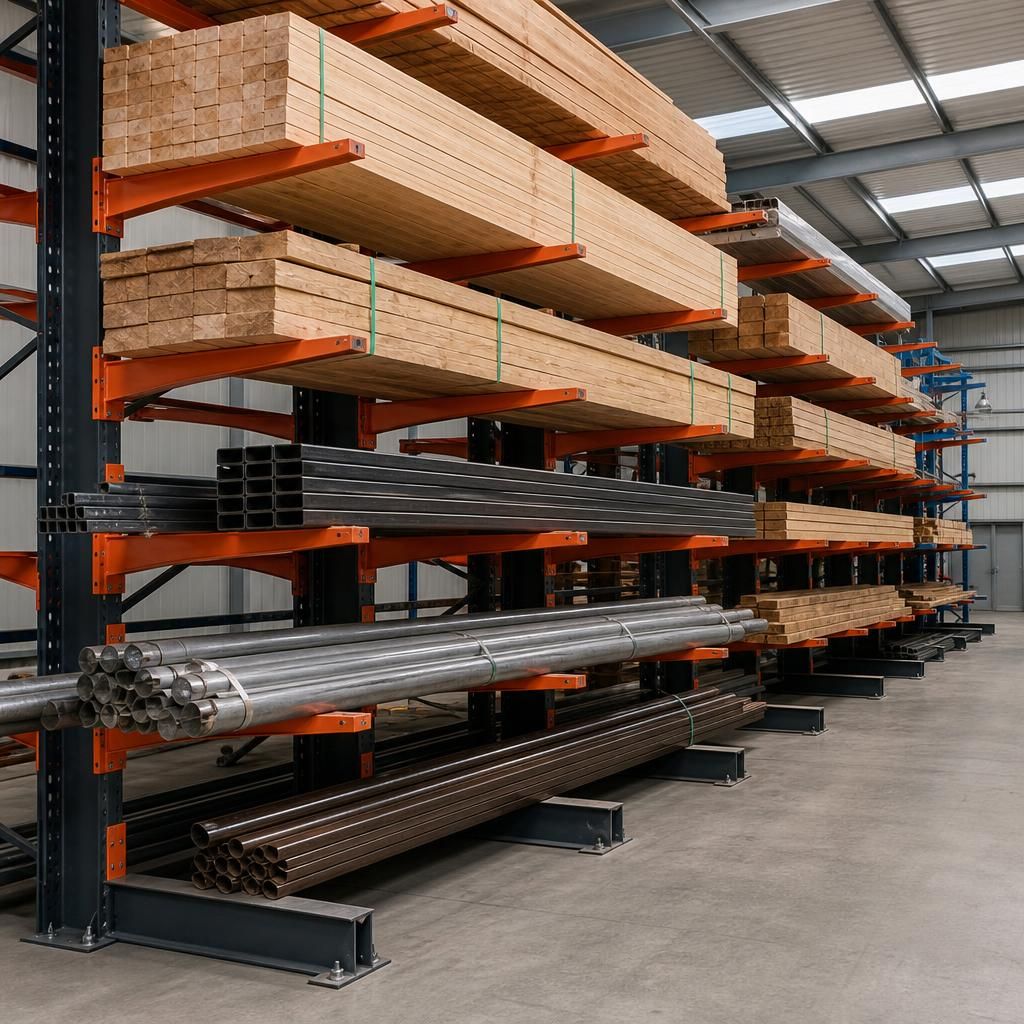
Cantilever warehouse racking systems manage different load types by matching the arm arrangement and supporting accessories to each product’s weight, shape and handling requirements. Long timber, dense steel sections, round pipes and flexible boards place different demands on the structure, so they should not be stored using the same assumptions about support or stability.
Arm spacing, length and capacity determine how the load is distributed, while decking, cradles, separators and end stops can provide additional support or prevent movement. These accessories must be selected for the intended goods and do not automatically increase the system’s safe working load. The loading plan should also account for overhang, point loads, the product’s centre of gravity and the equipment used to place or remove it.
Load notices should reflect the actual configuration of the warehouse racking system, including its uprights, arms, bay spacing and accessories. If stored materials, arm positions or handling equipment change, the design should be reviewed by a competent professional before the system is used in its new arrangement.
Discuss Your Cantilever Warehouse Racking Load Requirements
Discuss your cantilever warehouse racking load requirements with Able Racking to confirm the appropriate configuration, supports and safe working loads for your stored materials. Our experienced team can assess your current or planned system and advise on suitable next steps.