
How does corner protection contribute to the durability of warehouse racking systems?
Corner protection helps preserve the durability of warehouse racking systems by absorbing or deflecting impacts from forklifts, pallet trucks and other handling equipment before they reach vulnerable upright frames. By reducing dents, distortion and coating damage, it helps limit corrosion, maintain structural performance and extend the serviceable life of the warehouse racking.
Corner protection contributes to the durability of warehouse racking systems by reducing the impact forces transferred to upright frames, baseplates and adjacent components. Protectors absorb, deflect or distribute contact from forklifts, pallet trucks and other handling equipment, helping to prevent dents, distortion, coating damage and loosening around the base of the frame.
Upright frames are particularly vulnerable near aisle ends, intersections and loading areas where vehicle movements are frequent. Even a relatively minor impact can damage the protective coating or deform the steel. Repeated contact may then affect the alignment and stability of the structure, especially if damage is not identified and assessed promptly. A correctly selected corner protector provides a physical barrier between the equipment and the warehouse racking, reducing the likelihood of this damage occurring.
How corner protection preserves warehouse racking
- Absorbing impact energy: Heavy-duty guards can take the initial force of a collision, reducing the load transmitted to the upright.
- Deflecting vehicles and loads: Angled or shaped protection can guide handling equipment away from vulnerable frame sections rather than allowing direct contact.
- Protecting the surface finish: Preventing scrapes and deep impact marks helps preserve the protective coating and reduces the risk of corrosion developing.
- Reducing repeated minor damage: Protection limits the cumulative effect of routine contact, which can otherwise weaken or distort components over time.
- Protecting base areas: Guards positioned around the lower part of an upright help shield the connection between the frame and the floor, including the baseplate and fixings.
Corner protection is most effective when it is installed at locations with a predictable risk of impact. Common positions include aisle ends, rack runs beside vehicle routes, corners near loading and unloading areas, and points where traffic changes direction. The required design depends on the type of handling equipment in use, available clearance, traffic patterns, floor conditions and the dimensions of the warehouse racking.
Choosing suitable protection
Protection should be strong enough for the foreseeable impact risk and positioned so that it does not create a new obstruction. Steel guards, polymer barriers and other purpose-designed systems may be suitable in different environments. The choice should take account of impact resistance, fixing method, visibility, clearance for loads and compatibility with the existing warehouse racking layout.
A guard should not be treated as a substitute for safe operating practices or an assessment of damaged components. If a protector is loose, cracked, displaced or itself showing substantial impact damage, it may no longer provide the intended level of protection. Its condition should be checked during routine warehouse racking inspections and after any significant collision.
Installation and maintenance considerations
Correct installation is essential to long-term performance. Protection must be securely fixed to a suitable surface without interfering with baseplates, anchors, access routes or the operation of the storage system. It should also remain visible to equipment operators and be kept clear of pallets, packaging and stored materials.
During an inspection, the surrounding upright should be examined as well as the protector. Signs requiring further assessment may include bent steel, cracked welds, displaced beams, damaged anchors, excessive coating loss or changes in the alignment of the warehouse racking. A protector can hide damage if it is not removed or inspected appropriately, so repairs should be based on the condition of the underlying structure rather than the appearance of the guard alone.
Corner protection and service life
By preventing avoidable impact damage, corner protection helps warehouse racking retain its intended geometry and load-supporting performance for longer. It can also reduce the frequency of repairs and disruption caused by damaged uprights. However, it does not increase the approved load capacity of a system, correct poor installation or make damaged components safe to use. Any impact that may have affected structural steel should be reported, isolated where necessary and assessed by a competent person.
The most durable approach combines suitable corner protection with clear traffic controls, operator awareness, regular inspections and prompt repair of damage. Reviewing the position and condition of the protection after changes to vehicle routes, storage layouts or handling equipment helps ensure it continues to address the actual risks in the warehouse.
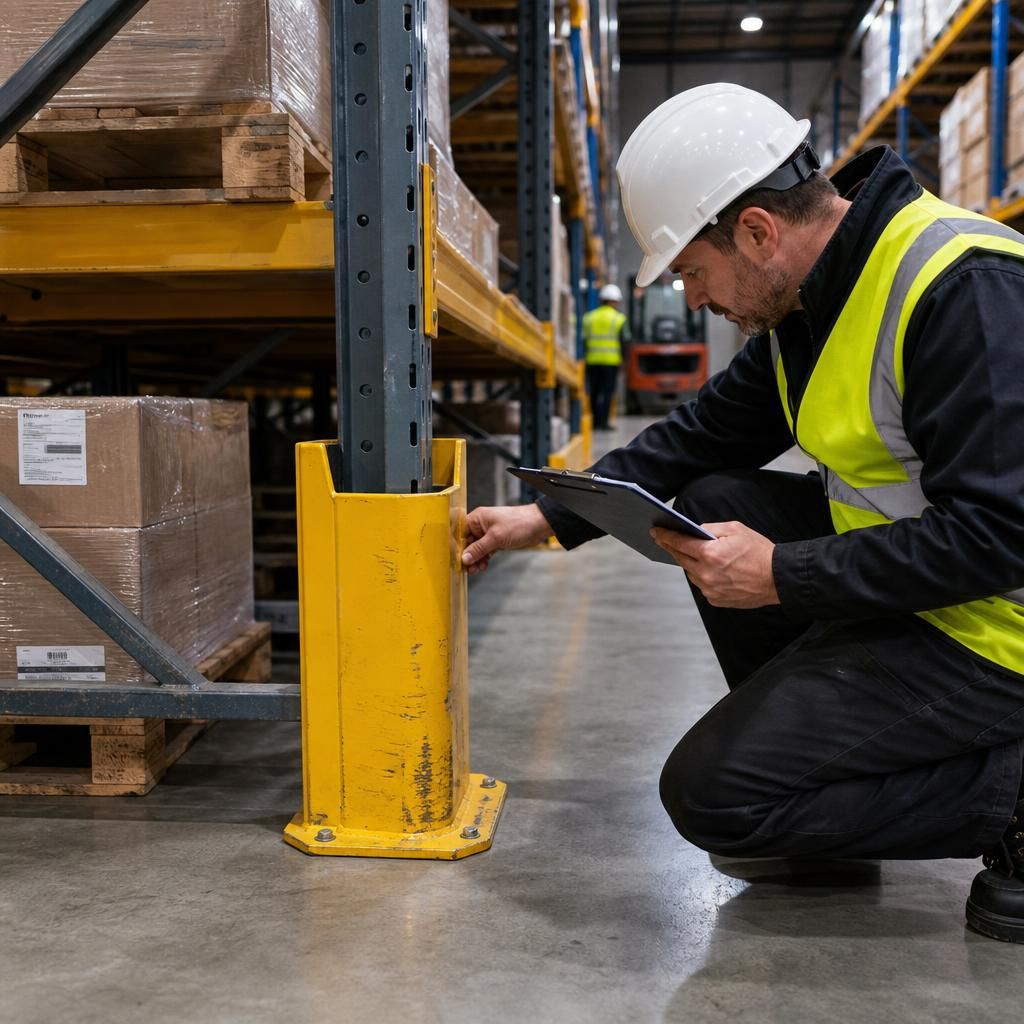
Corner protection improves the durability of warehouse racking by absorbing or deflecting impacts before they reach the upright frame, baseplate or floor fixings. It is particularly valuable at aisle ends, vehicle routes, loading areas and other locations where handling equipment regularly changes direction.
Effective protection must be suitable for the likely impact risk and securely installed without reducing access or interfering with pallets. Its position should provide clear visibility for operators while maintaining sufficient clearance for loads and handling equipment. Steel guards, polymer barriers and other purpose-designed solutions may be appropriate depending on the warehouse layout and traffic conditions.
Protection should also be checked during warehouse racking inspections and after any collision. A loose, cracked or displaced guard may no longer provide adequate protection, while damage behind it can include bent steel, coating loss, damaged anchors or changes in frame alignment. Inspecting both the guard and the underlying warehouse racking ensures that repairs are based on the condition of the structure, helping to preserve safe performance and extend its serviceable life.
Arrange an expert warehouse racking protection assessment
Arrange an expert warehouse racking protection assessment to identify vulnerable areas, check existing guards and confirm whether your system needs repairs or improved impact protection.