
What are the key features to look for in high-quality warehouse racking safety guards?
High-quality warehouse racking safety guards provide robust impact protection, fit securely, and remain effective in demanding warehouse conditions. Look for durable materials, suitable dimensions, clear visibility, straightforward installation, and a design that can be inspected and maintained easily.
High-quality warehouse racking safety guards are protective systems designed to absorb or deflect impact and reduce damage to uprights, frames and other vulnerable parts of a storage system. The most important features are suitable impact resistance, a secure fit, compatibility with the warehouse racking design, clear visibility, straightforward installation and easy inspection. The guard should protect the warehouse racking without creating new risks for people, vehicles or stored goods.
Robust impact protection
A safety guard must be capable of dealing with the types of impact likely to occur in its location. Forklift trucks, pallet trucks and other handling equipment can strike warehouse racking at different heights and angles, so protection should be selected according to the vehicle movements, aisle layout and operating conditions. A high-quality guard absorbs, spreads or redirects impact rather than transferring excessive force directly into the racking upright or frame.
Protection should also retain its intended position after an impact. A guard that cracks, becomes detached or distorts in a way that exposes the upright may no longer provide effective protection. Where a significant collision occurs, the guard and the affected warehouse racking should be assessed, even if there is no obvious damage from a distance.
Durable construction and suitable materials
The material should be appropriate for the level of risk and the environment. Steel protection can provide substantial resistance in demanding areas, while engineered polymers and other impact-resistant materials may offer useful flexibility, corrosion resistance and lower maintenance requirements. The best choice depends on the design of the guard, not simply on the material name.
Construction quality is also important. Look for consistent wall thickness, secure fixings, smooth edges and a finish that will withstand regular contact, cleaning and general warehouse use. In wet, cold, dusty or chemically exposed areas, the guard should have suitable resistance to corrosion and degradation. The product specification should make clear the conditions for which it is intended.
Correct fit and compatibility
A guard must match the dimensions, shape and profile of the warehouse racking it protects. It should sit securely around or alongside the upright without obstructing beams, connectors, baseplates, pallets or safety equipment. Poorly fitted protection can move during normal operations, catch on loads or leave vulnerable areas exposed.
Compatibility should be checked for the particular frame design and installation position rather than assumed from a general product description. Where protection is being added to an existing system, the installer should consider clearances, floor conditions, fixing points and the effect on access for inspections and maintenance. Guards should never be used to conceal damage or as a substitute for repairing a distorted upright or other structural component.
Secure installation
Effective protection depends on correct installation. Depending on the design, the guard may be fixed to the floor, attached to the upright or installed as part of a wider barrier arrangement. Fixings must be suitable for the substrate and installed in accordance with the manufacturer’s instructions. The finished installation should be stable, aligned and free from sharp projections.
Installation should not compromise the warehouse racking. Unauthorised drilling, welding or alteration of structural members can affect the integrity of the system and may invalidate design assumptions. A competent installer will confirm the proposed arrangement, follow the appropriate method and record any relevant changes for future inspection.
Clear visibility and hazard awareness
Good guards are visible to vehicle operators and pedestrians. Contrasting colours, reflective details or high-visibility markings can help identify the edge of the warehouse racking and the available clearance, particularly at aisle ends, corners and vehicle turning points. Visibility should support safe driving without creating glare or obscuring labels, load notices and inspection markings.
Visibility alone does not prevent impact. Guarding should be combined with sensible traffic routes, suitable aisle clearances, speed control, housekeeping and operator training. Where a location remains difficult to see, additional measures such as barriers, warning signs or changes to the traffic arrangement may be appropriate.
Coverage of vulnerable areas
The guard should protect the part of the warehouse racking most likely to be struck. This commonly includes front uprights at floor level, aisle ends, exposed corners and areas beside loading or picking routes. In some layouts, a single upright protector is not enough; a continuous barrier or end-of-aisle protection may be needed to prevent vehicles from reaching the frame.
Protection should be planned across the whole risk area rather than installed only where damage has already occurred. The assessment should consider vehicle direction, turning movements, pallet overhang, pedestrian access and the position of adjacent storage equipment.
Easy inspection and maintenance
A high-quality guard allows inspectors and warehouse staff to identify damage, looseness, displacement and wear without unnecessary dismantling. Its condition should be visible during routine checks, and its design should not prevent access to the warehouse racking upright, baseplate, floor fixings or warning labels.
Protectors should be included in the site’s inspection and maintenance arrangements. Check for cracks, splits, crushing, distortion, loose fixings, corrosion and movement. Impact-damaged protection may need replacement rather than repair, particularly where its performance depends on its original shape or material properties. Any damage to the warehouse racking itself should be assessed by a suitably competent person.
Appropriate clearances and safe operation
The guard should provide protection while preserving the clearances needed for safe handling. It must not reduce the space required for vehicle travel, pallet placement, load retrieval or pedestrian movement. It should also avoid creating trip points, snagging points or projections that could injure people or damage pallets.
Before installation, consider the largest loads and handling equipment used in the area, not just normal conditions. A guard that is too small may leave the upright exposed, while one that is poorly positioned may interfere with operations and encourage staff to work around it.
Traceable product information
Reliable safety guards should be supplied with clear information about their intended use, installation method, limitations and inspection requirements. Product identification makes it easier to order compatible replacements and confirm what has been installed in each area. Installation records, inspection findings and photographs can also help track recurring impact locations and support preventative action.
Where protection forms part of the warehouse racking safety arrangements, it should be considered alongside the system’s load notices, damage reporting procedure and planned inspections. Relevant guidance and the manufacturer’s instructions should be followed, with site-specific risks taken into account.
How to assess the right guard
- Identify the warehouse racking components and locations exposed to vehicle impact.
- Review the types of handling equipment, loads and traffic movements in the area.
- Confirm that the guard’s dimensions, fixing method and impact performance suit the existing installation.
- Check that it will not obstruct pallets, access routes, labels, baseplates or inspection points.
- Specify suitable material and finish for the warehouse environment.
- Use competent installation and record the completed arrangement.
- Include the guards in routine checks and replace protection that is no longer effective.
The strongest solution is therefore not simply the most substantial-looking guard. It is a correctly specified and securely installed product that matches the warehouse racking, the site’s handling activity and the likely impact risks. A warehouse racking safety assessment can confirm whether individual upright protection, end protection, barriers or a combination of measures is suitable for each location.
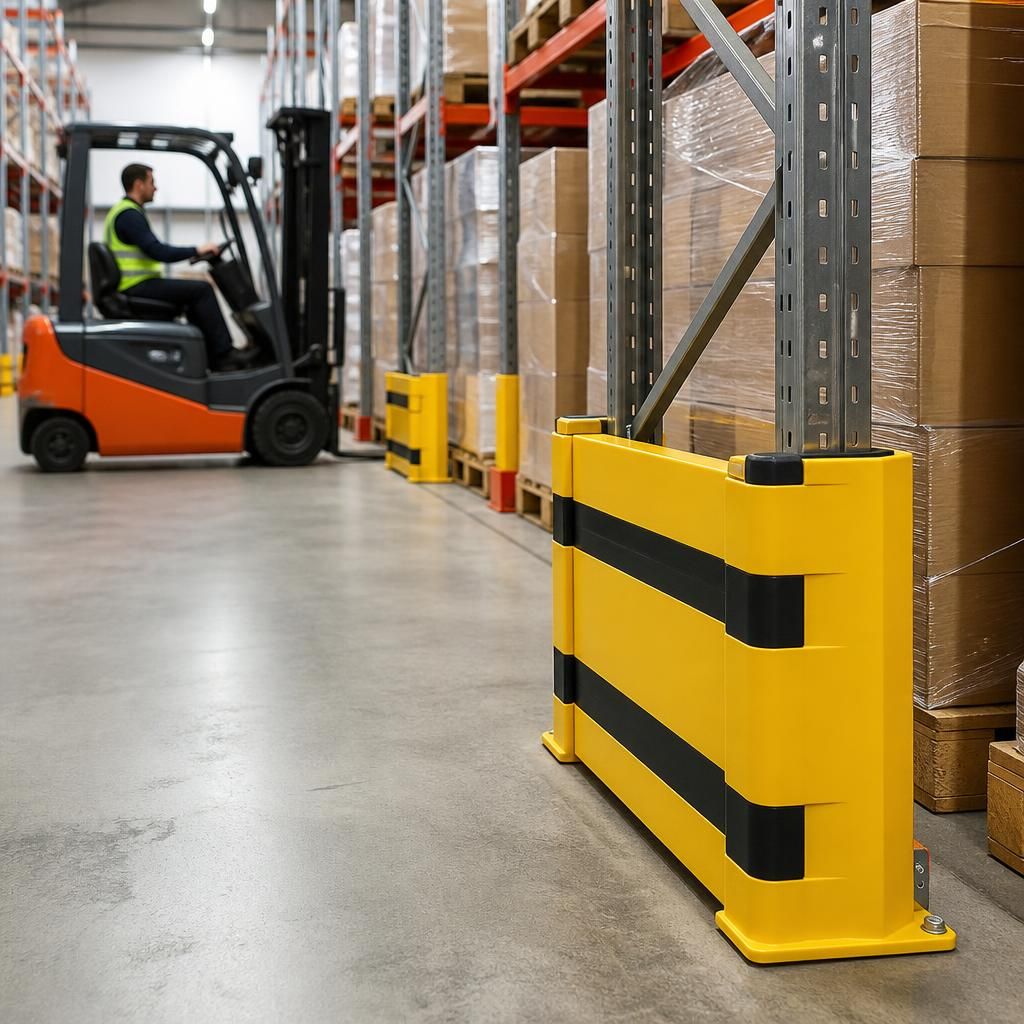
High-quality warehouse racking safety guards are designed to protect vulnerable uprights and frames from vehicle impact without obstructing normal warehouse operations. Their effectiveness depends on more than material strength: the guard must be correctly sized, securely installed and suitable for the location, handling equipment and likely impact direction.
A well-designed guard remains visible and accessible for inspection. High-visibility finishes help operators identify clearance points, while a secure fit prevents movement, snagging and exposed edges. The guard should also allow staff to check for cracks, distortion, loose fixings or displacement without unnecessary dismantling. Any impact damage should be assessed promptly, because a damaged guard may no longer protect the warehouse racking or could indicate damage to the structure behind it.
Arrange a Warehouse Racking Safety Guard Assessment
Arrange a warehouse racking safety guard assessment with Able Racking to confirm that your protection is correctly specified, securely installed and suitable for the risks in each area.