
How do Drive-In, Push-Back, and Pallet Flow racking systems enhance warehouse safety?
Drive-In, Push-Back and Pallet Flow racking systems enhance warehouse safety by providing controlled pallet movement, defined loading and unloading routes, and better stock organisation. When correctly designed, installed, used and routinely inspected, they help reduce collisions, unstable loads, blocked access points and damage to warehouse racking.
Drive-In, Push-Back and Pallet Flow warehouse racking systems enhance safety by controlling pallet movement, separating loading and retrieval activities, and making stock locations more predictable. Their safety benefits depend on suitable design, correct installation, competent operation, appropriate load selection and routine inspections. A well-organised system can reduce impact damage, unstable loads, blocked aisles and unsafe handling, but it does not remove the need for trained operators and ongoing maintenance.
Each system manages pallet movement differently, so the safety controls must reflect how it is used:
- Drive-In warehouse racking allows a forklift truck to enter storage lanes to place and retrieve pallets. It provides high-density storage, but requires disciplined vehicle operation because the truck works inside the structure and close to guide rails, uprights and support beams.
- Push-Back warehouse racking uses inclined rails or carts so pallets can be pushed towards the rear of a lane as new pallets are loaded. This limits the need for forklift trucks to enter the storage structure, although operators must control pallet speed and follow the correct loading sequence.
- Pallet Flow warehouse racking uses rollers or wheels to move pallets from the loading side towards the retrieval side. This creates defined loading and unloading faces and supports first-in, first-out stock rotation, provided pallets are compatible with the equipment and movement is properly controlled.
Controlled pallet movement reduces avoidable handling risks. Uncontrolled movement can cause pallets to collide, stop across an access point or become unstable during loading and retrieval. Push-Back and Pallet Flow systems use gravity-assisted movement, so the design should include suitable braking, speed control and end-of-lane protection. Operators should never attempt to stop a moving pallet by hand or enter a lane to correct a load while the system is in use.
Drive-In systems rely more heavily on careful forklift positioning. The truck must enter and leave lanes squarely, maintain a suitable speed and avoid contact with the structure. Guide rails, entry frames and lane supports can help the operator maintain alignment, but they are not intended to absorb repeated impacts. Clear operating instructions and adequate visibility are essential, particularly where lanes are deep or where the load restricts the driver’s view.
Defined loading and unloading routes improve workplace traffic safety. Pallet Flow systems generally create separate loading and retrieval faces, which can reduce opposing forklift movements at the same access point. Push-Back systems can also reduce vehicle travel within the storage area. Drive-In systems require specific controls for vehicle entry, reversing and pedestrian exclusion because forklifts operate within the storage lanes. Floor markings, barriers, one-way arrangements and suitable pedestrian routes should be considered as part of the overall warehouse design.
Storage systems should not be treated as a substitute for a suitable workplace transport risk assessment. Forklift routes, pedestrian crossings, charging areas, emergency exits and fire protection arrangements must work alongside the warehouse racking layout. Access points must remain clear, and loads should never project into travel routes or obstruct fire equipment and escape paths.
Correct load selection is central to safe operation. Pallets should be sound, stable and suitable for the chosen system. Damaged pallets, inconsistent pallet dimensions or loads with poor weight distribution can affect how pallets sit on rails, carts or support beams. In a Pallet Flow lane, an unsuitable pallet may fail to roll correctly. In a Push-Back lane, it may move unevenly or stop before reaching its intended position. In a Drive-In lane, it may be placed inaccurately or catch on the structure.
Load notices should state the permitted configuration and capacity for the installation. Operators should understand where pallets may be positioned, which levels are intended for particular loads and whether mixed pallet types are allowed. Capacity information must not be estimated from appearance or transferred from another warehouse racking installation. Any change to beam levels, pallet type, load weight or operating method should be reviewed before use.
Good stock organisation also supports safety. Consistent product allocation makes it easier to select the correct lane, follow the required rotation method and identify misplaced pallets. Drive-In storage is commonly suited to larger quantities of fewer stock lines, while Push-Back and Pallet Flow arrangements can provide more structured access to individual product groups. Clear location labels and an accurate inventory process reduce unnecessary searching, repositioning and repeated handling.
For Pallet Flow systems used on a first-in, first-out basis, loading and retrieval should take place from the designated faces. Introducing new stock at the retrieval end or removing pallets from the wrong side can defeat the intended stock sequence and create conflicting movements. Similar discipline is needed with Push-Back systems, where the loading sequence determines which pallet is presented for retrieval.
Routine inspections identify problems before they become serious hazards. Daily or pre-use checks should look for visibly damaged uprights, beams, rails, rollers, carts, bracing, guards and floor fixings. Operators should also report pallets that are leaning, damaged or out of position, along with unusual noise, restricted movement or pallets that do not travel as expected.
Formal warehouse racking inspections should be carried out by a suitably competent person at appropriate intervals and after significant events such as impact, alteration or relocation. The inspection should consider the structure, protective components, load signs, connections, floor condition and the way the installation is being used. Findings should be recorded, categorised and followed through to completion rather than treated as a standalone paperwork exercise.
Any damage that could affect structural integrity or safe pallet movement should be reported immediately. The affected location may need to be unloaded and taken out of service until it has been assessed. Repairs should use suitable components and follow the original design requirements; improvised straightening, welding or substitution can introduce further risks. Once repairs are completed, the area should be checked before being returned to operation.
Training turns a safe design into safe daily practice. Forklift operators and warehouse staff should understand the correct loading and unloading sequence, lane restrictions, pallet requirements, capacity limits and response to damage. They should also know that protective guards, guide rails and end stops are safety components, not features that permit careless contact. Refresher instruction is appropriate when equipment, layout, stock or working methods change, or when inspections identify repeated misuse.
For existing customers, the most useful review is often a combined assessment of the installation and its operating method. The inspection should ask whether the system still matches the loads being stored, whether vehicle routes remain suitable, whether stock rotation is being followed and whether damage patterns indicate a recurring problem. This practical approach helps distinguish an isolated incident from a design, training or maintenance issue.
In summary, Drive-In, Push-Back and Pallet Flow warehouse racking systems improve safety when they provide predictable pallet movement, controlled vehicle access and clear stock locations. Their performance depends on compatibility between the structure, pallets, handling equipment and operating procedures. Regular inspections, prompt repair of damage, competent installation and practical operator training are essential to keep the systems safe, compliant and efficient throughout their working life.
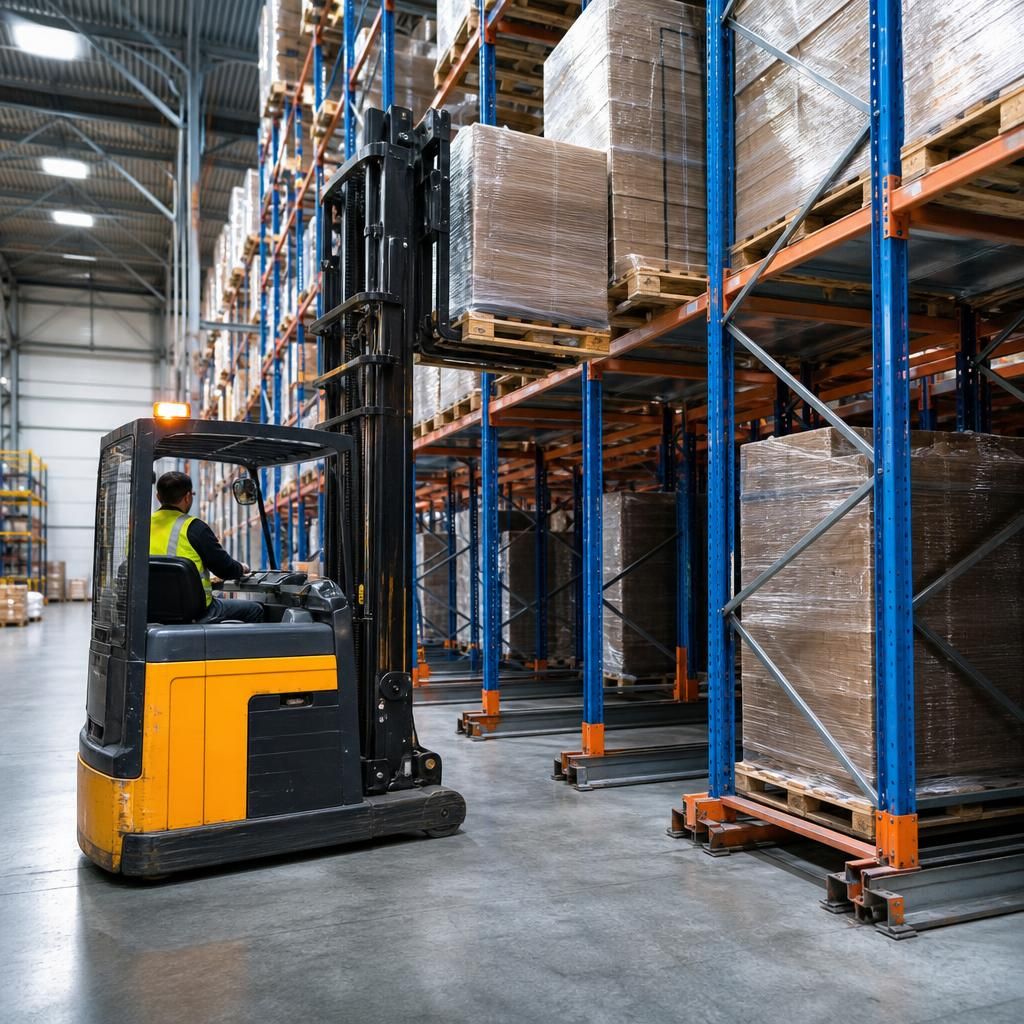
Routine inspections enhance the safety of Drive-In, Push-Back and Pallet Flow warehouse racking systems by identifying damage, movement problems and unsafe changes before they affect pallet stability or vehicle operations.
Checks should cover uprights, beams, rails, rollers, carts, guide components, guards, fixings, load notices and the surrounding floor. Operators should report impact damage, leaning pallets, unusual noise or restricted pallet movement immediately. Where damage could affect structural integrity or safe pallet travel, the affected location should be unloaded and taken out of use until it has been assessed and, where necessary, repaired by a competent person.
Arrange a safety inspection for your Drive-In, Push-Back or Pallet Flow racking
Arrange a safety inspection for your Drive-In, Push-Back or Pallet Flow warehouse racking to identify damage, movement issues and changes that may affect safe operation. Contact Able Racking to arrange a practical review by a competent inspector.