
What are the safety regulations and compliance standards for mezzanine lift systems in the UK?
Mezzanine lift systems in the UK must be suitable for their intended use, safely installed and operated under the Provision and Use of Work Equipment Regulations (PUWER), with the Lifting Operations and Lifting Equipment Regulations (LOLER) applying where the system lifts loads or people. Compliance also involves relevant machinery and building requirements, manufacturer instructions, safe working procedures, operator training and documented thorough examinations at suitable intervals.
In the UK, a mezzanine lift system must be suitably designed, installed, operated and maintained for its intended use. The main workplace requirements usually come from the Provision and Use of Work Equipment Regulations 1998 (PUWER) and, where the equipment lifts people or suspended loads, the Lifting Operations and Lifting Equipment Regulations 1998 (LOLER). Depending on the design, capacity and use of the system, machinery safety, building control, fire safety and workplace health and safety requirements may also apply.
Compliance is not established by a single certificate. It depends on the complete installation, including the lifting equipment, landing gates, guarding, controls, structural interfaces, operating procedures, training, inspections and maintenance arrangements. The employer or person responsible for the premises must be able to demonstrate that foreseeable risks have been assessed and controlled.
Provision and Use of Work Equipment Regulations
PUWER applies to work equipment used by employees and covers most lift systems used to move goods or people within a warehouse. The equipment must be:
- suitable for its intended purpose and the conditions in which it is used;
- installed and positioned so that it can be used safely;
- maintained in an efficient state, efficient working order and good repair;
- used only by people who have received suitable information, instruction and training;
- provided with suitable controls and isolation arrangements; and
- inspected where deterioration could create a significant risk.
PUWER also requires risks from moving parts, trapping points, falling loads, unauthorised access and unexpected movement to be controlled. Guards, barriers, interlocked landing gates, emergency stops and other protective devices must be appropriate to the design and operating environment. They must not be bypassed or left defective.
Inspections should be arranged after installation, after significant modification or relocation, following exceptional events such as impact or prolonged inactivity, and at suitable intervals during use. The interval should reflect the equipment, loading pattern, working environment and manufacturer’s instructions. Inspection findings and corrective actions should be recorded, with defects dealt with before the equipment is returned to service where they present a safety risk.
When LOLER applies
LOLER applies where a lift system is lifting equipment or accessories used at work. It is particularly relevant to goods lifts, platform lifts and systems designed to raise people or loads between levels. The equipment must be of adequate strength and stability, positioned and installed to minimise risk, and used in accordance with a planned lifting operation.
Under LOLER, lifting operations must be properly planned, appropriately supervised and carried out safely. The load, rated capacity, travel path, landing areas and access arrangements should all be considered. The system should not be overloaded, used to lift unsuitable loads or operated in a way that allows people to stand beneath suspended loads unless the equipment and procedure have been specifically designed for that purpose.
A competent person must carry out a thorough examination at suitable intervals. Unless a written examination scheme specifies otherwise, the commonly applied LOLER intervals are:
- at least every six months for equipment used to lift people and for lifting accessories; and
- at least every twelve months for other lifting equipment.
These are default intervals rather than a substitute for professional judgement. A competent person may recommend more frequent examinations where the system is heavily used, exposed to impact, operated in harsh conditions or subject to a higher level of risk. A thorough examination is separate from routine servicing and does not remove the need for daily or pre-use checks.
Following examination, the responsible person should receive a report identifying the equipment examined, any defects, required remedial action and the date by which action must be completed. Reports must be retained and acted upon. If a serious defect creates an immediate danger, the equipment should be taken out of use until it has been made safe.
Machinery safety and manufacturer documentation
A new lift system or substantially modified machine must be supplied with the documentation and conformity information required by the applicable machinery safety legislation. In Great Britain, this will generally involve the Supply of Machinery (Safety) Regulations 2008, as amended, with the applicable conformity marking, declaration and instructions supplied by the manufacturer or responsible supplier. The precise requirements depend on the type of equipment and when and where it was placed on the market.
The technical file, declaration of conformity, operating instructions, rated-load information and maintenance guidance should be available to the person responsible for the installation. Where a system has been altered, the party making the alteration must establish whether the change creates a new conformity assessment responsibility. Changes to controls, travel height, capacity, guarding or landing arrangements should never be treated as minor without a competent assessment.
The relevant British or European standard depends on the equipment design. Standards may cover lifting tables, goods lifts, access to landing areas, machinery controls, guarding and electrical safety. A standard can support a safe design, but using a standard alone does not replace a risk assessment or the legal duties imposed by PUWER and LOLER.
Building, structural and fire safety requirements
The lift system must be compatible with the supporting structure and the building. The installation should be reviewed for imposed loads, point loads, floor capacity, openings, impact protection, clearances and the effect of dynamic movement. Building control approval or other construction-related requirements may be relevant, particularly where the installation alters the structure, creates an opening through a floor or affects means of escape.
Fire safety must also be considered as part of the overall premises risk assessment. The lift opening, landing gates, compartmentation, fire-resisting construction, emergency access and escape routes should be assessed where applicable. The responsible person under the Regulatory Reform (Fire Safety) Order 2005 in England and Wales, or equivalent legislation elsewhere in the UK, must ensure that the arrangement does not compromise fire precautions or evacuation procedures.
Risk assessment and safe operating procedures
A task-specific risk assessment should address normal operation, foreseeable misuse, loading and unloading, access to each landing, pedestrian and vehicle movements, trapped or stranded persons, power failure, fire, equipment breakdown and maintenance activities. It should define who may operate the system, what loads may be carried, how loads must be positioned and when the equipment must be isolated.
Operating instructions should be available at the relevant locations and should match the actual installation. They should cover rated capacity, permitted loads, controls, landing-gate use, emergency stops, pre-use checks, reporting defects, emergency lowering or rescue arrangements and the action to take if a person becomes trapped. Where the equipment is not designed to carry people, that restriction must be clearly marked and enforced.
Operators and other relevant employees need suitable instruction and training. Training should include practical use of the controls, safe loading, exclusion zones, warning devices, defect reporting and emergency arrangements. Contractors carrying out servicing, examinations or repairs must also be competent for the equipment and task. Refresher training is appropriate when the system, procedure, workforce or risk changes.
Checks, maintenance and records
Routine checks should identify damaged landing gates, faulty interlocks, abnormal noise, hydraulic or mechanical leaks, worn components, damaged cables or chains, defective emergency stops and inaccurate or missing capacity signs. The frequency should be based on the manufacturer’s guidance and the findings of the risk assessment.
Keep an organised compliance file containing the risk assessment, operating procedures, training records, manufacturer instructions, conformity documentation, installation and commissioning information, maintenance records, inspection reports, LOLER thorough-examination reports and evidence that defects have been corrected. Records should be available to those managing the equipment and retained for an appropriate period under the organisation’s document-control arrangements.
Practical compliance review
- Identify exactly what the system lifts, its rated capacity, travel range and permitted users.
- Confirm that the design, installation and structural interfaces have been assessed by competent people.
- Determine whether PUWER, LOLER, machinery safety, building control and fire safety requirements apply.
- Check guarding, landing gates, interlocks, controls, emergency stops, signage and isolation points.
- Put in place a documented risk assessment, safe system of work and suitable operator training.
- Arrange routine checks, planned maintenance and thorough examinations at intervals justified by the equipment and its use.
- Record defects and prevent operation until safety-critical faults have been rectified and verified.
Because the correct requirements depend on the lift type and how it is used, a competent assessment should be completed whenever a system is installed, modified, relocated or brought back into service. Able Racking can help review the available documentation, identify inspection and examination requirements, and establish practical controls that support safe, compliant operation.
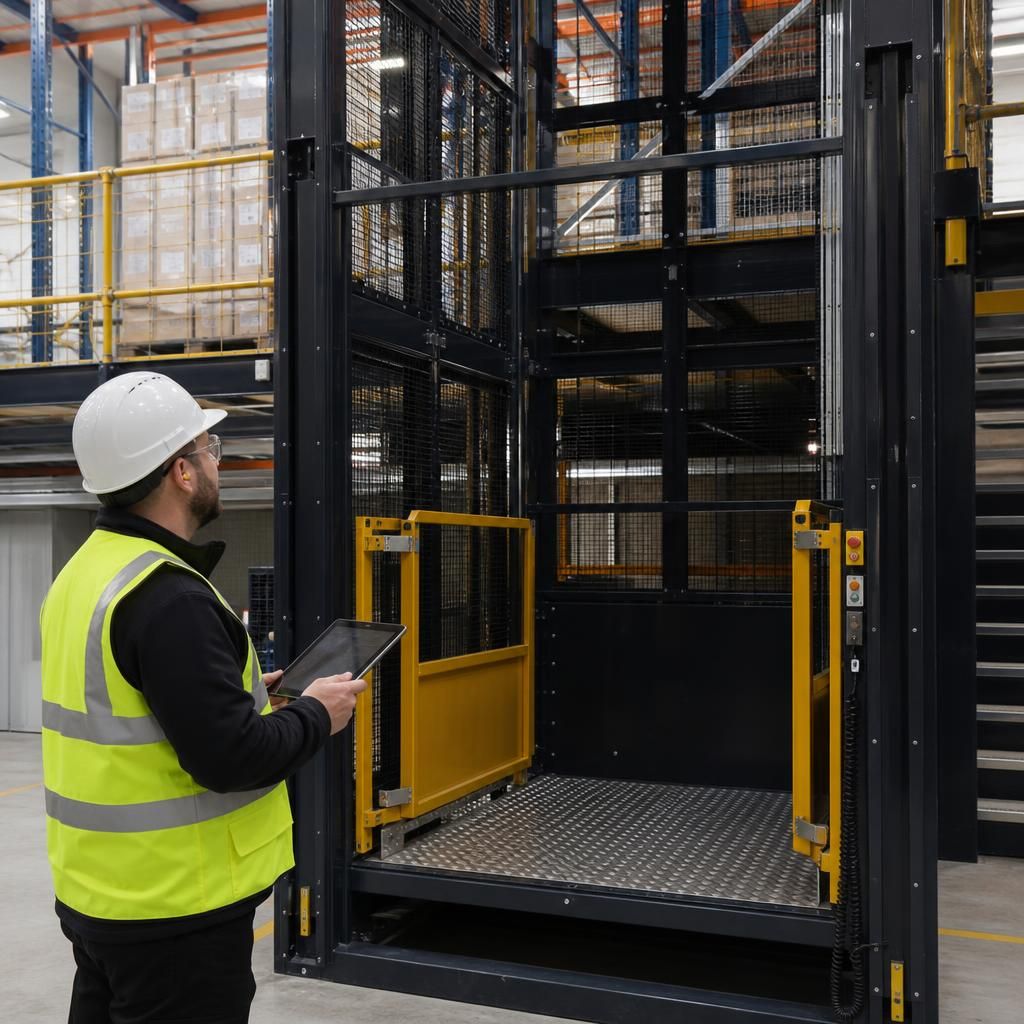
A thorough examination is a formal safety assessment of a mezzanine lift system carried out by a competent person. It checks whether the lifting equipment, landing gates, guarding, controls and safety devices remain safe for continued use, and is separate from routine servicing or maintenance.
The examination interval should reflect the equipment, how it is used, the working environment and any written examination scheme. A report should record the equipment inspected, defects found, required corrective action and the deadline for completing it. Any fault presenting an immediate danger should result in the system being withdrawn from use until repairs have been completed and its safe operation confirmed.
Review Your Mezzanine Lift Compliance
Arrange a practical review of your mezzanine lift system’s documentation, inspections and safety controls to identify any compliance actions. Contact Able Racking to discuss the next steps with an experienced specialist.