
What are the qualifications and experience of the professionals conducting the warehouse racking certification?
Warehouse racking certification should be conducted by competent professionals with recognised industry training, practical experience in warehouse racking inspections and a sound understanding of applicable safety guidance. Experienced inspectors can identify damage, installation defects, loading risks and compliance issues, then provide clear findings and suitable remedial recommendations based on the storage system and working environment.
Professionals conducting warehouse racking certification should have recognised training in storage equipment inspection, substantial practical experience and a detailed understanding of the safety requirements applying to warehouse racking. Competence is demonstrated not only by a certificate or course record, but also by the inspector’s ability to assess the condition, configuration, loading and use of a storage system accurately.
A suitably qualified inspector will normally have training covering:
- Warehouse racking inspection methods and the identification of damage, defects and unsafe conditions.
- Relevant British and European guidance, including BS EN 15635 and HSE guidance on the safe use of storage equipment.
- Load notices, permissible configurations, beam and frame capacities, and the effect of changes to the original system.
- Safe working practices, risk assessment and the control of hazards within active warehouse environments.
- Inspection reporting, defect classification, photographic evidence and the communication of corrective actions.
Practical experience is equally important. An experienced professional understands how warehouse racking is installed, loaded and used in day-to-day operations. They can distinguish between cosmetic damage and defects that may affect structural capacity, identify impact damage to frames and beams, recognise missing or incorrectly fitted components, and identify problems caused by overloading, poor housekeeping or unsuitable alterations.
The inspector should also be able to compare the installed system with available design information. This may include checking beam levels, frame layout, component compatibility, load signage, protection measures and any changes made since installation. Where drawings, manufacturer information or load data are unavailable, a competent inspector should explain the limitations of the assessment rather than make unsupported assumptions.
Warehouse racking certification is most reliable when the professional can combine an on-site inspection with a clear technical review. The inspection should cover the storage equipment, its immediate surroundings and the way it is operated. This helps identify risks such as vehicle impact, inadequate aisle clearance, unstable loads, unauthorised modifications and damage that has not been reported.
Professional competence should also include the ability to make proportionate recommendations. Not every observation requires the same response. A qualified inspector should classify findings according to their seriousness, explain whether affected areas need to be unloaded or isolated, and specify suitable actions such as monitoring, repair or replacement. Recommendations should be practical and should not compromise the original design or introduce incompatible components.
Experience with different warehouse environments is valuable because inspection conditions vary between businesses. A distribution warehouse, manufacturing site and cold-storage facility may present different loading patterns, traffic arrangements, environmental conditions and operational pressures. Inspectors who have worked across varied sites are better placed to understand how these factors affect warehouse racking safety.
Before appointing an inspection provider, businesses should check that the assigned professional:
- Has relevant inspection training and can provide evidence of competence.
- Has current knowledge of applicable guidance and inspection standards.
- Has practical experience with the type of warehouse racking being assessed.
- Uses a documented inspection method and records findings consistently.
- Can explain the seriousness of defects and the required timescale for action.
- Provides a clear report with photographs, locations, recommendations and any limitations.
- Understands the importance of impartial assessment and does not overlook defects because repair work may follow.
- Keeps knowledge current through refresher training, technical updates and continued site experience.
It is also important to distinguish between a formal qualification and general site experience. Someone who has worked around warehouse racking may recognise obvious damage, but that does not necessarily demonstrate the competence required to carry out a structured inspection or assess whether a defect affects safety. Conversely, a trained inspector should be able to apply their knowledge consistently, justify their findings and communicate them clearly to warehouse managers and responsible persons.
Following the inspection, the provider should issue documentation that identifies the inspected areas, records the findings and confirms any actions required. The document may be described as an inspection report, certification record or compliance document, depending on the provider’s process. Its value depends on the quality of the underlying inspection and the actions taken afterwards; a certificate does not make an unsafe system compliant if identified defects remain unresolved.
For ongoing compliance, businesses should retain inspection records, repair evidence, design information and load details, and should ensure that reported defects are closed out. A competent professional can also help establish suitable internal reporting arrangements, staff awareness and follow-up checks so that warehouse racking remains safe between formal inspections.
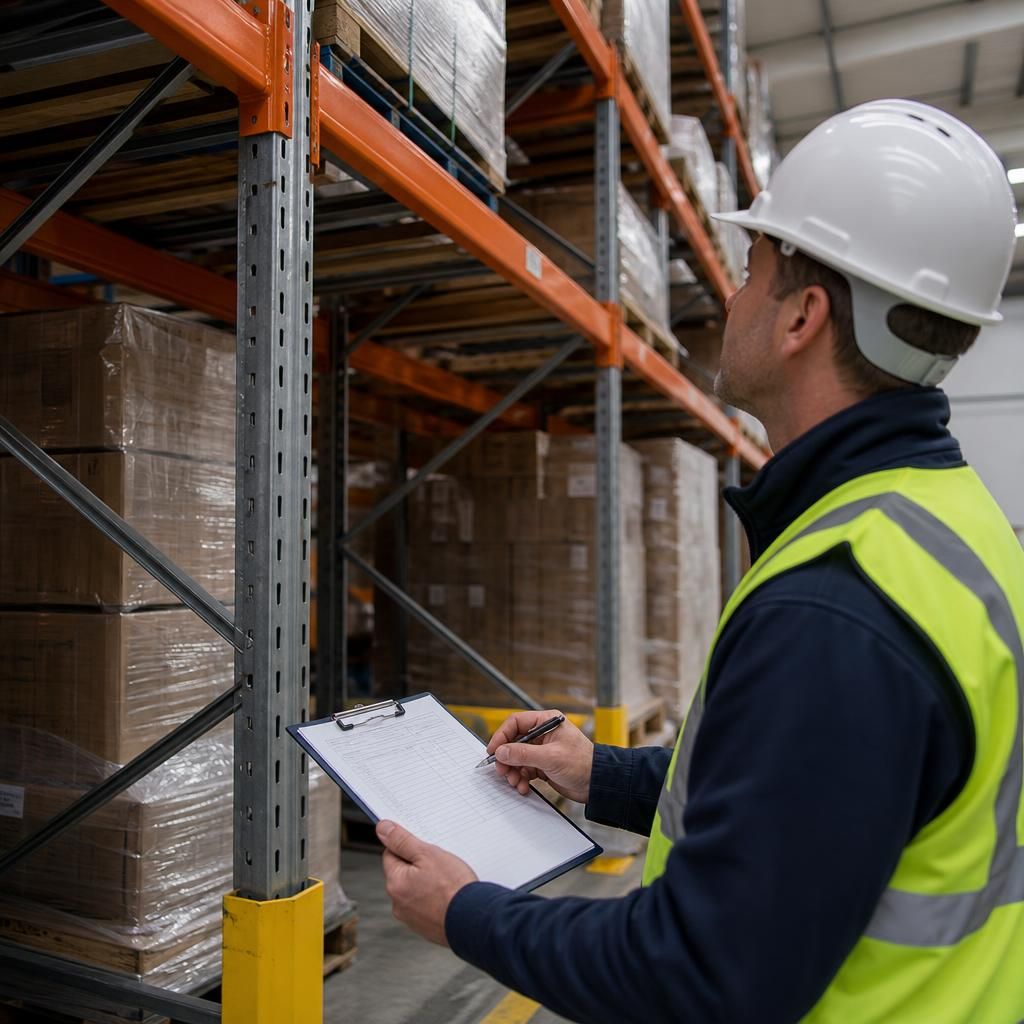
Reliable warehouse racking certification depends on both recognised inspection training and practical experience. A qualified professional must be able to assess damage, loading, component compatibility and how the system is used, rather than simply identify visible defects.
Experience helps the inspector distinguish cosmetic damage from faults that could affect structural capacity, recognise impact damage and unauthorised alterations, and judge whether an area requires immediate isolation, repair or continued monitoring. They should also explain their findings clearly, support them with appropriate evidence and state any limitations where design or load information is unavailable.
Arrange your warehouse racking certification with our qualified team
Arrange your warehouse racking certification with our qualified team and receive a clear, practical assessment of your storage system’s condition, safety and compliance.