
What are the most common repair techniques for warehouse racks, and how do they ensure compliance with safety standards?
Common warehouse rack repair techniques include carefully straightening or replacing damaged components, renewing fixings and guards, and isolating any unsafe section until repairs are completed. When selected following a competent inspection and carried out to the manufacturer’s specifications and applicable safety guidance, these repairs restore structural performance, reduce risk and support ongoing compliance.
The most common warehouse rack repair techniques are the replacement of damaged structural components, installation of approved repair sections, renewal of fixings and protection, and controlled isolation of unsafe areas. The correct method depends on the type, location and severity of the damage identified during a competent inspection. Repairs support compliance when they restore the system to its designed capacity, follow the manufacturer’s instructions and are checked before the repaired rack is returned to service.
Component replacement
Replacing a damaged component is often the safest and most reliable repair method. Uprights, beams, horizontal braces, diagonal braces, safety pins and other load-bearing parts may be replaced where they are bent, split, heavily distorted or otherwise unable to perform as intended. Replacement parts should be compatible with the existing warehouse racking system and installed using the correct connection details, fasteners and tolerances.
A damaged upright or beam should not be treated as a cosmetic issue. These components transfer loads through the structure, so an apparently local defect can affect the stability of the complete rack bay or run. The replacement decision should therefore consider connected frames, beam levels, floor fixings and the loads being stored.
Approved repair sections and bolted reinforcement
Where a complete component replacement is not necessary, an approved repair section may be fitted around or alongside the damaged area. These systems typically use purpose-designed steel sections, plates, brackets and bolts to restore the member’s capacity and protect the affected zone. They must be selected for the specific profile and damage, then installed in accordance with the repair system’s technical instructions.
Reinforcement is not a general-purpose solution for every defect. Drilling additional holes, welding plates or fitting improvised steelwork can weaken the original component, alter its behaviour or invalidate the manufacturer’s design assumptions. Any repair that changes the load path should be assessed by a suitably competent person before work begins.
Replacement of fixings and connection parts
Loose, missing or damaged bolts, nuts, locking devices, safety pins and beam connectors can reduce the security of a warehouse racking installation. Repair work may involve replacing the affected fixings with the specified parts, tightening them to the appropriate requirement and checking that beams are correctly seated and retained.
Connections should also be examined for elongated holes, cracked welds, damaged locking mechanisms and movement under load. Simply tightening a loose fixing does not correct a distorted connection or a damaged supporting member. The cause of the defect must be identified and addressed.
Repair or replacement of protection equipment
End-of-aisle guards, upright protectors, leg guards and other impact protection help prevent further damage from handling equipment. Bent or displaced protection should be repaired or replaced, and its fixings checked. Protection should be positioned so that it safeguards the rack without interfering with access, load placement or the operation of the warehouse.
Protection equipment does not make a structurally damaged upright safe by itself. If an impact has reached the rack member, the member must be assessed separately and repaired or replaced where required.
Controlled straightening and removal of distortion
Cold-straightening or site correction of damaged cold-formed steel is not normally an acceptable substitute for an approved repair. Applying heat, force or welding without a documented engineering method can change the steel’s properties, coating and load capacity. In limited circumstances, a manufacturer or suitably qualified engineer may specify a controlled method, but this should not be improvised by the repair team.
Where distortion is significant, component replacement or an approved repair section is generally more dependable than attempting to return the original part to its former shape.
Isolation and temporary controls
Before repair work starts, unsafe bays or affected areas should be clearly identified and taken out of use where necessary. This may require removing stock, preventing access, reducing loads or isolating an entire run until the defect has been assessed. Temporary controls remain in place until the competent person confirms that the repair is complete and the rack can safely carry its intended loads.
How the techniques support compliance
Compliance is achieved through the complete repair process rather than through a particular product or technique. A competent inspection should record the damage, establish its severity and determine whether immediate action is required. The repair should then be designed or selected for the rack profile, loading arrangement and manufacturer’s requirements.
- Work should be carried out by trained and experienced operatives who understand warehouse racking systems.
- Replacement parts and repair kits should be suitable for the installation and fitted in line with technical instructions.
- Loads, bay configurations and safety clearances should be checked against the available design information.
- Relevant guidance, including HSE guidance for pallet storage and the principles of BS EN 15635, should be considered where applicable.
- The completed work should be inspected, documented and clearly communicated to warehouse staff.
- Load notices, protection and housekeeping controls should be reinstated or updated before normal use resumes.
A post-repair check is essential. It confirms that components and fixings have been installed correctly, that the structure is stable and that no related damage has been overlooked. Inspection records should identify the affected location, work completed, parts used, any restrictions and the person who authorised the return to service.
Regular warehouse racking inspections remain necessary after a repair. New impacts, overloading, altered operating practices or changes to the storage configuration can create fresh risks. Prompt reporting of damage, clear defect procedures and planned maintenance help preserve the repaired system’s performance and reduce disruption to warehouse operations.
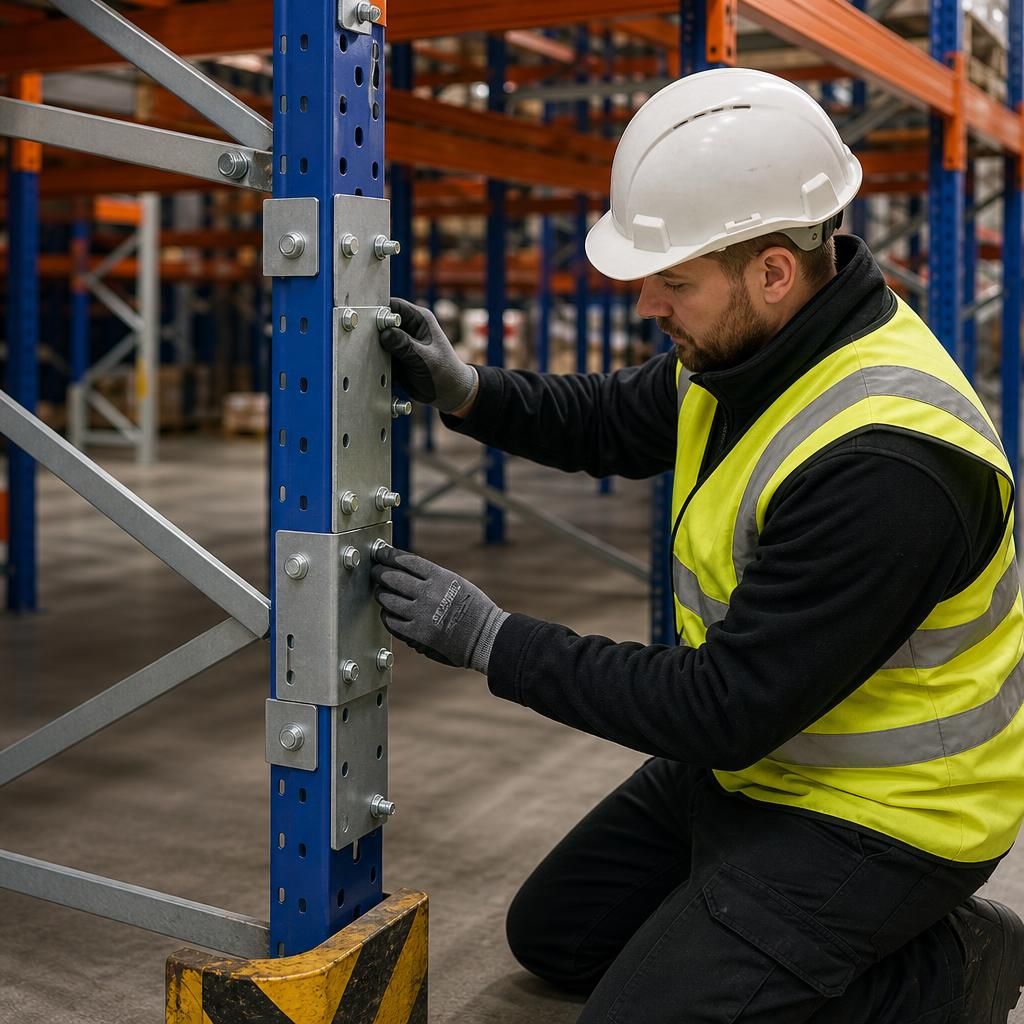
Approved repair sections can restore a damaged warehouse rack component without replacing the entire member, but they must be selected for the exact profile and defect. Purpose-designed steel sections, plates, brackets and bolts are fitted to the manufacturer’s technical instructions so the repaired area can transfer loads safely. Improvised welding, drilling or straightening may alter the component’s strength and should not be used without a documented engineering assessment. After installation, a competent person should check the repair, confirm that fixings and clearances are correct, and authorise the affected bay for return to service.
Book Your Warehouse Rack Repair Assessment
Contact Able Racking to arrange a warehouse rack repair assessment. Our experienced technicians can inspect the damage, recommend an appropriate repair technique and help confirm the system is safe to return to service.