
What qualifications should a warehouse racking inspector have to ensure compliance and safety?
A warehouse racking inspector should be a demonstrably competent person with relevant training, practical experience and a thorough understanding of warehouse racking systems, applicable legislation and HSE guidance. They should also be able to identify damage and unsafe conditions accurately, assess risk objectively, and produce clear inspection reports with appropriate recommendations; formal schemes such as SEMA-approved training can provide additional assurance.
A warehouse racking inspector should be a demonstrably competent person with relevant inspection training, practical experience and a detailed understanding of warehouse racking systems, applicable legislation and HSE guidance. They must be able to recognise damage and unsafe conditions, assess the associated risk objectively, recommend suitable control measures and produce a clear inspection report that can support corrective action.
There is not one universal statutory qualification that automatically makes someone competent to inspect every type of warehouse racking. Competence is assessed by considering the inspector’s knowledge, training, practical experience and ability to apply that knowledge to the particular storage systems and working environment. Formal qualifications and recognised industry training provide useful evidence of competence, but they should be supported by relevant site experience.
When appointing an inspector, the following qualifications and capabilities are especially important.
- Recognised warehouse racking inspection training: The inspector should have completed structured training covering the inspection of pallet racking and other warehouse racking systems. SEMA-approved training, including the SEMA Approved Racking Inspector route where appropriate, is widely recognised as useful evidence that the person has been trained in established inspection principles.
- Knowledge of applicable guidance and standards: The inspector should understand the relevant requirements of the Health and Safety at Work etc. Act, the Provision and Use of Work Equipment Regulations, HSE guidance such as HSG76, and applicable European or British standards, including EN 15635 where relevant. They should understand how these sources affect inspection, use, maintenance and reporting.
- Practical warehouse experience: Classroom training alone is not enough. An experienced inspector should understand how warehouse racking is loaded, operated and affected by forklift movements, site traffic, alterations, poor housekeeping and changes in use. Practical experience helps them distinguish normal wear from damage that could affect structural integrity.
- Technical understanding of racking components: The inspector should be able to identify the principal components of the system, including frames, uprights, beams, bracing, safety locks, column guards, ties, baseplates and floor fixings. They should also understand the importance of load notices, compatible components and any restrictions set by the original design.
- Ability to classify damage and risk: A competent inspector should recognise bent or distorted uprights and beams, missing or displaced safety devices, damaged bracing, loose or missing fixings, impact damage, corrosion, overloading and signs of instability. They should assess the severity and location of the defect rather than simply recording that damage exists.
- Understanding of corrective action: The inspector should know when a defect requires immediate isolation or unloading, when temporary controls may be appropriate and when a repair or replacement must be completed by a suitably qualified specialist. They should not recommend improvised repairs or authorise continued use where safety cannot be demonstrated.
- Accurate reporting and communication: Inspection findings should be recorded in a clear, traceable report. The inspector should be able to identify the affected location, describe the defect, provide photographs where useful, explain its significance and set out practical recommendations. They should also communicate urgent findings promptly to the responsible person on site.
A suitable inspector should also understand the limits of their role. A visual safety inspection is not necessarily a structural design assessment, a load-capacity verification or an approval of unauthorised alterations. If the inspection identifies a change to the original configuration, unusual loading, significant impact or uncertainty about the system’s design, the matter may need to be referred to the original supplier, a suitably qualified designer or another technical specialist.
Independence is another important consideration. The inspector should assess the warehouse racking objectively and should not overlook damage because the system is in regular use or because repairs are inconvenient. Where the inspector’s organisation also carries out repairs, the inspection report should still distinguish clearly between observed facts, risk classifications and proposed remedial work. This makes the findings easier to review and supports informed decisions by the duty holder.
Before an inspection takes place, ask for evidence of the inspector’s relevant training, experience and competence. It is reasonable to request details of recognised inspection qualifications, the types of warehouse racking inspected, familiarity with the applicable guidance, professional indemnity or public liability arrangements and examples of the reporting process. A reputable provider should be able to explain how inspectors are trained, supervised and kept up to date.
The inspector should also obtain relevant information before starting work. This may include layout drawings, load notices, manufacturer information, records of previous inspections, details of repairs and information about any alterations or changes in loading. This background does not replace a physical inspection, but it helps the inspector compare the installed system with its intended configuration.
In practice, the strongest assurance comes from combining recognised training with substantial hands-on experience, sound knowledge of warehouse operations and a disciplined reporting process. A qualification is an important indicator, but the inspector must be able to apply it consistently on site and provide recommendations that are technically justified, proportionate to the risk and clear enough for the responsible person to act on.
For continued compliance, inspection records should be retained alongside evidence that reported defects have been isolated, repaired or otherwise closed out. The responsible person should also confirm that any repair has been completed by a competent party and that the warehouse racking is safe to return to service. This turns the inspection from a paperwork exercise into an effective part of the warehouse’s safety management system.
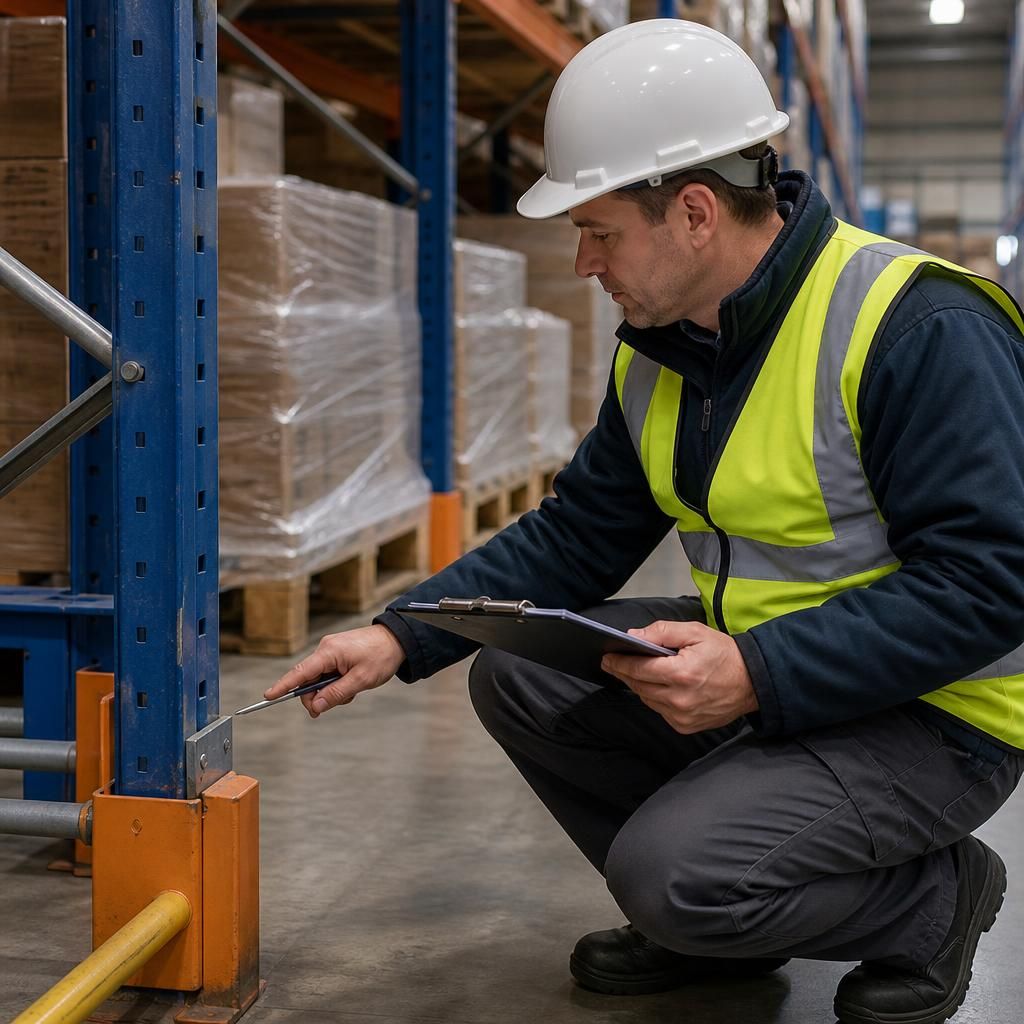
A qualified warehouse racking inspector needs more than classroom training. They should have recognised inspection training, practical experience with warehouse racking systems and a sound understanding of relevant health and safety guidance. This combination enables them to distinguish minor cosmetic damage from defects that may affect structural stability or safe operation.
Training should cover component identification, damage classification, risk assessment and inspection reporting. Practical experience is equally important because site conditions such as forklift impacts, altered layouts, missing safety devices, overloading and poor housekeeping can change the risk presented by a defect. Ask your inspector to provide evidence of relevant training, experience and a clear process for reporting urgent findings and confirming corrective action.
Speak to our qualified warehouse racking inspectors
Speak to our qualified warehouse racking inspectors for practical advice or to arrange a thorough inspection of your storage systems. We can help identify risks, clarify the required corrective action and support ongoing compliance.