
What are the main features of drive-through warehouse racking systems?
Drive-through warehouse racking systems provide high-density pallet storage in lanes that forklifts can access from both ends, allowing goods to be loaded from one side and retrieved from the other. Their main features include adjustable pallet support rails, guided forklift access, efficient use of warehouse space and stock rotation that supports a first-in, first-out (FIFO) approach.
Drive-through warehouse racking systems are high-density pallet storage systems with continuous lanes that forklifts can enter from both ends. Their defining features are pallet support rails within each lane, open access at both ends and a layout that can support first-in, first-out (FIFO) stock rotation when loading and retrieval are controlled correctly.
Two-sided forklift access
Unlike a closed-ended drive-in arrangement, a drive-through system allows forklift trucks to enter at one end and leave through the other. This through-access supports separate loading and unloading points, which can make stock movement more predictable and reduce the need for forklifts to reverse out of storage lanes.
The layout is particularly useful where goods need to move continuously through the warehouse. One face can be used for replenishment while the opposite face is used for order picking or despatch. The exact traffic arrangement should be planned around the warehouse’s forklift types, aisle widths, pallet dimensions and operating procedures.
Deep storage lanes
Each lane stores pallets in depth rather than placing every pallet directly beside a conventional access aisle. This reduces the amount of aisle space required and increases the number of pallet positions that can be created within a given floor area.
Storage density depends on the available building height, lane depth, pallet profile, load requirements, forklift specification and the clearances needed for safe operation. A high-density layout is not automatically the most suitable layout if the goods require frequent individual access or if the available handling equipment cannot operate safely within the lanes.
Adjustable pallet support rails
Horizontal support rails carry the pallets inside each storage lane. These rails are fixed to the upright frames at planned levels and can generally be adjusted to suit the pallet height, load characteristics and required storage configuration.
Correct rail positioning is essential. Pallets must be properly supported, with suitable clearances between the load, the rails and the surrounding structure. Damaged, incompatible or poorly positioned pallets can affect stability and increase the risk of contact with the warehouse racking.
Structural frames and bracing
Upright frames, horizontal beams or rails, bracing members, baseplates and fixings form the load-bearing structure. These components transfer the stored load and operational forces into the floor and must be selected for the intended configuration.
The design also needs to account for the forces created when forklift trucks enter, position loads and travel through the lanes. The structure should be installed on a suitable floor, properly anchored where required and protected against foreseeable impact in accordance with the design and applicable safety requirements.
Guided forklift operation
Drive-through warehouse racking is designed around forklift access within the storage lanes. Guide rails, entry guides, upright protection and clearly defined operating clearances can help drivers position pallets accurately and minimise contact with the structure.
Forklift suitability is an important feature of the overall system rather than a separate consideration. The truck’s lift height, turning characteristics, mast arrangement, load dimensions and visibility all affect whether it can use the lanes safely. Operators should follow the system’s working procedures and avoid entering a lane that is obstructed, damaged or occupied in a way that prevents safe movement.
Support for FIFO stock rotation
Access from both ends makes it possible to load pallets at one end and retrieve them from the other. When the warehouse follows that process consistently, older stock can be removed first and newer stock can be replenished behind it.
FIFO is not guaranteed simply by installing drive-through warehouse racking. It relies on suitable stock identification, disciplined loading and retrieval procedures, accurate inventory control and clear separation of inbound and outbound movements. Where stock rotation is less important and maximum density is the priority, a different operating method may be appropriate.
Adaptable pallet storage
Most systems are configured to suit the pallet type and the goods being stored. Features such as adjustable rail levels and varying lane depths allow the layout to be tailored to the available products, although changes should be assessed before they are made.
Loads should be compatible with the intended pallet supports and should remain stable during storage and handling. Mixed pallet sizes, overhanging loads, damaged pallets and unstable goods may require additional controls or a different storage arrangement.
Clear entry and exit points
Every lane requires clearly defined entry and exit areas. These points need adequate clearance for the forklift and load, a suitable floor condition and sufficient space for turning and aligning with the rails.
Good layout planning also considers pedestrian routes, emergency access, lighting, visibility and the movement of other warehouse vehicles. Marked traffic routes and suitable end-of-lane protection can help reduce accidental impact and make the system easier to operate safely.
Load identification and safety information
A drive-through warehouse racking installation should have visible information showing the intended configuration and safe working load limits. The information should correspond with the installed system, including the rail levels, lane arrangement and pallet requirements.
Loads must not exceed the specified capacity, and the configuration should not be altered without appropriate technical assessment. Changes to beam or rail positions, removal of components and the addition of unapproved accessories can affect the system’s structural performance.
Inspection and maintainability
The open lane design allows the uprights, rails, bracing and protection equipment to be checked from the operating areas. Regular user checks, formal inspections and prompt reporting of defects are important because forklift contact can cause damage that is not always obvious from a distance.
Any damaged component should be assessed by a competent person. Loads may need to be removed from an affected area, and repairs or replacement components should be completed using a suitable method and compatible parts. Routine housekeeping is also important: loose packaging, damaged pallets and obstructions can interfere with forklift movement and safe stock handling.
In practical terms, the main features of drive-through warehouse racking are two-ended access, deep pallet lanes, adjustable support rails, a load-bearing frame, guided forklift operation and the ability to support controlled FIFO movement. The best configuration depends on the goods, handling equipment, building constraints and operating procedures, so the system should be assessed as a complete warehouse racking installation rather than as a collection of individual components.
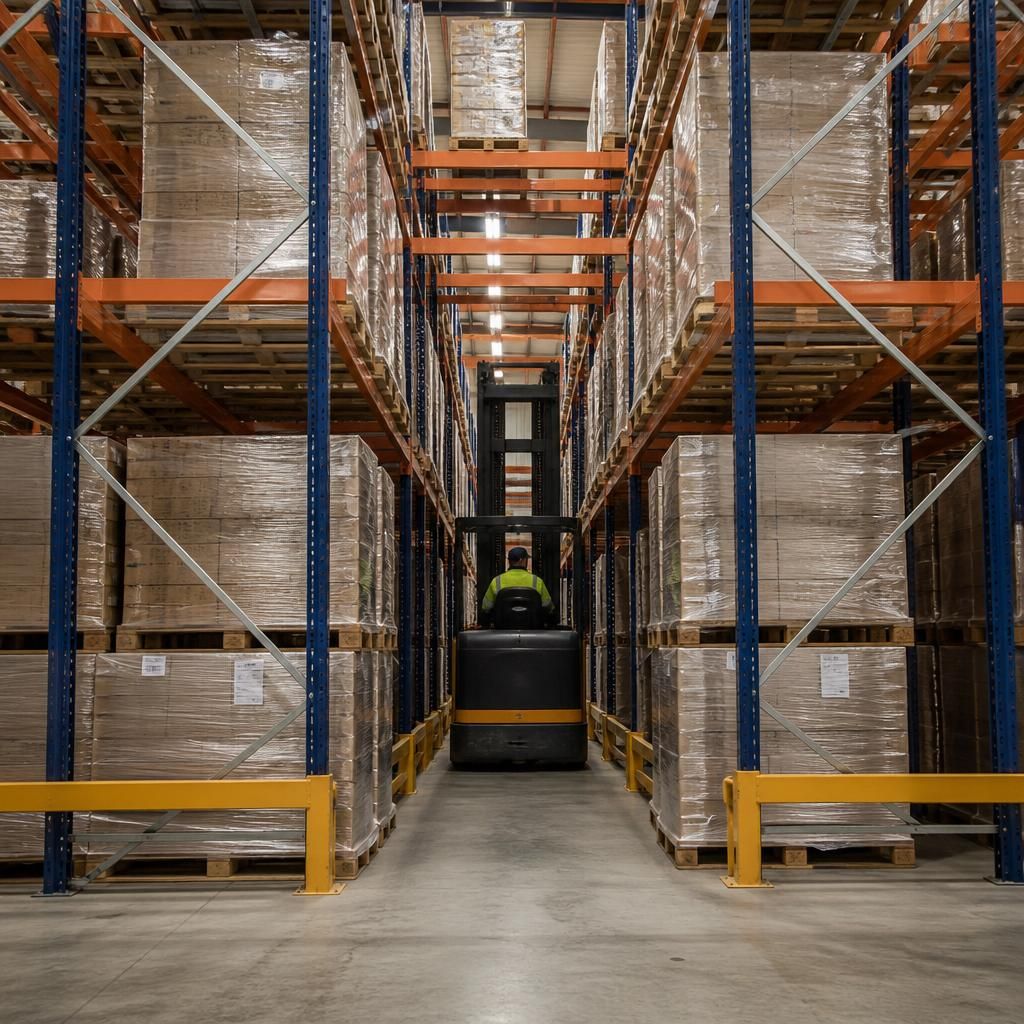
Two-sided forklift access is the defining feature of drive-through warehouse racking systems. Forklifts can enter a storage lane from one end and exit at the other, allowing pallets to be loaded from the replenishment side and retrieved from the opposite side without reversing out through the same opening.
This arrangement can support a controlled first-in, first-out (FIFO) process, provided stock is loaded and removed in the correct order. Clear traffic routes, suitable forklift access, stable pallets and disciplined inventory procedures are essential to maintain safe, predictable movement through each lane.
Discuss your drive-through warehouse racking requirements
Speak to Able Racking about your drive-through warehouse racking requirements, including storage layout, pallet loads, forklift access and safety considerations. Our experienced team can help assess your existing system or plan a suitable installation.