
What safety measures should be considered when implementing shuttle racking systems?
Implementing shuttle racking systems safely requires a suitable warehouse racking design, a documented risk assessment, competent installation, protection against vehicle impact, and clear operating procedures. Regular inspections, prompt repairs, controlled access and practical training for operators help maintain compliance and protect people, pallets and equipment.
Safe implementation of shuttle racking systems depends on suitable design, a documented risk assessment, competent installation, effective protection against vehicle impact, and clear operating controls. Regular inspections, planned maintenance and practical training are then needed to protect people, pallets, shuttle equipment and the wider warehouse operation.
Safety should be considered from the design stage rather than added after installation. The system must suit the building, pallet dimensions, load weights, storage requirements, vehicle movements and planned operating methods. A competent designer or supplier should confirm that the warehouse racking layout provides adequate clearances, suitable access and safe interaction between pallet shuttles, forklift trucks and personnel.
The design should also consider floor capacity, slab condition, column positions, lighting, fire protection, sprinkler clearances, escape routes and the location of doors or other services. Any restrictions affecting loading, unloading or maintenance should be recorded before work starts. Changes to pallet types, load weights or handling equipment may require the design to be reviewed.
A suitable risk assessment and method statement should cover installation, normal operation, foreseeable misuse, cleaning, fault finding, maintenance and emergency procedures. It should identify hazards such as:
- Forklift trucks striking frames, uprights, guide rails or end protections.
- Pallets being placed incorrectly, overloaded or damaged.
- A pallet shuttle moving unexpectedly or being operated from an unsafe position.
- People entering storage channels or exclusion zones while equipment is operating.
- Falling objects caused by poor pallet condition, incorrect positioning or damaged components.
- Obstructions, poor visibility, inadequate lighting or congested traffic routes.
- Electrical, battery-charging and isolation hazards associated with the shuttle equipment.
Installation should be completed by trained and competent operatives in accordance with the approved design and the manufacturer’s instructions. Frames, rails, stops, guides, end protections and safety devices must be correctly positioned, secured and checked before the system is handed over. The finished installation should be inspected for alignment, anchoring, damage, clearances and compatibility with the intended pallets and handling equipment.
Warehouse racking protection is particularly important because shuttle systems are often accessed by forklift trucks at the front of each channel. Column guards, end-of-aisle barriers and other suitable protections should be selected for the likely impact risks and installed without interfering with pallet movement. Protection should not be treated as a substitute for safe driving practices, controlled traffic routes and suitable operator training.
Operating areas should be clearly defined. Where possible, pedestrian routes should be separated from forklift traffic and shuttle operating zones. Access to channels should be restricted while a pallet shuttle is moving or while loading and unloading is taking place. Signs, floor markings, barriers and warning indicators should communicate the permitted activities and any areas where entry is prohibited.
Controls should prevent unintended movement and make it clear when a shuttle is active. Operators should understand how to start, stop, retrieve and park the equipment, as well as how to respond to a lost or obstructed shuttle. Emergency-stop controls must be accessible, tested and understood by relevant personnel. A safe isolation procedure should be available before anyone carries out inspection, cleaning, adjustment or maintenance.
Only suitable pallets should be used. Pallets must be compatible with the channel dimensions, support rails and shuttle design, and they should be checked for damage, instability, contamination and excessive wear. Loads must remain within the stated capacity and should be stable, evenly distributed and secured where necessary. Capacity information should be displayed clearly, and operators should know what to do when a pallet, load or storage position does not meet the requirements.
Training should be role-specific. Forklift operators need instruction in approaching the system, positioning pallets, using the shuttle controls where applicable and recognising unsafe conditions. Maintenance personnel require additional training in isolation, fault diagnosis and safe access. Supervisors should understand the operating limits, inspection arrangements, reporting process and escalation requirements. Refresher training should be provided when procedures, equipment, personnel or site conditions change.
Routine checks help identify problems before they become serious. Operators should report visible damage, unusual movement, impact, missing components, control faults and pallet instability immediately. Supervisors should review these reports and prevent further use where safety may be affected. A damaged area should be clearly identified and isolated until it has been assessed by a competent person.
Formal warehouse racking inspections should be arranged at suitable intervals, supported by a more detailed expert inspection in line with the manufacturer’s guidance and applicable safety requirements. Inspections should cover frames, beams, rails, guides, supports, guards, anchors, connections, stops, signage and the condition of the surrounding floor. The shuttle itself should also be checked for battery condition, wheels, sensors, controls, safety functions and signs of impact or wear.
Inspection records should identify the location and nature of each defect, the required action, the person responsible and the completion date. Repairs should use appropriate components and be carried out by competent personnel. Straightening or welding damaged structural components without an approved repair method can create additional risks and should not be used as an informal solution. The system should not be returned to service until the repair has been checked and its safe capacity confirmed where necessary.
Preventative maintenance should follow the shuttle manufacturer’s instructions and include the equipment, charging arrangements, rails, guides and protection. Battery charging areas should be suitably located, ventilated where required and kept clear of ignition sources and combustible materials. Maintenance activities should be planned so that warehouse traffic cannot expose engineers or other workers to avoidable risks.
Emergency arrangements should explain how to deal with a trapped or failed shuttle, a fallen load, structural damage, fire, battery incident, collision or injury. Workers should not enter a channel or attempt to recover equipment using improvised methods. The procedure should specify isolation requirements, access restrictions, suitable recovery equipment and the point at which specialist assistance is needed. Emergency routes and firefighting provisions must remain unobstructed.
Any collision, overload, dropped pallet, control failure or other abnormal event should trigger an assessment before normal operation resumes. The affected warehouse racking and shuttle equipment may require inspection even when damage is not immediately obvious. Findings should be recorded and used to improve traffic management, protection, training or maintenance arrangements.
Finally, keep a complete handover file containing the design information, load notices, risk assessments, operating instructions, training records, inspection reports, repair records and maintenance schedules. Review the arrangements whenever the system, stored goods, pallets, vehicles, staffing or warehouse layout changes. This documented approach provides the evidence needed to demonstrate that the shuttle racking system is being managed safely and kept in suitable working condition.
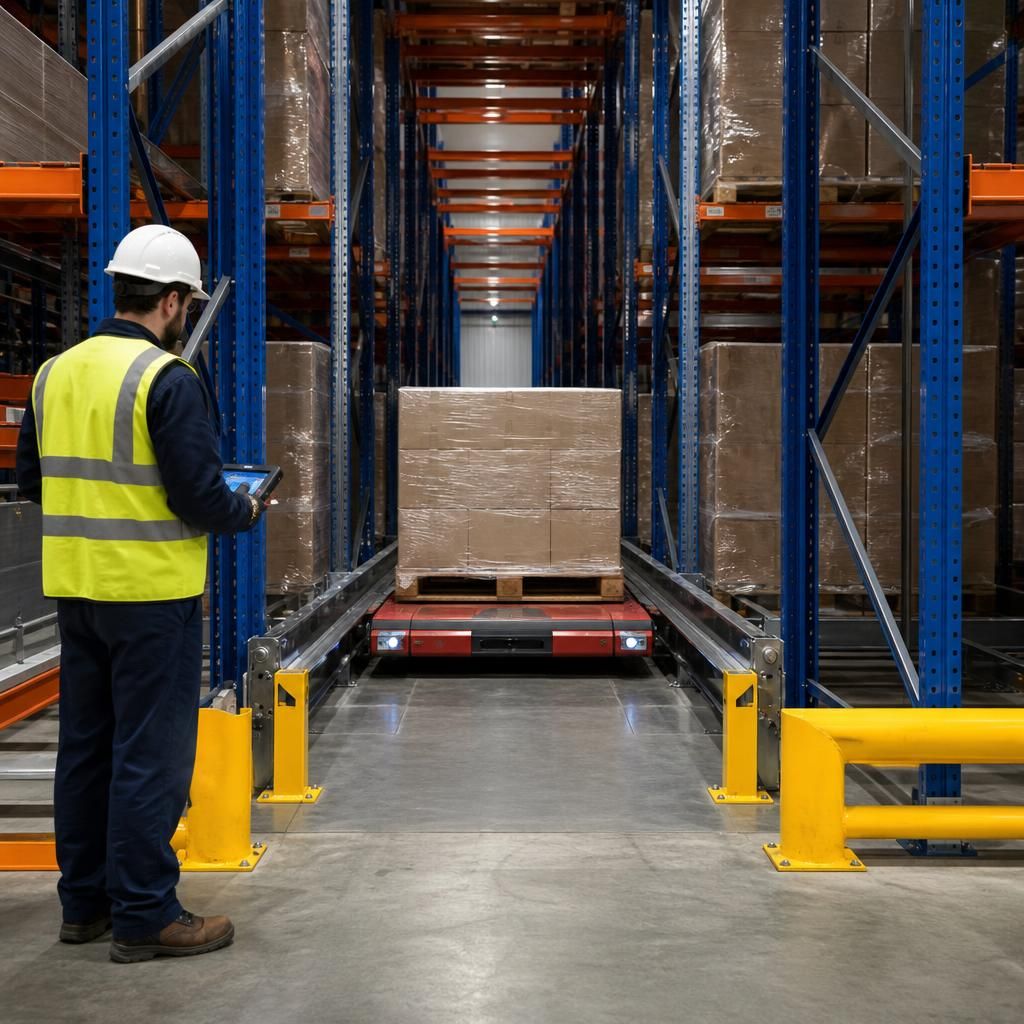
Regular inspection is a key safety measure for shuttle racking systems because impact, pallet damage and equipment faults can affect both the warehouse racking and the pallet shuttle. Operators should report damaged uprights, rails, guides, guards, anchors, pallets or unusual shuttle movement immediately.
Any area affected by a collision, dropped load or suspected overload should be isolated until it has been assessed by a competent person. Repairs must use suitable components and follow an approved method; damaged structural parts should not be straightened or welded as an informal solution. The system should only return to service after the repair, clearances and safe load capacity have been checked and recorded.
Arrange a shuttle racking safety inspection
Arrange a shuttle racking safety inspection with Able Racking to identify damage, confirm safe operating conditions and support ongoing compliance. Our experienced inspectors can provide practical recommendations for any required repairs or preventative maintenance.