
What regular maintenance is needed for cantilever warehouse racking, and why is it important?
Regular maintenance for cantilever warehouse racking includes planned inspections, checking uprights, arms, bases, bracing, fixings and load labels, and arranging prompt repairs or replacement of damaged components. It is important because it helps identify defects before they affect stability, protecting people and stock while supporting safe, compliant and efficient warehouse operations.
Regular maintenance for cantilever warehouse racking involves planned inspections, routine housekeeping, checking structural components and load information, and arranging prompt repair or replacement of any damaged parts. It is important because it helps identify defects before they affect stability, protecting people and stored materials while supporting safe, compliant and efficient warehouse operations.
Maintenance should be based on the system’s design, the loads being stored, the frequency of use, the warehouse environment and the manufacturer’s instructions. A documented programme normally combines checks by warehouse staff, scheduled inspections by a competent person and maintenance work carried out by suitably experienced operatives.
Routine checks by warehouse staff
People using the storage system should remain alert to visible changes during normal operations. Staff should report impact damage, leaning or distorted components, missing fixings, loose bracing, damaged load labels and any change that could affect the safe use of the installation. Areas around the bases and arms should be kept clear so that damage can be seen and vehicles can manoeuvre without unnecessary contact.
Staff checks are not a substitute for a formal inspection. They are an important early-warning measure that allows a concern to be isolated and investigated before the system is used again.
Components that require regular attention
- Uprights and columns: check for bending, dents, twisting, corrosion, cracks or other deformation that may affect their load-bearing capacity.
- Arms: inspect for bending, impact damage, movement, damaged end stops and signs that an arm is no longer correctly supported or secured.
- Bases and footplates: check that bases remain stable, properly aligned and securely fixed to the floor, with no significant damage around the anchors.
- Bracing: examine horizontal and diagonal bracing for distortion, looseness, missing parts or damaged connections.
- Bolts, fixings and connections: look for missing, loose or damaged fixings and confirm that connections have not been altered without approval.
- Load labels: make sure labels remain visible, accurate and securely attached, and that the stated capacities match the current arrangement and stored materials.
- Floor and surrounding area: check for deterioration, obstructions or changes that could affect the stability, access or safe operation of the installation.
Cleaning is also part of effective maintenance. Dust, packaging, oil and debris can hide damage, obstruct access and create slip or vehicle-control hazards. Cleaning methods should not introduce further damage, remove protective finishes or disturb structural connections.
Formal inspections and planned maintenance
A competent person should carry out formal inspections at an interval determined by the risk assessment, operating conditions and applicable guidance. The inspection should consider the whole installation rather than focusing only on the parts most likely to be struck. It should also take account of previous damage, repairs, changes to the layout, changes in stored loads and any recurring operational problems.
The inspection findings should be recorded clearly, including the location of each defect, its severity, the action required and the person responsible for closing it out. Photographs, marked-up layout drawings and repair records can help provide a reliable history of the warehouse racking system and make recurring damage easier to identify.
What to do when damage is found
Damaged cantilever warehouse racking should not simply be straightened, welded, drilled or repainted without an appropriate technical assessment. Unauthorised alterations can change the design performance of the system and may conceal a more serious loss of strength. Where a defect could affect stability or safe loading, the affected bay or arm should be unloaded, clearly identified and taken out of service until it has been assessed.
Repairs should follow the original design, the manufacturer’s requirements or an approved repair specification. Depending on the defect, the correct action may be tightening or replacing a fixing, replacing a damaged brace or arm, repairing a base connection, removing a component from service or replacing a larger section of the installation. The system should be rechecked after repair before it is returned to normal use, and the maintenance record should be updated.
Maintenance after changes or incidents
An additional inspection is needed after a vehicle impact, unusual overloading, fire, flooding, significant corrosion or any other event that may have affected the structure. It is also sensible to review the installation whenever the layout, arm levels, stored materials, handling equipment or operating method changes. A system that was suitable for one load profile may require reassessment when heavier, longer or differently supported materials are introduced.
Changes should be controlled rather than made informally. Altering arm positions, adding components, moving the installation or changing load labels without confirming the design can create a mismatch between the physical system and its stated capacity.
Why preventative maintenance matters
- It identifies damage and deterioration before they develop into a more serious stability concern.
- It reduces the likelihood of falling materials, structural failure and avoidable disruption.
- It helps protect employees, contractors, visitors, stock and handling equipment.
- It supports compliance with health and safety duties, manufacturer instructions and relevant industry guidance.
- It helps maintain the intended load capacity and usable life of the installation.
- It provides documented evidence that defects are being monitored and addressed.
- It can reveal repeated impact or loading problems so that working practices can be improved.
Maintenance is most effective when inspection, repair and staff training work together. Operators should understand the load labels, use suitable handling equipment, keep loads stable and report damage promptly. Supervisors should ensure that reported defects are acted upon and that no isolated area is brought back into use without suitable authorisation.
For existing customers, the practical approach is to review the current inspection records, confirm that load information remains accurate and arrange a competent assessment where there is damage, uncertainty or a change in use. Regular, properly documented care keeps cantilever warehouse racking dependable and helps prevent a small defect from becoming a larger safety or operational problem.
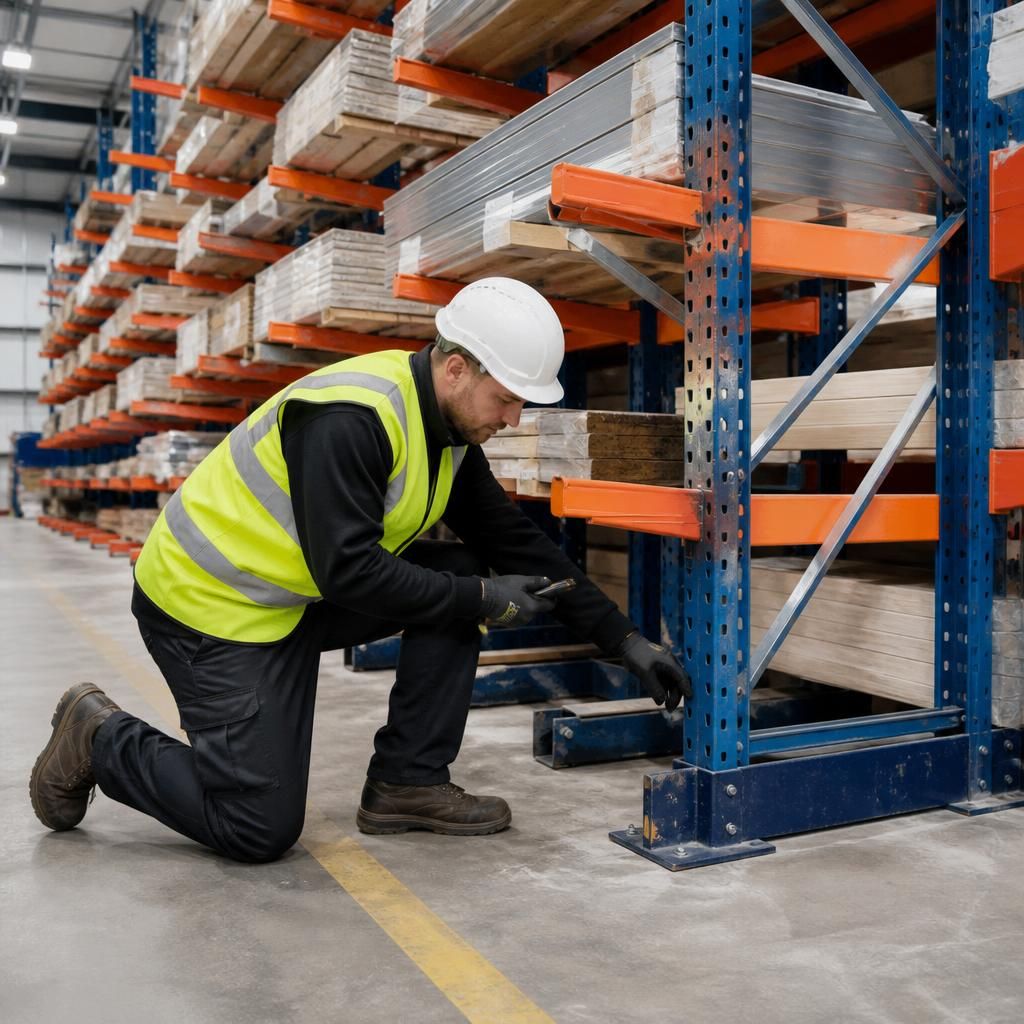
When damage is found on cantilever warehouse racking, the affected area should be made safe before further use. Unloading the affected arm or bay, clearly marking it and reporting the defect prevents a minor fault from being overlooked or exposed to additional loading.
Do not straighten, weld, drill or repaint damaged components without a suitable technical assessment. Repairs should follow the original design, the manufacturer’s requirements or an approved repair specification. After the work is completed, the repaired area should be inspected and the maintenance record updated before it is returned to service.
Arrange a cantilever warehouse racking maintenance inspection
Arrange a competent cantilever warehouse racking maintenance inspection with Able Racking to identify damage, confirm the system remains suitable for its intended loads and plan any required repairs.