
What materials are typically used in warehouse racking safety guards, and why are they important?
Warehouse racking safety guards are typically made from impact-resistant steel, reinforced polymers such as polyethylene or polyurethane, and rubber or other energy-absorbing materials. These materials help absorb or deflect impacts, protect upright frames and aisle-side components, reduce damage to handling equipment, and support safer, compliant warehouse operations.
Warehouse racking safety guards are typically manufactured from impact-resistant steel, reinforced polymers such as polyethylene or polyurethane, and rubber or other energy-absorbing materials. Each material is selected for a particular combination of strength, impact absorption, visibility, durability and suitability for the warehouse environment. Used correctly, these guards help protect upright frames, end frames and other aisle-side components from contact with handling equipment.
Steel is widely used where high structural strength and resistance to repeated impacts are required. Fabricated steel guards can be fixed around vulnerable upright frames or positioned at exposed ends of warehouse racking runs. Their main advantages include:
- High resistance to force from pallet trucks, lift trucks and other handling equipment
- Good durability in demanding industrial environments
- Ability to be fabricated into substantial end protectors, posts and barrier systems
- Compatibility with floor fixings that provide a secure, stable installation
Steel guards are particularly useful in areas where equipment movements are frequent or where the warehouse racking is exposed to significant traffic. However, a rigid steel guard can transfer impact energy into its fixings or the surrounding floor if it is poorly designed or incorrectly installed. The guard must therefore be suitable for the expected impact conditions, correctly positioned and checked for damage after a collision.
Polyethylene and polyurethane are common polymer materials for guards fitted directly around warehouse racking uprights. These materials are tough, lightweight and able to deform under impact. Rather than simply resisting a collision as a rigid barrier would, a polymer guard can absorb or distribute some of the energy before it reaches the upright frame.
Polymer guards offer several practical benefits:
- They can reduce scuffing and damage to painted or galvanised upright surfaces
- Their flexibility allows them to accommodate minor contact without immediately cracking or permanently deforming
- They are generally resistant to moisture, corrosion and many common warehouse contaminants
- They are easier to handle during installation than heavy steel alternatives
- High-visibility colours can make protected areas easier for operatives and vehicle drivers to identify
Polyethylene is often chosen for its toughness and resistance to moisture and chemicals, while polyurethane is valued for its resilience, flexibility and ability to recover after impact. The exact performance depends on the product formulation, thickness, shape, fixing method and operating environment. A polymer guard should not be assumed to provide structural protection simply because it appears substantial; its tested or specified performance should match the intended application.
Rubber and elastomeric materials are used where cushioning and energy absorption are more important than creating a rigid physical barrier. Rubber profiles, pads and buffers can be fitted to contact points or incorporated into protective systems. They help reduce the sharpness of an impact and can limit surface damage caused by occasional contact with handling equipment or loads.
Rubber is useful because it provides:
- Elastic cushioning at likely contact points
- Good grip between the guard and the protected surface when correctly designed
- Reduced noise compared with direct contact between metal components
- Protection against minor knocks, abrasions and repeated low-energy contact
Rubber is not always suitable as the sole protection in a high-traffic area. Its performance can be affected by temperature, ultraviolet exposure, oils, chemicals and prolonged compression. It may also split, harden or lose resilience over time. Regular inspection is needed to identify deterioration that may not be obvious from a distance.
Composite constructions combine materials to balance different performance requirements. For example, a guard may use a steel core for strength with a polymer or rubber outer layer for impact absorption. Other designs use reinforced plastics or a combination of metal brackets and resilient protective sections. These arrangements can protect the warehouse racking while reducing the amount of impact transferred to the floor, fixings and upright frame.
The choice of material should reflect the specific risk rather than relying on appearance or material name alone. Important considerations include:
- The type and weight of handling equipment operating nearby
- Vehicle speed, turning movements and the available aisle clearance
- Whether impacts are likely to be occasional, repeated or severe
- The position of the exposed upright or end frame
- The strength and condition of the warehouse floor
- Temperature, moisture, chemicals, oils and outdoor exposure
- Visibility for drivers and pedestrians
- Access needed for inspection, cleaning and repairs
- Whether the guard can be installed without interfering with pallets, beams or access routes
Material selection also affects maintenance. Steel should be checked for distortion, cracked welds, loose fixings, corrosion and damage to protective coatings. Polymer guards should be examined for splitting, punctures, excessive deformation, displacement and signs that they have become brittle. Rubber components should be checked for hardening, tearing, compression damage and loss of attachment. Any guard that has moved, fractured or no longer protects the intended area should be assessed and repaired or replaced promptly.
Protective materials do not remove the need for safe operating practices. Warehouse racking safety guards are one part of a wider safety arrangement that includes suitable layout, trained vehicle operators, controlled vehicle movements, good housekeeping and routine inspections. A guard that is too short, too flexible, incorrectly fixed or unsuitable for the likely impact may give a false sense of security while leaving the upright frame vulnerable.
During an inspection, the condition of the guard and the condition of the protected warehouse racking should both be considered. Impact marks, bent components, damaged floor fixings or displaced guards may indicate that the protection has absorbed an event but that the upright frame or nearby components also require examination. Visible damage should not be dismissed simply because the guard itself remains in place.
In practice, the most effective solution is often a material and design combination selected following a review of the warehouse layout, traffic patterns and previous damage. Steel provides robust resistance, polymers offer flexible impact protection, and rubber supplies cushioning at contact points. Choosing the correct specification, installing it properly and maintaining it through regular inspections are what allow these materials to protect warehouse racking safely and consistently.
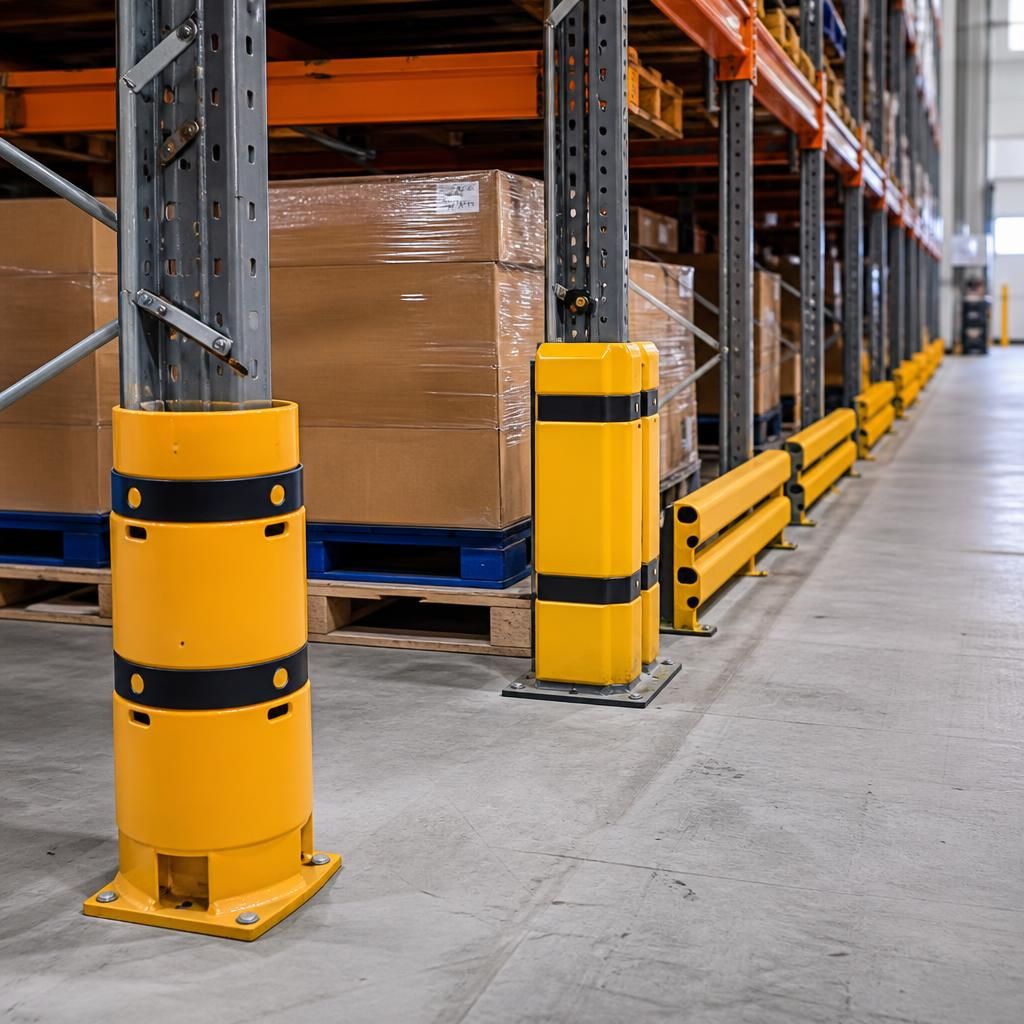
Warehouse racking safety guards are made from materials selected to control impact energy before it reaches vulnerable upright frames. Steel provides high resistance where substantial physical protection is needed, while polyethylene, polyurethane and rubber can absorb or distribute contact more effectively.
The correct choice depends on the handling equipment, traffic movements, floor condition and likely impact severity. Composite guards, such as a steel core with a resilient outer layer, can combine structural strength with cushioning. Whatever the material, the guard must be correctly fixed, positioned and inspected for distortion, cracking, splitting, displacement or other damage after contact.
Talk to our experts about warehouse racking safety guards
Talk to our experts about selecting, installing or maintaining warehouse racking safety guards suited to your site and operating conditions. Contact Able Racking for practical guidance from experienced warehouse safety professionals.