
What are the key differences between narrow aisle racking and very narrow aisle racking systems?
Narrow aisle racking uses reduced aisle widths to increase storage density while retaining access for conventional or specialised forklift equipment, whereas very narrow aisle racking uses substantially tighter aisles and typically requires dedicated turret trucks or other guided equipment. Very narrow aisle systems can provide greater space efficiency, but they usually involve higher equipment, design and operating requirements and may offer less flexibility for mixed handling operations.
Narrow aisle warehouse racking uses reduced aisle widths to increase pallet storage capacity while retaining access for versatile forklift equipment, whereas very narrow aisle warehouse racking uses substantially tighter aisles and normally requires dedicated trucks, guidance systems and more precise installation. Very narrow aisle systems can provide greater storage density, but narrow aisle systems generally offer more flexibility and lower equipment complexity.
The most important difference is the relationship between aisle width, handling equipment and available storage space. Narrow aisle layouts reduce the space allocated to forklift travel compared with conventional warehouse racking, but they still allow suitable reach trucks or other specialised equipment to manoeuvre between the runs. Very narrow aisle layouts reduce the travel space further, allowing additional runs of pallet racking or greater use of the building’s footprint. The trade-off is that the operating environment becomes less tolerant of poor alignment, damaged components or unsuitable handling equipment.
Aisle configuration and access
Narrow aisle warehouse racking is designed around an aisle width that permits the selected truck to enter, position and retrieve loads safely. The exact width is not universal: it depends on the truck specification, pallet dimensions, load overhang, rack depth, turning requirements and the clearances required by the system designer. A narrow aisle arrangement may therefore suit a warehouse that needs improved capacity without committing fully to a dedicated very narrow aisle operation.
Very narrow aisle warehouse racking is configured with significantly tighter operating corridors. Trucks may travel along fixed routes, use rail or wire guidance, or be controlled through other systems that keep them accurately aligned with the storage positions. This reduces the space needed for manoeuvring, but it also means that aisle planning, floor condition and rack tolerances need closer control. End-of-aisle transfer areas and emergency access routes must be considered as part of the complete layout rather than treated as spare space.
Handling equipment
Narrow aisle systems can often be operated with reach trucks or other equipment selected to match the rack arrangement. Some operations may retain a degree of compatibility with existing handling equipment, although a conventional counterbalance truck may still require wider access for safe turning and load handling. Equipment capability should be confirmed before finalising the layout, including lift height, turning radius, mast configuration, load centre and the operator’s visibility from the cab.
Very narrow aisle systems commonly use specialised turret trucks or other dedicated trucks. These may rotate or position the forks within the aisle, allowing pallets to be stored on either side without requiring the whole truck to turn. Depending on the design, the truck may be operated from floor level or with the operator raised with the load. Guidance equipment, battery charging arrangements, truck availability and operator training all form part of the system’s operating requirements.
Storage density and accessibility
Both approaches improve space utilisation by reducing unused aisle area. Very narrow aisle warehouse racking normally achieves the higher storage density because more of the building can be allocated to storage positions. It can be particularly effective where the warehouse has a high ceiling, consistent pallet profiles and a large volume of stock requiring direct access.
Narrow aisle warehouse racking can provide a better balance where stock changes frequently, different load types are handled, or several types of forklift need to work in the same operation. It may be easier to access individual pallet positions without relying on a dedicated truck for every retrieval. The correct choice depends on whether the priority is maximum capacity, rapid access, equipment flexibility or a combination of these factors.
Design and installation requirements
Very narrow aisle warehouse racking generally demands tighter design and installation controls. The floor must provide suitable flatness and condition for the selected guidance method and truck. Rack frames, beams, protection and aisle clearances must be installed to the required tolerances. Building columns, lighting, fire protection, doors, sprinkler coverage and services must also be checked because tighter aisles leave less room to accommodate obstructions or later changes.
Narrow aisle systems also require a professional design, but they may provide more tolerance for ordinary warehouse variation. This does not remove the need for accurate surveys, suitable floor loading and properly installed protection. Every configuration should be assessed against the intended pallet loads, beam levels, lift heights, traffic routes and foreseeable impact risks. Changes to pallet weight, packaging or handling equipment can affect the suitability of an existing installation.
Cost and operational commitment
Very narrow aisle warehouse racking can reduce building expansion requirements by making better use of the available volume. However, the initial investment may be higher because of specialised trucks, guidance infrastructure, floor preparation, installation tolerances and operator training. Maintenance arrangements may also be more involved, particularly where the operation depends on dedicated equipment.
Narrow aisle warehouse racking may have a lower equipment and implementation burden, especially where suitable trucks are already available. It can also be easier to adapt if the warehouse later handles different pallet sizes or changes its product mix. A proper comparison should consider the complete cost of ownership, including trucks, batteries or charging, servicing, training, rack protection, repairs, inspections and any effect on picking or replenishment time.
Safety and compliance
Neither system is automatically safe simply because the aisle dimensions have been reduced. The installation must be designed for the actual loads and equipment, protected against foreseeable impacts and operated under suitable procedures. Operators need training specific to the trucks and the layout, including controlled travel, load placement, pedestrian separation and reporting of damage.
Warehouse racking should be subject to regular user checks and a documented expert inspection at appropriate intervals, with any damage assessed promptly. In very narrow aisle areas, even relatively minor frame, beam or guidance damage can affect clearances and truck operation. Defects should be isolated where necessary, unloaded safely and repaired using an appropriate method rather than being bent back or improvised on site.
Which system is suitable?
Choose narrow aisle warehouse racking when the operation needs improved capacity but still values equipment versatility, straightforward access and the ability to accommodate changing requirements. Consider very narrow aisle warehouse racking when storage density is the primary objective, the inventory is reasonably consistent, the building and floor are suitable, and the business is prepared to operate and maintain dedicated equipment.
The decision should be based on a site survey and a complete handling assessment rather than aisle width alone. Reviewing pallet dimensions, load weights, stock turnover, required access, truck specifications, floor condition, fire strategy and future expansion plans will identify the most practical arrangement. A correctly designed system should improve capacity without compromising safe access, inspection, maintenance or day-to-day operating control.
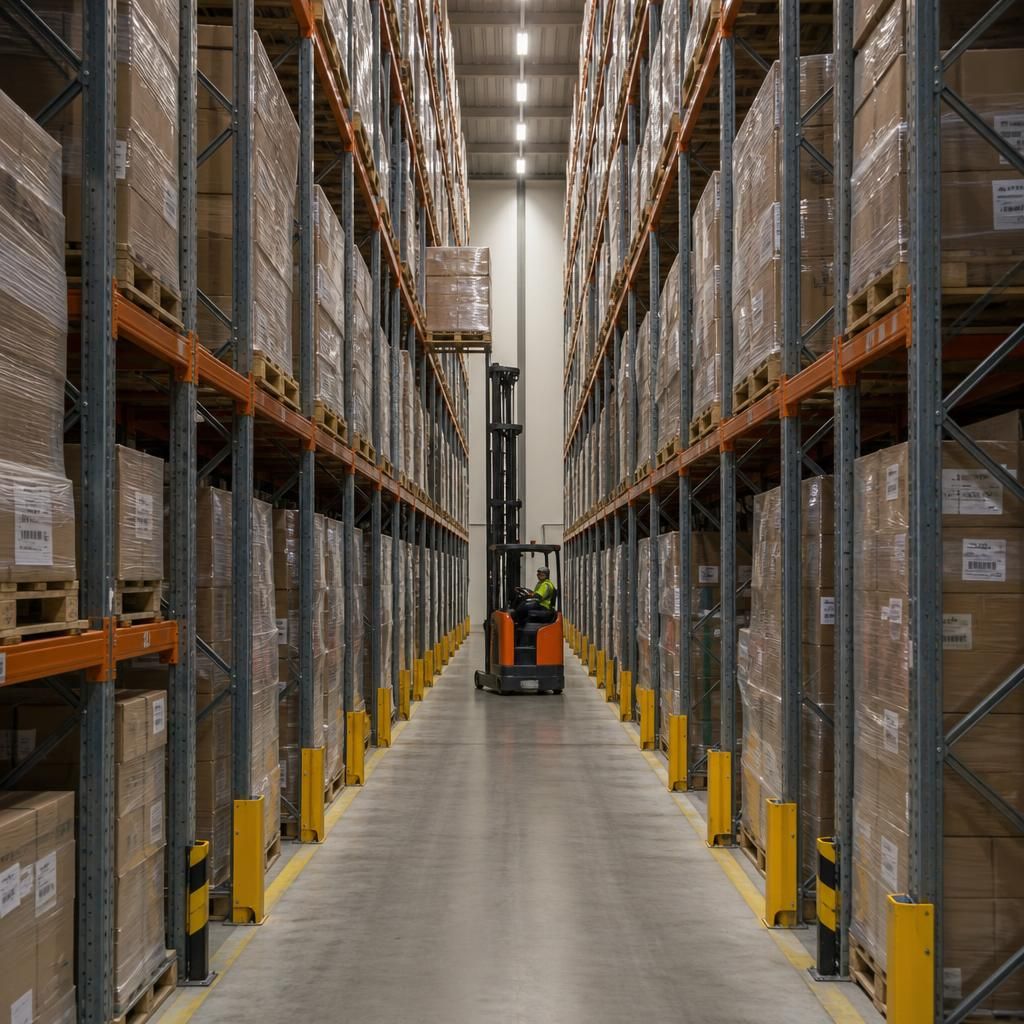
The main difference between narrow aisle racking and very narrow aisle racking is the balance between storage density and handling flexibility. Narrow aisle racking leaves enough operating space for suitable reach trucks and can accommodate changing stock or equipment requirements. Very narrow aisle racking uses tighter aisles to create more storage positions, but normally depends on dedicated turret trucks, guidance systems and more precise installation.
This choice should be based on the complete operation rather than aisle width alone. Consider pallet dimensions, load weights, lift heights, stock turnover, floor condition, truck access and future changes to the warehouse. Very narrow aisle racking may maximise available space, while narrow aisle racking can provide simpler access and greater versatility. Both systems require professional design, suitable protection, operator training and regular warehouse racking inspections to remain safe and compliant.
Discuss your narrow aisle racking requirements
Discuss your narrow aisle racking requirements with Able Racking to assess the most suitable layout, handling equipment and safety controls for your warehouse. Our experienced team can advise on design, installation, inspections and ongoing maintenance.