
What are the key differences between Drive-In, Push-Back, and Pallet Flow racking systems?
Drive-In warehouse racking provides very high-density storage but limited direct access, typically operating on a last-in, first-out (LIFO) basis. Push-Back warehouse racking offers greater selectivity with LIFO storage, while Pallet Flow warehouse racking uses rollers to support first-in, first-out (FIFO) movement, making it better suited to stock rotation and date-sensitive goods.
Drive-In, Push-Back and Pallet Flow warehouse racking systems differ mainly in how pallets are stored, accessed and rotated. Drive-In warehouse racking prioritises maximum storage density and normally operates on a last-in, first-out (LIFO) basis. Push-Back warehouse racking provides greater selectivity and faster access to individual load positions while still generally using LIFO. Pallet Flow warehouse racking uses inclined roller lanes to move pallets through the structure, supporting first-in, first-out (FIFO) stock rotation.
The most suitable system depends on the warehouse layout, available space, product characteristics, stock rotation requirements, handling equipment and the level of direct pallet access needed. Selecting the system solely for its storage density can create operational problems if it does not match the way goods are received, stored and dispatched.
Drive-In warehouse racking is designed for high-density storage of similar products. Forklift trucks enter the storage lanes to place pallets on support rails. Because the forklift operates inside the structure, fewer access aisles are required than with conventional selective warehouse racking. This allows a substantial amount of floor space to be used for storage.
Drive-In warehouse racking is most effective where a business stores large quantities of the same product or has relatively few stock-keeping units with several pallets per line. It is particularly appropriate where storage density is more important than immediate access to every pallet.
- Access method: Forklift trucks enter the storage lanes to load and retrieve pallets.
- Stock rotation: Usually LIFO, as the last pallet loaded is normally the first available for retrieval.
- Storage density: Very high because the arrangement uses fewer access aisles.
- Selectivity: Limited, as pallets positioned deeper in a lane cannot usually be accessed without moving those in front.
- Best suited to: Homogeneous products, bulk storage and goods where strict FIFO rotation is not essential.
Drive-In warehouse racking requires disciplined loading and unloading. Operators must follow the intended loading sequence, use suitable handling equipment and avoid contact with the upright frames, rails and rear protection. The system should also be inspected regularly because damage within a storage lane can affect both the structure and the safe movement of forklift trucks.
Push-Back warehouse racking uses inclined rails, carts or nesting platforms. A forklift places a pallet on the first available position and gently pushes previously stored pallets further back along the lane. When a pallet is removed, the remaining pallets move forwards under gravity or controlled mechanical assistance.
Push-Back warehouse racking generally operates on a LIFO basis, although the arrangement can provide more accessible storage lanes than Drive-In warehouse racking. Forklift trucks normally load and unload from the front of the system rather than travelling into the storage lane. This can make handling quicker and reduce the risk associated with forklift travel inside the structure.
- Access method: Pallets are loaded and retrieved from the front of each lane.
- Stock rotation: Normally LIFO, making it suitable for goods without a strict expiry sequence.
- Storage density: High, although the system requires more aisle space than Drive-In warehouse racking.
- Selectivity: Better than Drive-In warehouse racking because each lane can hold a separate product line or batch.
- Best suited to: Medium to high-volume storage where several pallets are held per product line and rapid front access is useful.
Push-Back warehouse racking can support efficient loading and unloading, but operators must control forklift movements carefully. Excessive impact, incorrect pallet placement or unsuitable pallet dimensions can damage carts, rails or guides. The movement of pallets should remain smooth and predictable, with no obstruction preventing the load from travelling safely to the front position.
Pallet Flow warehouse racking uses roller lanes set at a controlled incline. Pallets are loaded from one side and move towards the opposite picking face. Braking devices, separators and end stops help regulate pallet movement and maintain safe control of the load. Loading and retrieval take place from different sides, creating a dedicated loading face and a dedicated unloading face.
This configuration supports FIFO stock rotation because the first pallet loaded into a lane is normally the first pallet presented for retrieval. It is therefore particularly valuable for date-sensitive, batch-controlled or perishable goods, provided the warehouse team follows the correct loading sequence.
- Access method: Pallets are loaded at the replenishment side and retrieved at the opposite picking side.
- Stock rotation: FIFO, supporting more consistent batch and date control.
- Storage density: High, although space is needed for both loading and unloading operations.
- Selectivity: Good for individual product lines, with each lane typically assigned to a specific product or batch.
- Best suited to: Goods requiring stock rotation, regular replenishment and efficient case or pallet picking.
Pallet Flow warehouse racking can reduce the need for forklift trucks to enter storage lanes, but it requires accurate pallet placement and properly maintained roller equipment. Pallets must be compatible with the lane width, roller arrangement and load capacity. Damaged pallets, uneven loads or incorrectly positioned goods can affect movement and create unsafe conditions at the picking face.
The main differences can be summarised by considering four operational factors: access, rotation, density and handling method.
- Access: Drive-In warehouse racking offers the least direct access because pallets may need to be moved from the front of a lane. Push-Back warehouse racking provides front access to several pallet positions, while Pallet Flow warehouse racking separates loading from retrieval to maintain a consistent product flow.
- Rotation: Drive-In and Push-Back warehouse racking normally use LIFO storage. Pallet Flow warehouse racking is intended for FIFO storage.
- Density: Drive-In warehouse racking generally provides the highest density because it minimises access aisles. Push-Back and Pallet Flow warehouse racking also use space efficiently but require additional working areas and mechanical components.
- Product variety: Drive-In warehouse racking is most effective with a limited range of products stored in larger quantities. Push-Back warehouse racking can accommodate more product lines, while Pallet Flow warehouse racking is particularly effective where each lane is managed by product, batch or date.
- Forklift movement: Drive-In warehouse racking requires forklift trucks to enter the lanes. Push-Back warehouse racking is operated from the aisle, and Pallet Flow warehouse racking normally allows the storage lanes to remain free from forklift traffic.
- System complexity: Drive-In warehouse racking has a relatively straightforward structure but depends heavily on careful forklift operation. Push-Back and Pallet Flow warehouse racking include moving components that require correct adjustment, inspection and maintenance.
When choosing between the systems, begin by reviewing the warehouse’s stock profile rather than focusing only on the available floor area. Consider whether goods have expiry dates, whether batches must remain separate, how frequently pallets are replenished, how quickly orders need to be picked and whether the operation requires direct access to specific pallets.
Drive-In warehouse racking may be appropriate where large quantities of the same product are stored and stock can be managed on a LIFO basis. Push-Back warehouse racking is often a better fit where high-density storage is required but the operation needs more front-facing lanes and simpler forklift access. Pallet Flow warehouse racking is normally the strongest option where FIFO rotation, batch control and a clear replenishment-to-picking process are essential.
Warehouse conditions should also be assessed before installation or alteration. The review should include floor condition, clear height, aisle dimensions, forklift specifications, pallet quality, load weights, fire protection arrangements, pedestrian routes and the intended loading pattern. These factors affect both system performance and the safe working clearances around the structure.
Whichever system is selected, safe operation depends on suitable design, competent installation, clear operating procedures and routine inspection. Warehouse teams should understand the correct loading and unloading sequence, maximum load limits, damage-reporting process and requirements for keeping access routes clear. Uprights, beams, rails, rollers, carts, guides, guards and end stops should be checked for impact damage, displacement, wear or obstruction.
Any suspected structural damage should be reported immediately and the affected location should be isolated where necessary until it has been assessed by a competent person. Repairs and alterations should not be improvised on site, as replacing components with unsuitable parts or changing the original configuration can affect the system’s design performance.
In practical terms, choose Drive-In warehouse racking for maximum density and bulk LIFO storage, Push-Back warehouse racking for dense front-access storage with flexible product allocation, and Pallet Flow warehouse racking for controlled FIFO movement and reliable stock rotation. A site-specific assessment can confirm whether the preferred system is compatible with the building, handling equipment, products and operating procedures.
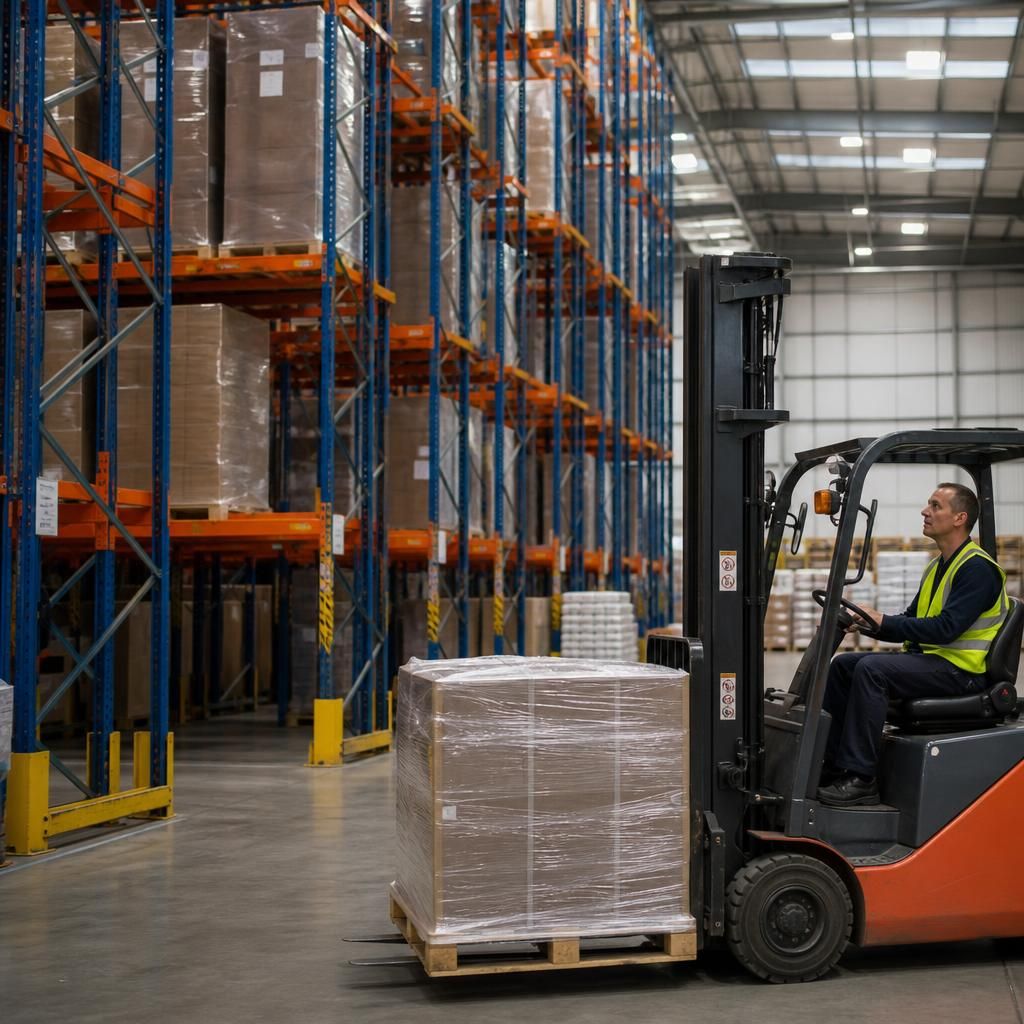
The key operational difference between Drive-In, Push-Back and Pallet Flow warehouse racking is how pallets are accessed and rotated. Drive-In warehouse racking normally uses LIFO storage, with forklifts entering lanes to reach pallets. Push-Back warehouse racking also generally uses LIFO, but pallets are handled from the front on carts or rails. Pallet Flow warehouse racking uses inclined rollers to move pallets from the loading side to the picking side, supporting FIFO stock rotation.
This makes each system suitable for a different stock profile. Choose Drive-In warehouse racking for dense storage of large quantities of similar goods, Push-Back warehouse racking where front access and flexible lane allocation are more important, and Pallet Flow warehouse racking where batch control, expiry dates or regular stock rotation require a clear first-in, first-out process.
Need expert advice on choosing the right warehouse racking system?
Speak to Able Racking for expert advice on selecting a warehouse racking system that matches your stock profile, handling equipment and operational requirements. Our experienced team can assess your needs and recommend a safe, practical solution.