
What maintenance is required for mezzanine floor gates?
Mezzanine floor gates require routine visual inspections, functional testing, cleaning and lubrication where specified by the manufacturer, with any damage or faults repaired promptly by a competent person. Keep maintenance records and include the gate in your site’s planned safety inspections to support ongoing compliance and safe operation.
Mezzanine floor gates require planned visual inspections, functional checks, cleaning, and lubrication where specified by the manufacturer. Any damage, unusual movement, worn component, or failure of the gate to close and secure must be reported and rectified promptly by a competent person. Maintenance records should be retained and the gate included within the site’s wider safety inspection programme.
Maintenance should follow the manufacturer’s instructions, the original installation requirements, and the findings of your workplace risk assessment. The frequency of checks depends on factors such as how often the gate is used, the loads handled nearby, the operating environment, and whether the gate is exposed to impact from vehicles or handling equipment. A gate used continuously in a busy warehouse may need more frequent checks than one used occasionally.
Routine visual checks should look for:
- Damage, distortion, cracks, corrosion, or missing parts in the frame, posts, rails, mesh, toe boards, or protective panels.
- Loose, damaged, or missing bolts, fixings, welds, hinges, rollers, handles, catches, locking devices, and safety interlocks.
- Gaps or openings that have changed from the original design and could allow a person, product, or load to pass through unintentionally.
- Signs that the gate has been struck by a forklift, pallet, vehicle, or other handling equipment.
- Movement, leaning, settlement, or damage to the supporting floor structure or guardrail connection.
- Obstructions, debris, packaging, or stored items that could prevent the gate from operating or securing correctly.
Visual checks should not be limited to the gate itself. Inspect the surrounding edge protection, access area, loading position, floor surface, and any nearby traffic route. Damage to an adjacent barrier or changes to the way goods are presented at the edge can create a risk even when the gate appears undamaged.
Functional testing should confirm that the gate:
- Moves smoothly through its intended operating range without sticking, excessive resistance, uncontrolled movement, or unusual noise.
- Closes fully and remains in the safe position without being held by hand.
- Engages its latch, lock, counterbalance, interlock, or other securing mechanism reliably.
- Cannot be opened or moved unintentionally from the exposed edge.
- Maintains the required protection while goods are being loaded or removed.
- Returns to, or can be placed in, the safe position after use, where the design requires this.
Never bypass an interlock, remove a guard, tie a gate open, or modify the operating method to overcome a fault. A gate that does not secure correctly should be taken out of service, with the affected area controlled until a competent person has assessed and repaired it.
Clean the gate and its operating components as part of routine housekeeping. Remove dust, packaging, product residue, and other debris that could obstruct hinges, rollers, tracks, latches, or sensors. Use cleaning products and methods that are suitable for the material and finish. Do not apply lubricant unless the manufacturer permits it, as some lubricants can attract abrasive dust or interfere with locking and sensing components.
Where lubrication is specified, use the correct product and apply it only to the identified points. Check the gate afterwards to confirm that it still latches and operates correctly. Lubrication is not a substitute for investigating stiffness, wear, misalignment, or damage; these symptoms may indicate a component or installation fault.
Repairs should be completed by a suitably competent person using compatible replacement components and an approved method. Do not drill, weld, extend, remove, or otherwise alter the gate without confirming that the change has been assessed and authorised by the manufacturer, designer, or another appropriately qualified person. An apparently minor alteration can affect clearances, load paths, counterbalance forces, interlocks, or the performance of the edge protection.
After repair, the gate should be functionally tested before it is returned to service. The person completing the work should verify that all fixings and safety devices are present, the surrounding protection remains effective, and the gate performs as intended under normal operating conditions. Where the gate forms part of lifting equipment or incorporates powered components, additional examination, inspection, or maintenance requirements may apply under the relevant workplace regulations and manufacturer’s instructions. The responsible person should confirm the applicable requirements for the specific design.
Keep inspection and maintenance records that identify the gate, inspection date, findings, defects, risk controls, repair details, replacement parts, and the person who completed or approved the work. Records should also show when a defect was closed out and when the equipment was returned to service. This provides a useful audit trail and helps identify recurring problems, such as repeated impact damage or poor loading practices.
Staff who operate or work near the gate should know its correct operating method and how to report a defect. Training should cover the safe loading position, the prohibition on climbing through or around the gate, the need to keep the edge clear, and the action to take if the gate will not close or lock. Supervisors should monitor the working practice, particularly where loading arrangements or shift patterns change.
Maintenance should also be reviewed after an incident, impact, structural alteration, change of use, or significant change to the goods-handling process. A gate that has been struck may have hidden damage or altered alignment even if it continues to operate. Arrange a competent assessment before relying on it again, and review the risk assessment if the original controls are no longer suitable.
A planned maintenance schedule normally combines user checks before or during use, documented workplace inspections at an appropriate frequency, manufacturer-recommended servicing, and additional checks after damage or modification. The correct interval should be based on risk and actual use rather than a generic timetable. If there is uncertainty about the gate’s condition, compatibility, or inspection requirements, obtain advice from a suitably competent safety professional or the original equipment supplier before continuing to use it.
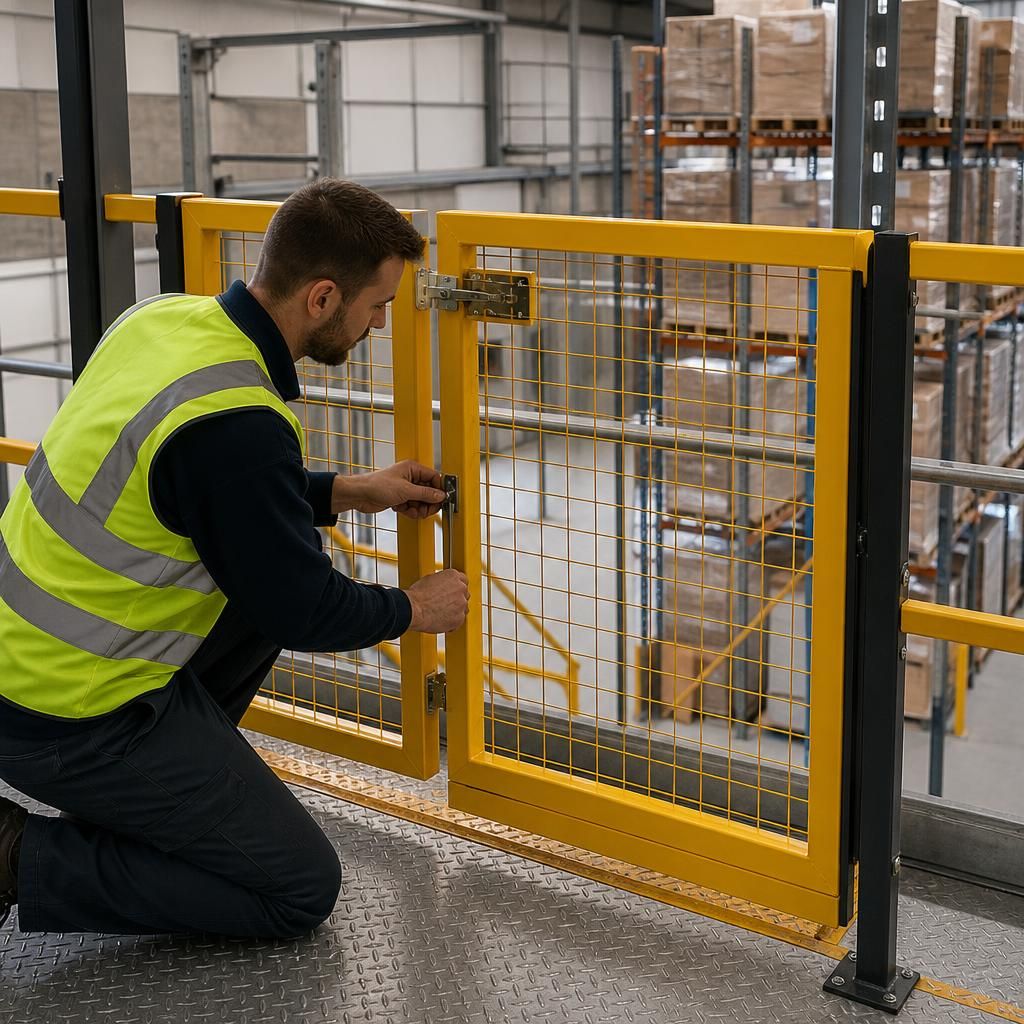
Regular functional checks are essential for keeping mezzanine floor gates safe to use. Confirm that the gate moves smoothly, closes fully and engages its latch, lock or interlock without assistance. Inspect the frame, hinges, rollers, fixings and surrounding edge protection for damage, looseness, corrosion or obstruction. If the gate does not secure correctly, remove it from service and arrange assessment and repair by a competent person. Record the inspection, any defects found and the action taken so there is a clear maintenance history.
Arrange a mezzanine floor gate inspection
If your mezzanine floor gate shows damage, unusual movement or locking faults, arrange an inspection by a competent Able Racking professional before returning it to service. We can assess its condition, identify required repairs and advise on appropriate ongoing maintenance.