
What impact do warehouse activities and environmental conditions have on racking inspection frequency?
Warehouse activities and environmental conditions can increase the frequency of warehouse racking inspections when they create a higher risk of impact, damage or deterioration. Busy vehicle movements, frequent stock changes, heavy loads, temperature variation, moisture, corrosion, poor lighting and uneven floors should prompt more regular checks, with immediate reporting and assessment after any significant incident.
Warehouse activities and environmental conditions determine how often warehouse racking should be inspected because they affect the likelihood of impact, overloading, instability, corrosion and other forms of deterioration. A low-risk storage area may follow the planned inspection programme, while busy or harsh environments require more frequent visual checks, closer monitoring and earlier expert inspections.
The inspection frequency should be based on a documented risk assessment, the type and condition of the warehouse racking, the work carried out around it and the manufacturer’s instructions. The planned programme should also be reviewed whenever warehouse operations, storage arrangements or environmental conditions change.
Warehouse activities that may require more frequent inspections include:
- Frequent forklift truck, pallet truck or other vehicle movements close to warehouse racking.
- Regular loading and unloading at ground level, where uprights, frames and guards are more exposed to impact.
- Rapid stock rotation or frequent changes to pallet positions, which can increase handling errors and loading outside the intended configuration.
- Storage and retrieval of heavy, unstable, oversized or awkwardly shaped goods.
- High-level storage, where damage or displacement may be harder to identify and the consequences of failure may be more serious.
- Changes to beam levels, bay layouts, load limits or the type of pallets being stored.
- Congested aisles, restricted visibility, poor traffic separation or work taking place near storage areas.
- Installation, alteration, maintenance or other activities that could disturb the warehouse racking or its protective equipment.
Impact damage is one of the clearest reasons to increase inspection frequency. Even when a collision appears minor, it can affect an upright, beam connector, bracing member, guard or floor fixing. Damage may not be obvious from a normal operating position, so affected areas should be isolated where necessary and assessed by a competent person before being returned to service. Warehouse staff should report damage immediately rather than waiting for the next planned inspection.
Environmental conditions can also accelerate deterioration or make damage more difficult to identify. Particular attention is needed where warehouse racking is exposed to:
- Moisture, condensation, leaks or wash-down processes that may lead to corrosion.
- High or low temperatures that affect materials, stored products or the performance of protective components.
- Outdoor or semi-enclosed conditions, where wind, rain and changing temperatures can increase exposure.
- Dust, chemicals or airborne contaminants that may obscure defects or damage protective finishes.
- Poor lighting, which can prevent operatives from identifying bent members, missing components or damaged fixings.
- Uneven, damaged or settling floors that may affect the alignment, stability or anchorage of the warehouse racking.
- Areas where water, ice or other substances create a greater risk of vehicle impact or unstable handling.
Where these conditions are present, inspections should focus not only on the warehouse racking itself but also on the surrounding floor, traffic routes, lighting, drainage, fire protection and housekeeping. Corrosion, movement, settlement or repeated exposure should be recorded so that deterioration can be tracked over time. Cleaning or repainting should not conceal damage or substitute for an engineering assessment.
A practical inspection programme normally combines several levels of checking. Operatives should remain alert to visible damage and report concerns immediately. Routine visual inspections should be completed at a frequency appropriate to the assessed risk; UK guidance and the relevant warehouse racking standard commonly support frequent visual checks, often at least weekly in active storage areas. A more detailed inspection by a technically competent person should be arranged at planned intervals, normally no longer than twelve months, or sooner where the risk assessment, inspection findings or working conditions justify it.
The exact interval should be shortened when there is a history of collisions, repeated damage, poor compliance with loading rules, frequent layout changes or evidence that defects are not being reported promptly. It may also need to be shortened after severe weather, flooding, a significant spill, building movement, a fire, an impact or any other event that could affect structural integrity. An inspection after an incident is additional to the routine programme and should not be treated as the next scheduled inspection.
Inspection records should identify the date, location, findings, photographs where useful, risk classification, action required and date of completion. Defects should be prioritised so that serious damage is dealt with immediately, while less urgent issues are monitored and repaired within a defined timescale. Recurring defects may indicate a need to improve traffic management, operator training, load control, protective equipment, housekeeping or the layout of the warehouse racking rather than simply increasing inspection frequency.
For an accurate schedule, review the warehouse racking design and load information alongside collision records, inspection history, environmental exposure and planned operational changes. Able Racking can help assess these factors during a professional inspection and recommend a proportionate programme of visual checks, expert inspections, repairs and follow-up actions to keep the storage system safe, compliant and suitable for the way it is being used.
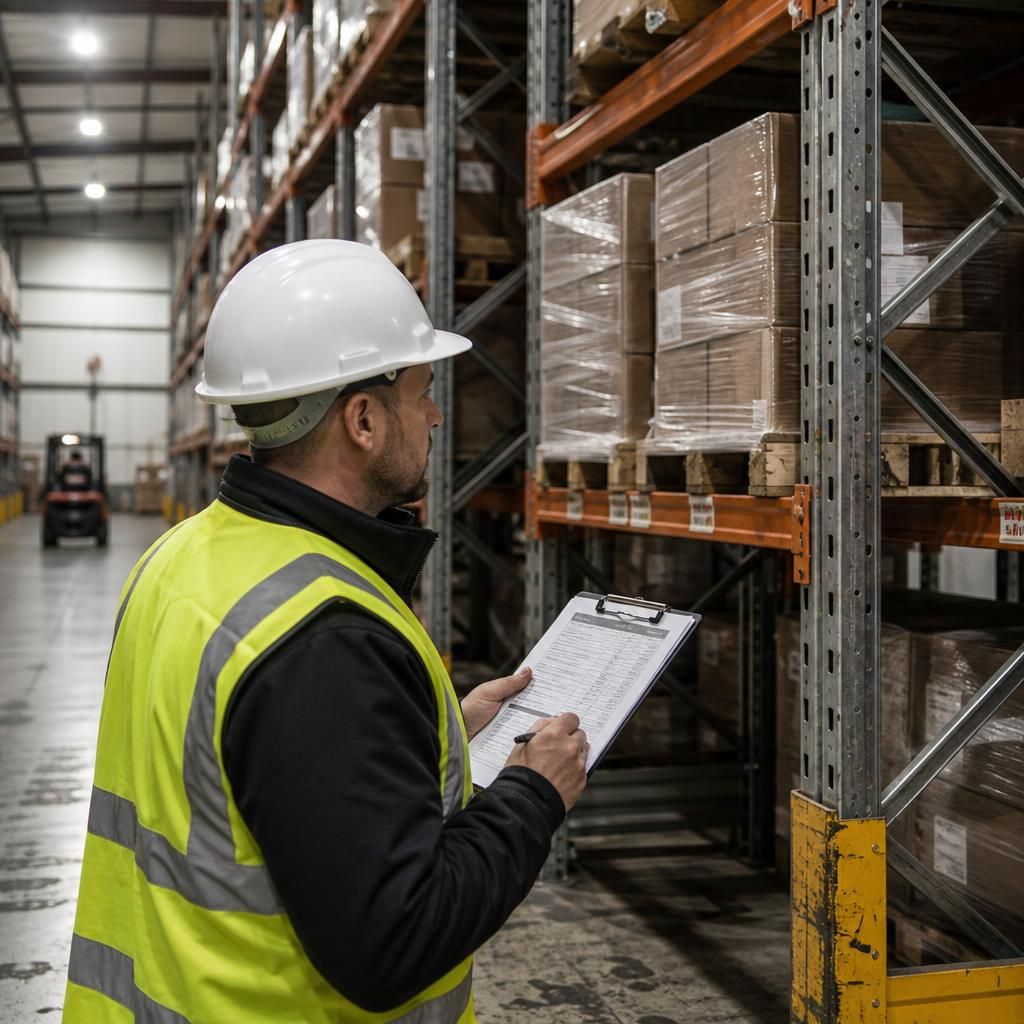
Warehouse activities and environmental conditions determine racking inspection frequency because they influence the risk of impact, overloading, corrosion and instability. Busy vehicle routes, frequent stock changes, heavy or awkward loads, moisture, poor lighting and uneven floors all justify closer monitoring and may require inspections more often than the standard planned programme.
Inspection arrangements should be reviewed after a collision, flooding, fire, significant spill, building movement or any operational change that could affect the storage system. Damage must be reported immediately and the affected area assessed by a competent person; it should not wait until the next scheduled inspection.
Records should show the conditions being monitored, the defects identified and the actions completed. This helps distinguish isolated damage from recurring problems, such as repeated vehicle impacts or corrosion. Where issues continue, improving traffic routes, housekeeping, load control or operator training may reduce risk more effectively than simply increasing inspection frequency.
Arrange an Expert Warehouse Racking Inspection
Arrange an expert warehouse racking inspection with Able Racking to review activity levels, environmental conditions and any damage affecting your storage system. We can recommend a suitable inspection programme and identify any repairs or preventative measures required.