
What are the key safety features to consider in warehouse racking systems?
Key safety features in warehouse racking systems include suitable load-rated components, secure beam connections, column guards, end-of-aisle protection, bracing and clearly displayed load notices. These features must be supported by correct installation, routine inspections and prompt repairs to protect people, prevent collapse and maintain compliance.
The key safety features in warehouse racking systems are load-rated components, secure connections, effective impact protection, stable bracing, suitable decking, clear load notices and controls that support regular inspection and maintenance. These features must work together. A well-designed warehouse racking system can still become unsafe if it is overloaded, struck by handling equipment, altered without assessment or allowed to deteriorate.
Load-rated design and components
Every warehouse racking system should be selected and configured for the loads it is expected to carry. This includes the weight of each unit load, the number of storage levels, beam spans, bay dimensions, lifting equipment and the way pallets are placed and removed. Uprights, beams, bracing and connectors must be suitable for the intended arrangement rather than treated as interchangeable parts.
Load capacity can change when beam levels are moved, bays are extended, components are replaced or the stored goods differ from the original design. Any alteration should therefore be assessed by a competent person before the system is put back into service.
Secure beam connections
Beam-to-upright connections should be fully engaged and fitted with the correct locking devices. These prevent beams from being accidentally lifted or displaced during normal operations. Locking pins, safety clips and connectors should be checked for damage, absence or poor engagement during inspections.
A connection that appears to be in place may not be properly secured. Inspectors should look for signs such as a beam sitting unevenly, damaged connector components, movement at the joint or impact marks around the connection. Damaged parts should not be straightened or repaired using improvised methods; they should be replaced with suitable components.
Upright protection and impact barriers
Column guards and other protective barriers help reduce damage caused by lift trucks, pallet trucks and other workplace traffic. Protection is particularly important at aisle ends, corners, loading areas and locations where vehicles manoeuvre close to the structure.
Protection should be positioned so that it does not obstruct access, reduce aisle clearance or create a new collision hazard. It should also be inspected because a damaged guard may no longer protect the upright effectively. Impact protection reduces risk but does not remove the need to investigate collisions and assess any damage to the warehouse racking system.
Bracing and structural stability
Diagonal and horizontal bracing maintains the geometry and stability of the warehouse racking system. Bracing members should be correctly fitted, free from significant distortion and securely connected. Missing, bent or loosened bracing can affect the behaviour of an entire bay and should be treated as a priority defect.
Warehouse racking should be installed on a suitable floor with appropriate fixing where required by its design. The floor, anchors and base plates should be checked for damage, movement and signs of settlement. Structural stability can also be affected by uneven loading, unauthorised modifications and contact with adjacent equipment.
Suitable decking and pallet support
Decking, pallet supports and beams must be suitable for the pallet type, load and storage method. They should prevent pallets from slipping through the beams or becoming unstable during placement and retrieval. The support arrangement must account for pallet condition, pallet dimensions and the possibility of unevenly distributed goods.
Damaged or missing decking should be removed from use until it has been assessed. Loads should not be placed on bent supports, broken boards or components that are not designed to carry them. Where open mesh or other decking is used, its capacity and suitability should be confirmed for the intended loads and operating conditions.
Back protection and anti-collapse measures
Where stored goods could fall towards a walkway, work area or adjoining operating zone, suitable back protection may be required. Mesh panels, barriers or other anti-collapse measures can help contain goods, but their suitability depends on the load, height, bay configuration and the area being protected.
Back protection should not be used to compensate for poor pallet placement or overloaded beams. It must be correctly attached and kept clear of obstructions that could reduce its effectiveness. Openings, gaps and damaged panels should be reviewed during inspections.
End-of-aisle and traffic protection
End-of-aisle barriers, guard rails and clearly defined traffic routes help separate vehicle movements from the warehouse racking structure and people working nearby. The protection should be robust enough for the foreseeable impact risk and positioned in accordance with the site layout.
Good traffic management also includes suitable aisle widths, visibility at crossings, controlled vehicle speeds, pedestrian segregation where practicable and adequate lighting. Safety features should be considered alongside the way the warehouse is actually operated, not just how it appears on a layout drawing.
Clearly displayed load notices
Load notices should be visible, legible and relevant to the installed configuration. They should identify the permitted loads and any restrictions that operators need to understand, such as maximum beam loads, bay loads or limitations relating to pallet placement.
Notices must be updated if the warehouse racking system is altered. A faded, missing or inaccurate notice can lead to unsafe assumptions, particularly where different bays have different capacities. Operators should know not to exceed the stated limits or place damaged pallets into storage.
Protection against incorrect use
Safe systems of work help prevent common causes of damage. Pallets should be positioned centrally and squarely, loads should be stable, and operators should avoid dragging goods across beams or striking uprights with handling equipment. The storage arrangement should leave sufficient clearance for safe loading and unloading.
Unauthorised changes, including removing bracing, relocating beams, adding components or connecting separate structures, can invalidate the original design assumptions. Any proposed change should be reviewed by a suitably competent person and recorded so that load information and inspection arrangements remain accurate.
Inspection and maintenance arrangements
Physical safety features are effective only when they are maintained. The warehouse racking system should be subject to routine visual checks by trained staff and a more detailed periodic inspection by a competent person. The inspection should cover uprights, beams, bracing, connectors, guards, decking, anchors, load notices and evidence of overloading or impact.
Damage should be classified and managed according to its severity. Areas presenting an immediate risk should be unloaded and isolated until they have been made safe. Less serious defects should still be recorded, assigned for repair and monitored so that they do not develop into a greater structural problem.
Repairs should use compatible components and follow the supplier’s or designer’s requirements. Straightening damaged structural members on site, welding without approval or mixing unsuitable components can create further risk. After repairs or alterations, the affected area should be checked before normal storage resumes.
Installation, competence and training
Correct installation is a fundamental safety feature because it establishes the alignment, connections, bracing and clearances on which the design depends. Installation should be completed by experienced operatives who understand the system and the manufacturer’s requirements, followed by a suitable handover and inspection.
Warehouse staff and handling-equipment operators should be trained to recognise damage, respect load limits, place pallets correctly and report unsafe conditions. Training should reflect the actual warehouse racking system and be refreshed when the layout, equipment or working methods change.
For UK workplaces, safety arrangements should be managed in line with the relevant manufacturer’s instructions, applicable British and European standards, and recognised Health and Safety Executive guidance. A documented inspection and repair process provides evidence that risks are being actively controlled, but it does not replace competent judgement on the condition of individual components.
In practice, the safest approach combines a correctly designed warehouse racking system with impact protection, secure components, accurate load information, disciplined operation and prompt action when defects are found. Regular inspections are essential because they identify damage and changes in condition before they become a wider safety issue.
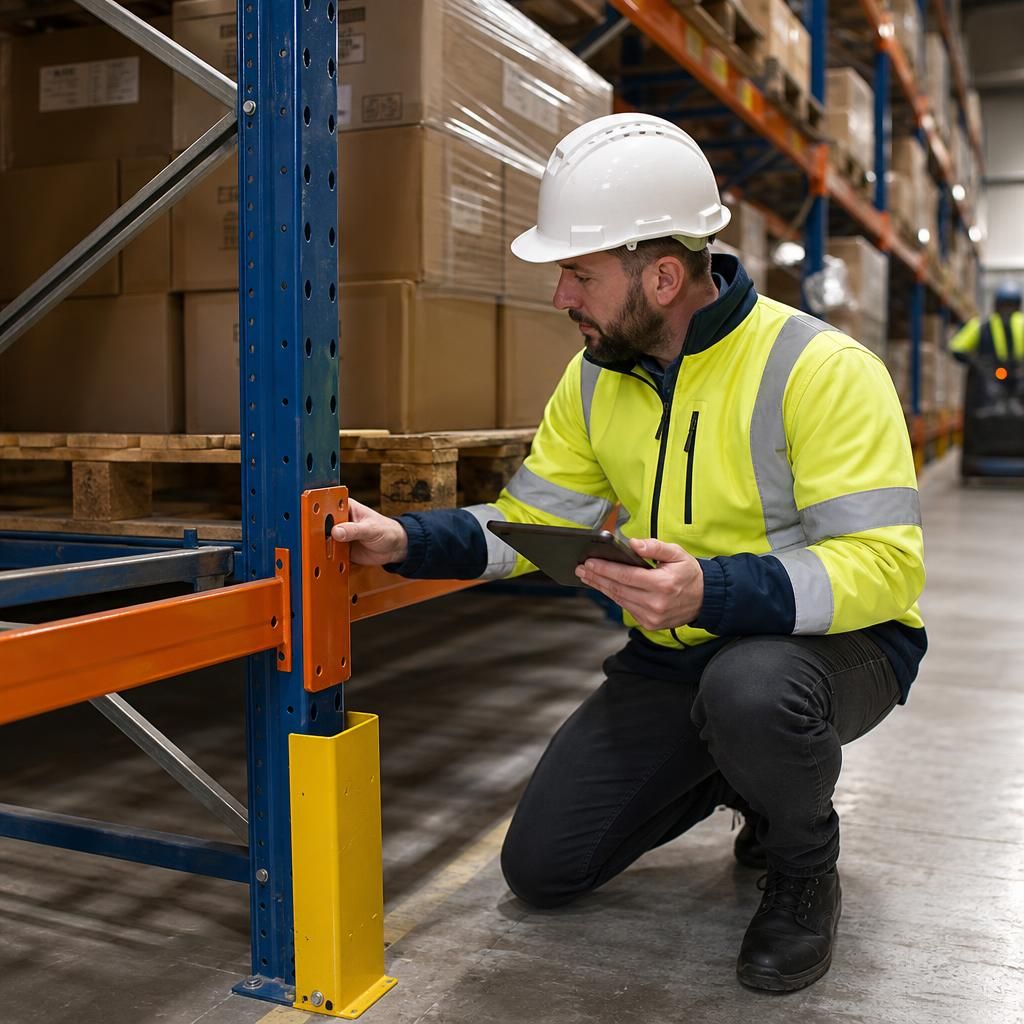
Regular inspection is a key safety feature in warehouse racking systems because it identifies impact damage, loose connections, overloading and deterioration before they create a wider structural risk. Visual checks by trained staff should be supported by detailed inspections from a competent person, with findings recorded and reviewed.
Any serious damage should lead to the affected area being unloaded and isolated until it has been assessed and made safe. Repairs should use compatible components and follow the system designer’s requirements. After repairs, alterations or a significant impact, the affected warehouse racking should be checked before storage resumes.
Book your warehouse racking safety inspection
Book your warehouse racking safety inspection with Able Racking to identify damage, overloading and other risks before they affect your operations. Our experienced inspectors provide clear findings and practical recommendations for keeping your warehouse racking safe and compliant.