
What safety measures should warehouse racking installers implement during installation?
Warehouse racking installers should use a documented risk assessment and method statement, competent operatives, suitable PPE, controlled work areas and safe lifting equipment throughout the installation. They should also check components for damage, secure each bay in line with the design, maintain site coordination and inspect the completed warehouse racking before it is put into service.
Warehouse racking installers should control the installation through a documented risk assessment and method statement, competent operatives, suitable personal protective equipment, secure work areas, safe lifting practices and systematic inspections. Every warehouse racking bay should be assembled in accordance with the approved design and manufacturer’s instructions, with site conditions and any changes reviewed before work continues.
Plan the installation before work starts
A suitable risk assessment should identify hazards arising from the warehouse layout, delivery movements, lifting operations, work at height, nearby machinery, overhead services and interaction with other contractors. The method statement should explain the installation sequence, required equipment, exclusion zones, emergency arrangements and responsibilities of everyone involved.
The installation team should review the design and confirm that it matches the available space, floor conditions, access routes, load requirements and intended use. Any discrepancy between the design and the site should be reported and resolved by the appropriate competent person rather than dealt with through improvised alterations.
Use competent and properly briefed operatives
Installers should have suitable training, practical experience and an understanding of the warehouse racking system being fitted. Before starting, the team should receive a site induction and a task briefing covering the method statement, hazards, communication arrangements and emergency procedures. Supervisors should monitor the work and stop the installation if conditions become unsafe or the agreed method can no longer be followed.
Where the installation involves powered access equipment, lifting equipment or other specialist machinery, only appropriately trained and authorised people should operate it. Visitors, delivery drivers and other workers should be kept away from the installation area unless their presence is necessary and properly controlled.
Establish a controlled work area
A clearly defined exclusion zone should be created around the installation. Barriers, signs and suitable traffic controls can prevent people from walking beneath suspended components or entering areas where frames, beams or tools could fall. The installation team should coordinate with the warehouse operator so that vehicle movements, picking activity and other work do not conflict with the installation sequence.
Where the work takes place in an active warehouse, temporary changes to pedestrian and vehicle routes should be communicated in advance. Forklift trucks and other vehicles should be separated from the work area wherever practicable. If separation is not possible, a suitable traffic management system, trained banksmen and agreed communication methods should be used.
Inspect materials and the working environment
Components should be checked when they arrive and again before assembly. Frames, beams, braces, guards, fixings and accessories should be free from damage that could affect their strength or fit. Incorrect, missing or damaged components should be quarantined and reported rather than installed.
The installers should also check the floor and surrounding area. The floor should be suitable for the proposed warehouse racking loads, sufficiently clear for safe assembly and capable of accepting the specified anchors. Any unevenness, obstructions, damage or uncertainty about the floor should be referred for assessment before fixing begins.
Apply safe lifting and handling methods
Warehouse racking components should be moved using equipment that is suitable for their weight, dimensions and the available access. Lifting accessories should be inspected, correctly rated and used in accordance with the lifting plan or safe system of work. Loads should not be moved over people, and workers should avoid standing in areas where a component could swing, roll or fall.
Manual handling should be reduced where reasonably practicable. When components must be handled by hand, the team should consider their size, weight, balance, sharp edges and the route to the installation point. Clear communication is essential when several operatives are lifting or positioning a frame or beam.
Control work at height
Installers should avoid working at height where the task can be completed from ground level. Where access at height is necessary, the equipment selected should be suitable for the task and used on stable ground by trained operatives. Harnesses, edge protection or other fall-prevention measures should be provided where the risk assessment requires them.
Improvised access, unsecured ladders and standing on warehouse racking components should not be accepted. Tools and small components should be secured or managed so they cannot fall into the area below. The exclusion zone should remain in place until the risk from falling objects has been removed.
Assemble and secure each bay correctly
Frames, beams, bracing and connections should be installed in the specified sequence so that the partly assembled structure remains stable. Temporary supports or additional controls may be needed while a section is being positioned. Installers should not leave an incomplete or unstable section unattended in an area accessible to other people.
Connections should be fully engaged and checked as assembly progresses. Base plates should be correctly positioned, anchors installed to the specified requirements and frame alignment verified. The team should not drill new holes, remove bracing, alter components or substitute fixings without approval from the relevant designer or manufacturer.
Protection such as frame guards, end-of-aisle protection and beam safety devices should be fitted where included in the design or required by the site risk assessment. These measures help reduce the consequences of contact with warehouse vehicles and should not be treated as a replacement for good traffic control.
Maintain good housekeeping
Packaging, offcuts, unused fixings and tools should be removed regularly. Clear access routes reduce trip hazards and allow emergency access. Components should be stored so that they cannot roll, topple or obstruct fire exits, walkways, electrical equipment or vehicle routes.
Any spillages, damaged flooring, poor lighting or other changing conditions should be addressed promptly. Work should be paused if the area cannot be kept sufficiently safe for the installation team and other people using the warehouse.
Coordinate changes and unexpected conditions
Installers should report changes such as revised aisle layouts, obstructions, unsuitable floor conditions, damaged components or differences between the supplied materials and the design. A competent person should assess the issue and record any approved change before work proceeds.
On-site adjustments made for convenience can affect the capacity and stability of warehouse racking. Cutting, welding, drilling, removing structural members or changing the intended arrangement should therefore only take place with suitable technical approval.
Complete final checks before handover
When installation is complete, the warehouse racking should be inspected against the approved design and installation instructions. Checks should cover frame position, plumb, beam engagement, bracing, anchors, fixings, protection, damaged components, aisle clearances and any specified load notices or safety signage.
The handover information should identify the completed arrangement, safe working load information where applicable, inspection requirements and any restrictions on use. The warehouse operator should understand that the system must not be loaded or altered until the installation has been checked and formally released for service.
Keeping records of the risk assessment, method statement, briefings, equipment checks, material issues, installation inspections and handover provides a clear safety trail. It also supports future warehouse racking inspections and helps identify defects or unauthorised changes at an early stage.
In practical terms, the essential controls are:
- an installation-specific risk assessment and method statement;
- competent, briefed and appropriately supervised operatives;
- inspection of components, equipment, floor conditions and access routes;
- controlled pedestrian and vehicle movements;
- safe lifting, handling and work-at-height arrangements;
- correct assembly, anchoring and protection in line with the approved design;
- prompt reporting and approval of changes or unexpected conditions; and
- a documented final inspection and handover before the warehouse racking is used.
These controls should remain part of a managed installation process rather than being treated as separate checks. Clear planning, competent supervision and a properly documented handover help ensure that the completed warehouse racking is stable, suitable for its intended use and ready for ongoing inspection and maintenance.
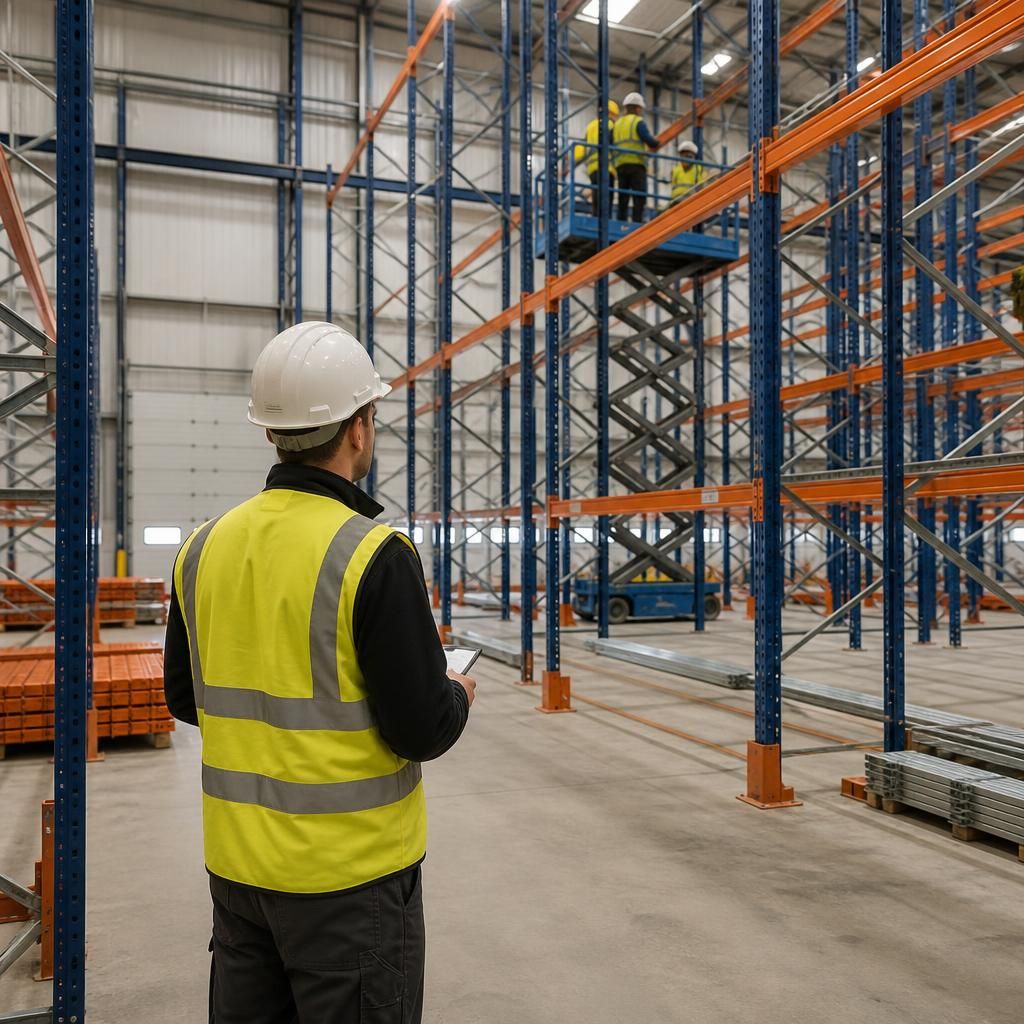
Before warehouse racking is used, installers should complete a documented final inspection and handover. This confirms that the system has been assembled to the approved design and that frames, beams, bracing, anchors, fixings, protection and aisle clearances are suitable for service.
Any damaged or incorrectly fitted components must be corrected before release. The handover should also provide load information, restrictions on use and ongoing inspection requirements, giving the warehouse operator a clear record of what has been installed and how it must be managed safely.
Discuss your warehouse racking installation safety requirements
Discuss your warehouse racking installation safety requirements with our experienced team. We can help review the planned work, identify essential controls and support a safe, compliant installation.