
How can cantilever warehouse racking improve operational efficiency?
Cantilever warehouse racking improves operational efficiency by storing long, bulky or irregularly shaped materials in an organised system with clear access from the aisle. Its adjustable arms support effective space use, faster stock handling and safer loading and retrieval, provided the system is correctly designed, loaded and maintained.
Cantilever warehouse racking improves operational efficiency by giving long, bulky and irregularly shaped materials a structured storage location with clear aisle access. Its open-front design and adjustable arms make it easier to store, identify, load and retrieve items than floor stacking or unsuitable fixed shelving. When the system is correctly designed, loaded and maintained, it can improve space utilisation, material flow, stock control and handling safety.
More effective use of storage space
Cantilever warehouse racking makes better use of vertical space while keeping long loads organised horizontally. Items such as timber, steel sections, pipes, conduit, sheet materials and other extended products can be stored on designated levels rather than spread across the warehouse floor. This can release floor space for walkways, work areas, production activities and vehicle movements.
The configuration can be adapted to the available building height, aisle arrangement and load dimensions. Arms can be positioned to suit the product range, while the number and spacing of storage levels can be selected to reduce unused space. Correct design is important: storing materials too close to the ceiling, adjacent structures or handling equipment can create access and safety problems.
Faster loading and retrieval
The open structure of cantilever warehouse racking provides direct access to each stored load. Operatives can identify the required material from the aisle without moving several other products first. This reduces double handling and helps loading and retrieval activities follow a more predictable process.
Access is particularly useful where products vary in length, weight or profile. Instead of forcing different materials into standard pallet locations, each load can be assigned to a suitable arm level or bay. This supports quicker selection and makes it easier to return unused materials to their intended location.
Handling efficiency also depends on the surrounding layout. Aisles should provide adequate clearance for the equipment being used, and loading areas should be positioned so materials do not need to travel unnecessarily through busy parts of the warehouse. The system should be planned around actual handling methods, including forklift use, cranes, manual handling or a combination of these.
Clearer stock control
Defined storage locations make it easier to see what is available and where it is stored. This can support stock checks, order preparation and replenishment by reducing time spent searching through mixed or floor-stacked materials. Clear labelling and consistent location rules further improve accuracy.
Materials should be grouped according to practical factors such as product type, length, weight, demand and handling requirements. Frequently used items can be positioned where they are quick to access, while less frequently selected stock can be stored in less accessible locations, provided the arrangement remains safe and suitable for the equipment in use.
Good stock control also reduces the risk of damaged or forgotten materials. Loads that are stored off the floor and separated by type are easier to inspect. Operatives can identify damaged packaging, bent products or unstable stacks before the material is moved or issued.
Reduced handling risk
A suitable cantilever warehouse racking system gives long loads a stable, supported storage position. This is generally safer and more manageable than leaving materials in travel routes or creating unsupported floor stacks. Separating storage from pedestrian and vehicle routes also helps reduce the likelihood of impacts and obstructions.
Efficiency should not be measured only by speed. A process that requires fewer awkward lifts, less manual repositioning and less exposure to moving vehicles is more dependable as well as more productive. Load limits, arm capacities, upright ratings and the condition of the structure must be understood by the people using the system.
Training and clear operating procedures are essential. Operatives should know how to place and remove loads, where different materials belong, how to identify damage and when to report a concern. Loads must remain within the specified capacity and should be positioned to maintain stability and prevent excessive overhang.
Greater adaptability as requirements change
Businesses often handle materials that change in size, volume or demand. Adjustable cantilever warehouse racking can accommodate these changes more effectively than storage arrangements designed around one fixed product range. Arms, levels and bay layouts may be reconfigured where the system design permits it, allowing storage capacity to evolve with operational requirements.
Any alteration should be assessed before it is carried out. Changing arm positions, adding components or storing heavier materials can affect the system’s structural performance. Modifications should be completed or approved by a competent specialist, with updated load information and records provided where necessary.
Reliable performance through inspection and maintenance
Regular inspections help ensure that efficiency is not undermined by damaged uprights, arms, bracing, base connections or protective components. A damaged system may restrict access, require workarounds or create a serious safety risk. Identifying defects early allows appropriate action to be taken before they disrupt operations or worsen.
Daily user checks should look for obvious damage, displaced components, unstable loads and signs of impact. Formal inspections should be carried out by a suitably competent person at appropriate intervals, with findings recorded and corrective actions followed through. Any area presenting an immediate danger should be taken out of use until it has been assessed and made safe.
How to achieve the best operational result
The efficiency benefits depend on matching the system to the products, building and work processes. Before installation or changes, review the material dimensions, weights, turnover, handling equipment, aisle requirements, loading pattern and future storage needs. The design should also account for floor condition, vehicle routes, pedestrian movement, lighting and emergency access.
Once installed, maintain accurate load notices, location labels and user instructions. Review the arrangement when products, handling equipment or workflows change. A correctly specified and well-managed cantilever warehouse racking system can then provide organised access, better use of available space and safer, more consistent material handling.
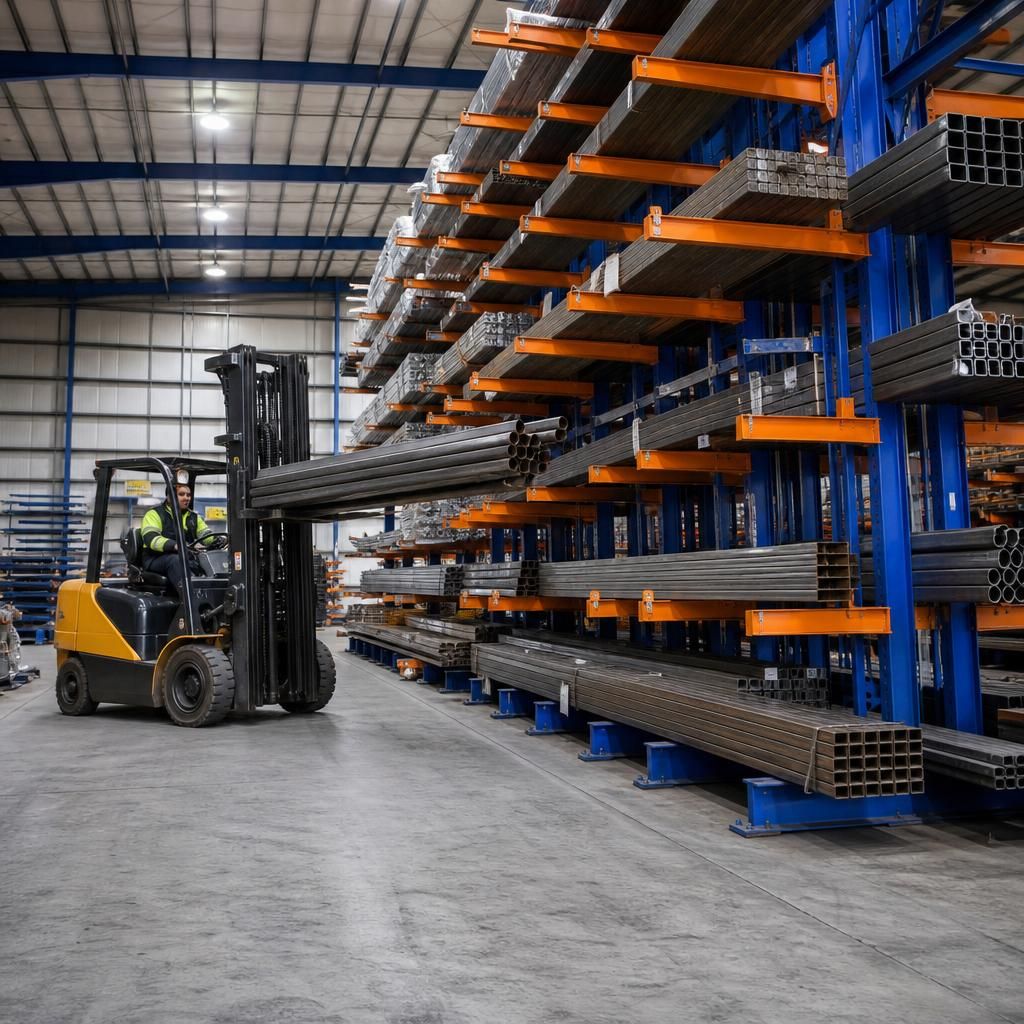
Cantilever warehouse racking improves operational efficiency by giving long, bulky and irregularly shaped materials a dedicated storage position with direct aisle access. Adjustable arms and storage levels help keep products organised, reduce floor stacking and make it easier for operatives to identify, load and retrieve stock without unnecessary movement or double handling.
Efficiency depends on correct system design and disciplined use. Load capacities, product dimensions, aisle clearances and handling equipment must be considered together, while clear labelling and regular inspections help maintain safe, predictable workflows. When the layout reflects actual storage and handling requirements, available space is used more effectively and materials can move through the warehouse with fewer delays.
Review Your Cantilever Warehouse Racking Efficiency
Review your cantilever warehouse racking layout, load requirements and handling processes with Able Racking to identify practical efficiency improvements. Contact our experienced team for advice on inspection, maintenance or system changes.