
How can businesses identify and mitigate warehouse rack safety hazards effectively?
Businesses can identify warehouse rack safety hazards through routine visual checks, formal inspections and prompt reporting of impact damage, overloading, instability or missing components. Mitigation involves isolating unsafe areas, completing competent repairs, maintaining clear operating procedures and training staff to use storage systems safely and within their design limits.
Businesses identify warehouse racking safety hazards by combining routine visual checks, planned inspections, staff reporting and review of operating conditions. Effective mitigation then depends on isolating unsafe areas, correcting the underlying cause, using competent repair specialists and maintaining procedures that keep loads, vehicles and people within the storage system’s design limits.
Hazard identification should be systematic rather than limited to obvious damage. Warehouse racking can become unsafe through impact, overloading, poor installation, unauthorised alterations, missing components, uneven floors, inadequate protection or changes to the way the system is used. A structured inspection process helps reveal both visible defects and developing risks before they lead to collapse, falling goods or injury.
Key hazards to look for include:
- Impact damage: bent or twisted uprights, damaged bracing, distorted beams, marked frames and loose or displaced components caused by forklift or pallet-truck contact.
- Overloading: loads that exceed the stated capacity, concentrated loads, unevenly distributed pallets or storage arrangements that do not match the configuration assessed by the supplier.
- Instability: unsecured frames, missing anchors, inadequate floor fixings, leaning structures, damaged bracing or signs that the system has moved from its intended position.
- Falling-stock risks: poorly positioned pallets, damaged pallets, insufficient beam supports, missing safety pins, unsuitable load dimensions or goods projecting into aisles.
- Missing or altered components: removed bracing, replaced beams, improvised repairs or changes made without checking the effect on the system’s capacity and stability.
- Unsafe surroundings: blocked aisles, poor visibility, inadequate lighting, slippery floors, restricted emergency access or vehicle routes that pass too close to storage structures.
- Operational weaknesses: unclear load notices, inadequate driver training, poor segregation between pedestrians and vehicles, or pressure to store goods in spaces not designed for them.
Routine checks provide the first line of detection. Employees and warehouse supervisors should know how to recognise impact damage, displaced loads and unsafe behaviour. Visual checks should take place as part of normal operations, with findings recorded and escalated according to the severity of the risk. Staff should never be expected to straighten, weld, drill or otherwise modify damaged warehouse racking themselves.
Formal inspections should be carried out by a technically competent person who understands the construction, use and failure risks of the system. The inspection should consider the condition of frames, beams, bracing, connectors, base plates, anchors, guards, safety pins, pallets, load signs and the surrounding floor. It should also assess whether the system is being used as designed, including load type, pallet dimensions, handling equipment, clearances and traffic arrangements.
Inspection records should describe the location and nature of each defect, its severity, the immediate control applied and the action required. Photographs, marked-up layout plans and repair records can make it easier to track recurring problems and confirm that corrective work has been completed. A repeated defect in the same aisle may indicate a vehicle-route, visibility or training problem rather than an isolated equipment fault.
When a serious defect is found, control the risk immediately. The affected bay, frame or aisle should be clearly identified and taken out of use where necessary. Loads should only be removed if doing so can be completed safely and without increasing instability. Staff and vehicle operators must be kept away from the exclusion area until a competent person has assessed the condition. Damaged components should not be returned to service simply because the structure appears stable at that moment.
Repairs should follow the system manufacturer’s requirements or be designed and approved by a suitably competent specialist. Repairs may involve replacing damaged components, reinstating bracing, renewing anchors, correcting alignment or removing incompatible parts. Straightening damaged structural members, drilling new holes or welding on site can alter the performance of the system and should not be treated as a routine solution. The completed repair should be checked before the area is reopened, with updated records retained.
Preventative controls should address the cause as well as the damage. Useful measures include:
- Displaying clear load notices that correspond with the actual warehouse racking configuration.
- Protecting vulnerable frame ends and corners with suitable guards where vehicle impact is foreseeable.
- Maintaining sufficient aisle widths, working clearances and visibility for the equipment in use.
- Separating pedestrians from vehicles through layout, barriers, marked routes and controlled crossing points.
- Using pallets that are suitable for the load and in good condition, and removing damaged pallets from service.
- Preventing unauthorised alterations, relocations or changes to beam levels.
- Keeping aisles, escape routes and access to fire-fighting equipment clear.
- Reviewing capacity and layout whenever the type, weight, dimensions or handling method for stored goods changes.
Training is an important part of mitigation because many defects arise from everyday use rather than installation. Operators should understand load limits, pallet positioning, safe vehicle movements, impact reporting and the consequences of placing goods outside marked locations. Supervisors should be able to stop unsafe activity and confirm that reported defects are dealt with promptly. Refresher training is particularly relevant after layout changes, new equipment, an incident or a pattern of repeated damage.
Warehouse racking safety should be managed through a documented inspection and reporting process aligned with the principles of BS EN 15635 and relevant UK workplace guidance, including the HSE’s warehousing and storage guidance. The inspection frequency should reflect the level of use, traffic, risk and previous damage. A competent expert inspection should be arranged at appropriate intervals, alongside more frequent internal checks and immediate reporting after significant impact or an operational change.
The most effective approach is a continuous cycle: identify the hazard, protect people from it, investigate the cause, complete an appropriate repair or improvement, verify the result and monitor whether the problem returns. This combines warehouse racking inspections, competent maintenance, suitable protection and practical staff training, helping businesses preserve structural integrity, meet their safety responsibilities and keep warehouse operations controlled.
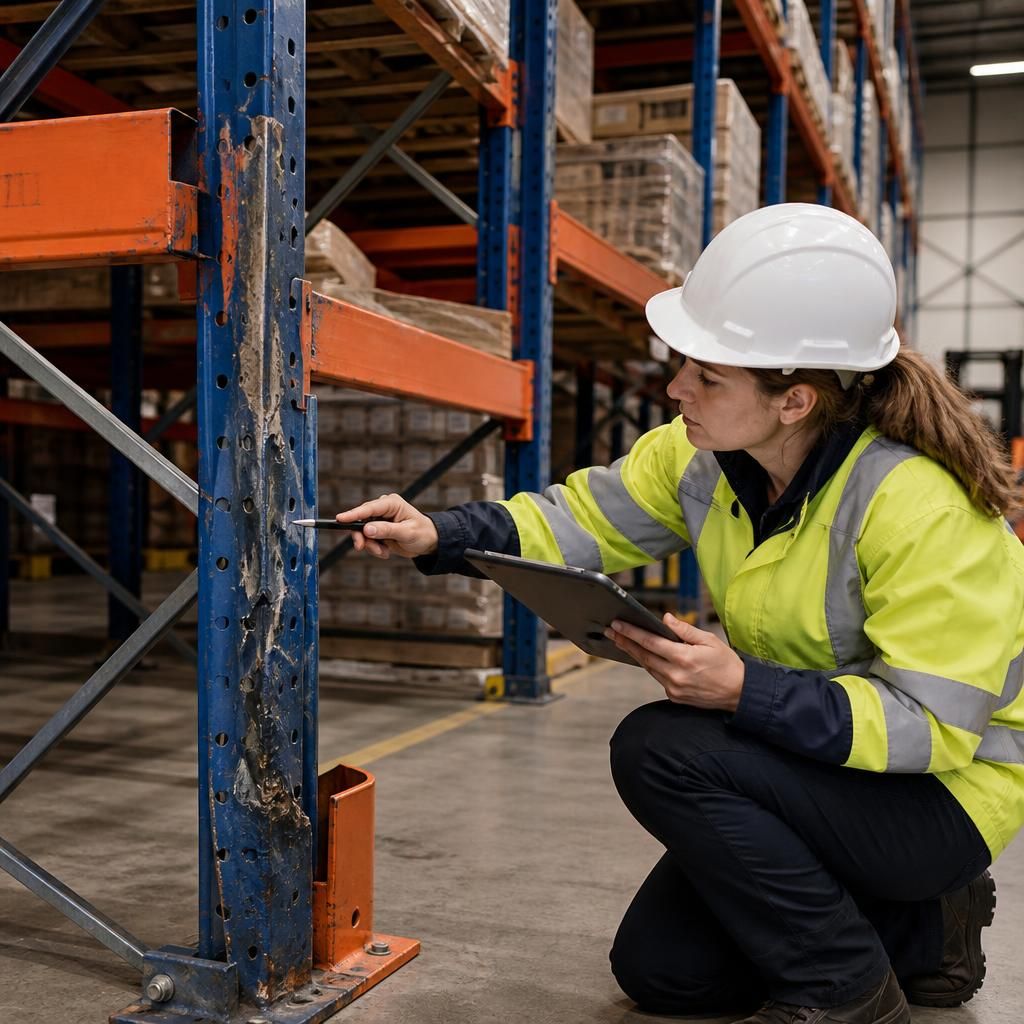
Warehouse racking safety hazards should be controlled as soon as they are identified, particularly where impact damage, instability or falling-stock risks could affect people. The affected bay or aisle should be clearly marked, isolated from warehouse traffic and reported to a supervisor before further use.
A competent person should assess the defect and determine whether the warehouse racking can remain in service, requires repair or must be taken out of use. Staff should not straighten, weld, drill or modify damaged components themselves. Loads should only be removed when this can be done without increasing instability, and the area should remain restricted until the repair has been completed and checked.
Inspection records should note the defect, location, immediate control and corrective action. Reviewing repeated damage can also reveal wider causes, such as unsuitable vehicle routes, poor visibility, inadequate protection or insufficient operator training.
Arrange an expert warehouse racking safety inspection
Arrange an expert warehouse racking safety inspection with Able Racking to identify hazards, assess defects and prioritise appropriate corrective action. Contact our experienced team to keep your storage system safe, compliant and fit for purpose.