
What safety components should be integrated into warehouse racking systems to ensure compliance and safety?
Warehouse racking systems should integrate protective frames and end-of-aisle guards, correctly fitted safety pins or clips, secure floor anchors, beam locks, load notices and suitable backstops where required. These components must be correctly specified, installed and routinely checked, alongside documented inspections and prompt repairs, to protect people and stock while supporting compliance with UK workplace safety requirements.
Warehouse racking systems should integrate physical protection, structural restraints, load-control information and inspection arrangements as one safety system. Essential components include correctly fitted safety pins or beam locks, secure floor anchors, column and end-of-aisle protection, load notices, suitable pallet supports and backstops, and anti-collapse measures where the design and risk assessment require them. Each component must be correctly specified for the system, installed in accordance with the manufacturer’s instructions and checked routinely.
Safety pins, clips and beam locks
Safety pins, locking clips and beam locks prevent beams from being accidentally lifted or displaced from their connectors. They should be present at every relevant beam connection, fully engaged and suitable for the particular warehouse racking design. Missing, damaged or incorrectly fitted devices can allow a beam to move when it is loaded or struck by handling equipment. They should be checked during routine user inspections and replaced with approved components rather than improvised alternatives.
Column, frame and end-of-aisle protection
Upright guards, frame protectors and end-of-aisle barriers help shield structural members from impact by forklifts, pallet trucks and other vehicles. Protection should be positioned so that it does not obstruct access, reduce the usable aisle width unnecessarily or create a new handling hazard. Guards must be firmly secured and kept in place; a damaged guard should not be treated as adequate protection simply because the upright behind it appears undamaged.
Where vehicle movements present a risk to the rear of a system, additional barriers or protection may be appropriate. The required arrangement depends on traffic routes, vehicle type, operating speeds, clearances and the consequences of a collision.
Floor anchors and structural stability
Baseplates should be securely anchored to a suitable floor using fixings specified for the load, frame design and floor construction. Anchors, baseplates and surrounding concrete should be checked for looseness, damage, corrosion and signs of movement. A fixing that has pulled out or a baseplate that is no longer level can affect the stability of the whole structure.
Frames, bracing and beam connections must remain complete and undamaged. Structural alterations, relocated beams and replacement parts should be assessed by a competent person, because changing one part of a system can affect its load capacity and overall stability.
Load notices and capacity information
Clearly displayed load notices are a key safety component. They should identify the permissible loads for the relevant configuration, including beam levels where necessary, and should remain visible to the people loading and operating the system. Notices must reflect the actual installed arrangement, not a previous layout or a different beam size.
Load information supports safe decisions, but it does not make overloading acceptable. Staff should understand the notice, the limits of the system and the need to report uncertain or unidentifiable loads. Loads should be placed evenly, with heavier goods stored at appropriate levels and pallets positioned securely within the beam spans.
Pallet supports, decking and backstops
Pallet supports, timber or steel decking and other load-supporting accessories can reduce the risk of pallets slipping, falling or being placed incorrectly. They should be compatible with the pallet type, the stored goods and the specified capacity. Damaged decking, bent supports or unsuitable pallets can create concentrated loads and should be removed from service until assessed.
Rear pallet stops or backstops may be required where there is a risk of loads being pushed through the rear of a bay, falling into a passageway or interfering with another work area. They should be designed and positioned so that they restrain the load without transferring unacceptable impact forces to the frame or interfering with sprinklers and other building services.
Anti-collapse mesh and containment
Safety mesh, panels and other containment systems can help prevent loose goods, cartons or pallets from falling into areas behind or beside the warehouse racking. Their suitability depends on the size and weight of the goods, the height of storage, the operating environment and the potential impact energy. Mesh should be securely attached, free from significant damage and not used as a substitute for sound loading practices or structural repair.
Clearances, aisle controls and housekeeping
Safe clearances between loads, vehicles, walkways, building features and adjacent storage should be maintained. Bollards, barriers, pedestrian segregation and clearly defined routes can reduce the likelihood of impact. Good housekeeping is also a safety control: damaged pallets, protruding goods, debris and unauthorised items in aisles can cause collisions and unstable loading.
Lighting should be sufficient for operators to identify load notices, damage, obstructions and unsafe positioning. Any fire protection arrangements, sprinkler clearances and emergency access requirements must also be maintained when safety components or storage layouts are installed.
Inspection and maintenance controls
Safety components only provide protection when they remain present, correctly fitted and suitable for the working conditions. Trained staff should carry out regular visual checks for impact damage, missing pins, displaced beams, loose anchors, damaged guards, leaning frames, overloaded bays and fallen or unstable goods. Findings should be recorded, reported and acted upon.
A formal warehouse racking inspection by a competent person should be completed at appropriate intervals and after significant events such as impact, alteration, relocation or a change in use. The inspection should assess both the structure and its protective components. Damaged areas should be isolated where necessary, unloaded safely and repaired or replaced using suitable parts. Continued use should not be permitted where the condition creates a risk to people or stock.
Integrating the components into a compliant system
Selection should begin with a documented assessment of the warehouse layout, loads, vehicles, pedestrian movements, floor condition and foreseeable impact risks. The installed system should match the design specification, manufacturer’s requirements and applicable UK workplace safety guidance, including the principles set out in BS EN 15635. Staff should receive practical instruction on load limits, safe loading, reporting damage and keeping protection in position.
The most reliable approach is to combine suitable components with competent installation, visible capacity information, regular inspections and prompt corrective work. This prevents safety devices from becoming isolated add-ons and helps ensure that warehouse racking remains stable, protected and suitable for its intended use.
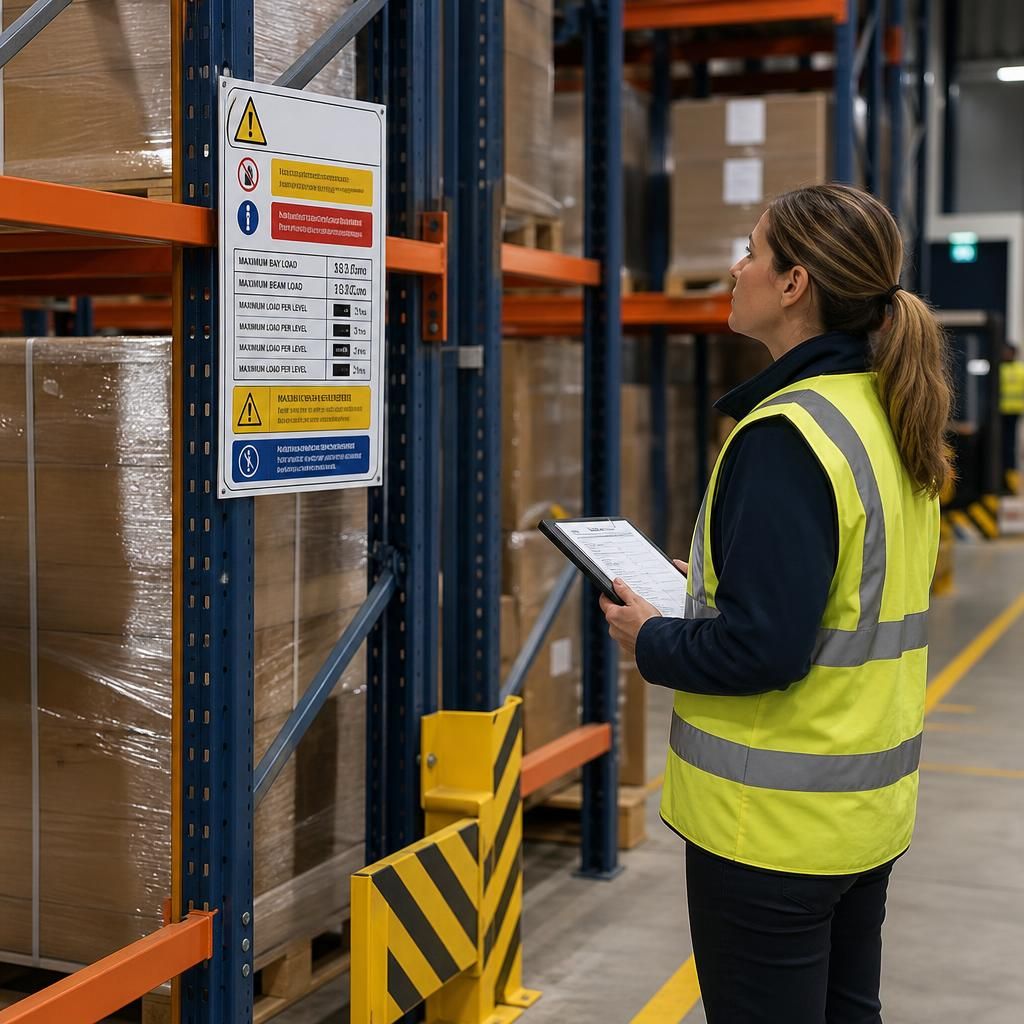
Load notices are a core safety component of warehouse racking because they show the maximum permitted loads for the installed configuration. The notice must be clearly visible, securely displayed and kept up to date whenever beam levels, components, layout or intended use changes.
Operators should use the information when selecting storage locations and loading bays. Pallets must be suitable, stable and positioned correctly, with heavier goods stored where the design permits. If a load limit is missing, unclear or does not match the warehouse racking arrangement, the bay should not be loaded until it has been checked by a competent person.
Arrange a Warehouse Racking Safety Inspection
Arrange a warehouse racking safety inspection with Able Racking to identify damaged components, missing protection and compliance issues before they affect your operation.