
What are the key maintenance requirements for mezzanine sliding gates?
Key maintenance requirements for mezzanine sliding gates include regular visual inspections, cleaning and checking the track, rollers, guides, fasteners, guarding and safety interlocks for wear, damage or obstruction. Defects should be repaired promptly by a competent person, moving parts lubricated only where permitted by the manufacturer, and all inspections, servicing and repairs recorded to support safe, reliable and compliant operation.
Mezzanine sliding gates require planned inspections, routine cleaning, correct lubrication where permitted, prompt repair of defects and accurate maintenance records. The track, rollers, guides, frame, guarding, fasteners and safety features should all be checked by a competent person so the gate continues to control access to the platform edge and operate reliably under normal working conditions.
Follow the manufacturer’s instructions and risk assessment
Maintenance should begin with the manufacturer’s instructions, the original installation information and the site’s risk assessment. These documents identify approved lubricants, adjustment points, inspection intervals and any components that must only be replaced with specified parts. The maintenance schedule should also reflect how frequently the gate is used, the loads handled nearby, the working environment and any history of faults or impact damage.
Where the gate forms part of a workplace access or loading arrangement, the employer should ensure that inspection and maintenance arrangements support the requirements of the relevant UK health and safety legislation. Work on the gate should be carried out by a person with suitable knowledge, training and experience. More complex repairs, structural adjustments and work affecting guarding should not be undertaken by untrained site personnel.
Inspect the main operating components
Routine checks should establish whether the gate opens and closes smoothly, remains stable throughout its travel and stops in the intended position. Inspect the following components for wear, looseness, distortion, corrosion, cracking or damage:
- The running track, including its alignment, fixings and end stops.
- Rollers, wheels, bearings and other moving parts for excessive wear, flat spots, stiffness or unusual noise.
- Guide channels and retainers for obstruction, misalignment or damage.
- The gate frame, infill and protective guarding for distortion, missing sections or sharp edges.
- Hinges, brackets, bolts, anchors and other fasteners for looseness or movement.
- Handles, catches, locks and closing mechanisms for secure and consistent operation.
A gate that drags, binds, rattles, fails to close fully or requires unusual force should be taken out of normal service until the cause has been assessed. Repeated adjustment without identifying the underlying defect can allow wear or misalignment to worsen.
Keep tracks and moving parts clean
Dust, packaging material, debris and product residue can obstruct the track or increase friction. The track and guide areas should be cleaned using a method that does not damage the finish or force contamination into bearings. Spilt liquids and corrosive substances should be removed promptly, particularly in environments where they may affect steel components or protective coatings.
Lubrication should only be applied where the manufacturer permits it and with the specified product. Some tracks and rollers are designed to operate without additional lubricant, while excessive oil or grease can attract dust and create a slipping or contamination hazard. Lubrication is not a substitute for replacing worn bearings, correcting alignment or repairing damaged components.
Check guarding and edge protection
The gate and associated guarding must continue to prevent people, materials and equipment from reaching the open platform edge when access is not intended. Inspect for gaps, loose panels, damaged mesh, missing sections and changes that could allow a person or load to pass through an unsafe opening.
Pay particular attention to the relationship between the sliding gate and the adjacent edge protection. The gate should close the access point properly and should not leave a hazardous gap at either end or beneath the moving section. Any alteration to the surrounding platform, guardrail or loading area should trigger a review of the gate arrangement and its risk assessment.
Test safety features and operating controls
Where fitted, safety interlocks, limit devices, locks, alarms and other protective features should be function-tested as part of the planned maintenance regime. The test should confirm that the gate cannot be used in an unsafe position and that the relevant protective function operates consistently. Interlocks must not be bypassed, wedged open or defeated to overcome an operating problem.
Check that warning notices and operating instructions remain legible and positioned where users can see them. Staff should understand how to operate the gate, what loads may be presented at the opening and how to report a fault. A gate should never be used as a lifting aid, barrier for unsupported loads or substitute for a proper loading procedure.
Repair defects promptly
Defects should be assessed according to their potential effect on safety and reliability. A damaged frame, failed fixing, defective lock, unsafe gap, faulty interlock or seriously obstructed track may require the gate to be withdrawn from use immediately. The affected area should be controlled while repairs are arranged, rather than relying on a temporary workaround that does not provide equivalent protection.
Repairs should restore the gate to its intended design and performance. Components should not be drilled, welded, removed or modified without confirming that the change is suitable for the structure and its protective function. Following repair, the gate should be inspected and function-tested before it is returned to service.
Maintain clear records
Maintenance records should identify the gate or location inspected, the date of the inspection, the person who carried out the work, findings, actions required and the date defects were closed. Records should also include component replacements, adjustments, lubrication, functional tests and any restrictions placed on use.
Good records help identify recurring faults, demonstrate that planned maintenance is being completed and provide useful information when arranging a detailed examination or future repair. They should be retained in accordance with the site’s safety management procedures and be available to the people responsible for the workplace and equipment.
Use a proportionate inspection routine
Operators should report obvious problems before using the gate, including stiffness, abnormal noise, visible damage, missing fixings or failure to latch. Planned visual and functional inspections should then be completed at intervals determined by the risk assessment, manufacturer’s guidance and conditions of use. A more detailed inspection is appropriate after impact, alteration, prolonged disuse, a significant fault or any event that may have affected alignment or structural integrity.
Maintenance is most effective when it is preventative rather than reactive. Combining operator checks, scheduled servicing, competent inspections and prompt defect management helps preserve safe operation, reduces avoidable downtime and supports continued compliance of the mezzanine access arrangement.
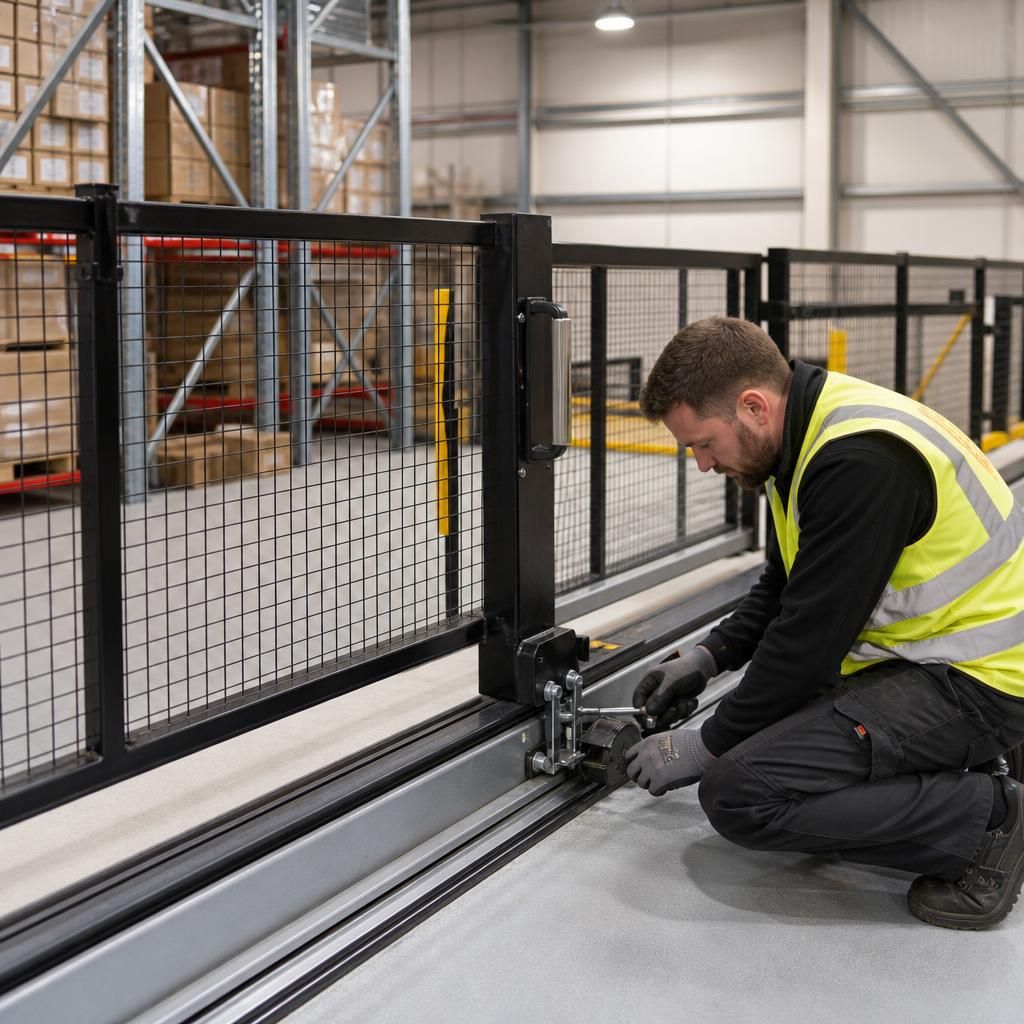
Regular inspection and prompt repair are the most important maintenance requirements for mezzanine sliding gates. The track, rollers, guides, fasteners, frame, guarding and safety features should be checked for wear, damage, obstruction or misalignment so the gate continues to protect the platform opening.
Keep the track and guide areas clear of dust, packaging and other debris, and lubricate moving parts only where the manufacturer permits it. Test the gate to confirm that it moves smoothly, closes fully and remains secure. Any damaged component, unsafe gap, failed lock or defective interlock should be reported immediately and assessed by a competent person before the gate is returned to service.
Record inspections, servicing, repairs and functional tests, including any restrictions placed on use. These records help identify recurring faults, demonstrate that maintenance is being managed and support safe, reliable operation over the gate’s working life.
Arrange a mezzanine sliding gate maintenance inspection
Arrange a mezzanine sliding gate maintenance inspection with Able Racking to identify wear, damage and safety defects before they affect reliable operation. Our experienced team can assess the gate and recommend any necessary servicing or repairs.