
What materials are best for mezzanine floor gates?
Steel is generally the best material for mezzanine floor gates because it provides high strength, impact resistance and long-term durability in demanding workplaces. Aluminium can be suitable where low weight and corrosion resistance are priorities, but the choice should reflect the gate design, loading requirements, operating environment and applicable safety standards.
Steel is usually the best material for mezzanine floor gates because it combines high strength, impact resistance and long-term durability. It is particularly suitable for busy industrial environments where gates may be used frequently, exposed to pallet-handling activity or required to retain substantial loads. Aluminium can be a useful alternative where low weight and corrosion resistance are more important, but the correct choice depends on the gate design, loading requirements, operating conditions and relevant safety standards.
A mezzanine floor gate is part of the edge protection system, so its material must be considered alongside the frame, hinges, locking mechanism, counterbalance or interlocking arrangement, and the supporting structure. A lightweight material is not automatically the safest option. The complete gate must remain stable, operate predictably and withstand the forces likely to occur during normal use and foreseeable misuse.
Steel gates
Steel is widely selected for industrial safety gates because it offers a strong and rigid construction. Properly designed steel gates can resist impact from loads, withstand repeated operation and maintain their shape in demanding working conditions. This makes steel appropriate for areas where goods are transferred to and from an elevated platform, particularly when the gate is likely to experience regular contact or accidental knocks.
- Strength and rigidity: steel is well suited to gates that need to provide robust edge protection and resist deflection.
- Impact resistance: a suitable steel design can tolerate the knocks associated with material handling and industrial traffic.
- Durability: painted, powder-coated or galvanised finishes can help protect the steel from corrosion and wear.
- Design flexibility: steel can be formed into pallet gates, vertical lift gates, hinged arrangements and other safety configurations.
The main limitation is weight. Steel gates may require stronger hinges, counterbalancing or mechanical assistance to ensure that they can be opened and closed safely. The supporting structure must also be capable of accommodating the gate and the forces transferred through its fixings. Corrosion protection is important in damp, exposed or chemically aggressive environments, and damaged coatings should be repaired before corrosion develops.
Aluminium gates
Aluminium is lighter than steel and naturally resistant to corrosion. Its lower weight can make the gate easier to operate and may reduce the demands placed on hinges, lifting components and supporting fixings. Aluminium can therefore be suitable for environments where the gate is operated frequently, manual handling effort needs to be minimised or moisture is a significant concern.
- Low weight: aluminium can simplify manual operation and reduce the effort required by the user.
- Corrosion resistance: it is useful in clean, humid or externally exposed areas, subject to the specific environment.
- Clean appearance: aluminium can provide a practical finish where appearance and ease of cleaning matter.
Aluminium is generally less rigid than steel and can be more vulnerable to denting or deformation under severe impact. It must therefore be specified carefully where the gate is exposed to vehicle movements, heavy loads or rough handling. The design should account for the required strength rather than relying solely on the material’s low weight or corrosion resistance.
Galvanised steel
Galvanised steel is often a strong choice where durability and corrosion protection are required together. The galvanised coating protects the underlying steel, making it suitable for many warehouses, workshops and partially exposed settings. It can offer the strength of steel without relying only on paint or powder coating for protection.
Galvanised surfaces should still be checked for damage, particularly around cut edges, welds, fixings and areas subject to repeated contact. If the gate is installed in an environment with high humidity, corrosive substances or strict hygiene requirements, the finish should be assessed against the conditions rather than assumed to be suitable.
Stainless steel
Stainless steel may be appropriate where corrosion resistance, cleanliness and chemical resistance are especially important. It can be considered for food production, pharmaceutical, medical or coastal environments, although the grade and finish must match the exposure conditions. Stainless steel is typically more expensive than standard or galvanised steel, so it is usually selected where its additional properties provide a practical benefit.
Even stainless steel is not maintenance-free. Contamination, unsuitable cleaning products, contact with incompatible metals and harsh chemicals can affect its surface. The gate should be inspected and cleaned in accordance with the manufacturer’s recommendations.
Mesh, solid and composite designs
The material is only one part of the specification. The gate may use mesh panels, solid panels, tubular sections or a combination of components. Mesh can improve visibility and ventilation, while solid panels may help prevent goods or loose items from passing through the gate. The openings must not create avoidable trapping, falling-object or access hazards.
Composite materials may be suitable in specialist applications, but they should only be used where their structural performance, fire behaviour, impact resistance and long-term durability are documented for the intended use. A material that performs well in a light-duty environment may not be appropriate for frequent industrial loading operations.
How to choose the most suitable material
Before selecting a material, assess the complete operating environment and the way the gate will be used. Important considerations include:
- the type, size and weight of loads being transferred;
- the likely impact from pallets, handling equipment and other workplace activity;
- how frequently the gate will be opened and closed;
- whether the gate will be manually operated or mechanically assisted;
- exposure to water, humidity, chemicals, dust, temperature changes or outdoor conditions;
- the required visibility, ventilation and protection against falling objects;
- the condition and capacity of the supporting structure and its fixings;
- access, egress, emergency arrangements and the risk of unauthorised entry;
- inspection, cleaning, lubrication and repair requirements; and
- the applicable workplace safety requirements and manufacturer’s instructions.
The gate should be assessed as a complete, compatible system. Combining materials can introduce issues such as galvanic corrosion, different rates of expansion or incompatible fixings. Hinges, bolts, bearings, locking devices and counterbalance components should be specified for the gate’s weight and expected duty, not selected independently.
Inspection and maintenance implications
Every material requires routine inspection. Check for bent members, cracks, corrosion, loose fixings, worn hinges, damaged mesh, sticking movement and failures of the locking or interlocking arrangement. Pay particular attention to areas where the gate connects to the supporting structure, as movement or looseness can affect the entire protection system.
Steel gates should be monitored for coating damage and corrosion. Aluminium gates should be checked for dents, distortion and fatigue around fixings or moving parts. Stainless and galvanised components should be inspected for surface damage and contamination. Any defect that could affect the gate’s strength, controlled movement or ability to prevent access to an open edge should be assessed promptly and the gate taken out of service where necessary.
In summary, steel is normally the most versatile option for a robust industrial mezzanine floor gate, while aluminium is useful where low weight and corrosion resistance are priorities. Galvanised steel provides additional protection in many exposed environments, and stainless steel is suited to specialist corrosive or hygiene-sensitive applications. The final specification should be based on a competent assessment of loads, impact, environment, operation and the complete safety system, rather than on material choice alone.
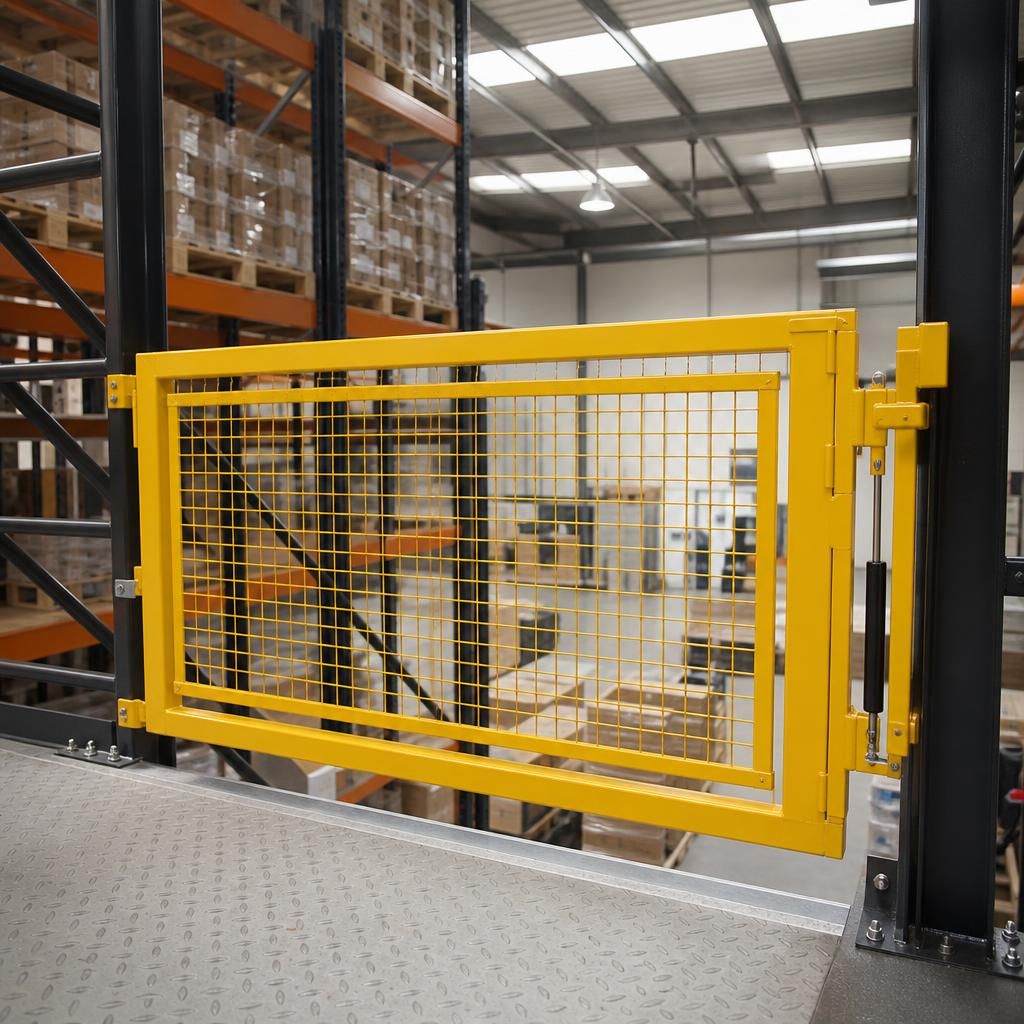
Steel is generally the most suitable material for a mezzanine floor gate where strength, rigidity and impact resistance are priorities. It is well suited to busy industrial areas where pallets or other loads are transferred regularly and the gate may be exposed to accidental knocks.
Aluminium can be a practical alternative where low weight, easier manual operation or corrosion resistance is more important. However, it may be more susceptible to denting or distortion under heavy impact. The final choice should consider the complete gate system, including its hinges, locking mechanism, counterbalance, fixings and supporting structure, as well as the loads, operating frequency and environmental conditions.
Get expert advice on mezzanine floor gate materials
Speak to our experienced team for advice on selecting a mezzanine floor gate material suited to your loads, operating conditions and safety requirements. We can help you assess the complete gate system and identify a practical, durable specification.