
What practical safety challenges could arise during warehouse racking inspections, and how do the courses address these issues?
Warehouse racking inspections can involve live warehouse traffic, restricted access, elevated components, damaged frames or beams, unclear load information and the need to judge whether defects require immediate action. SEMA courses address these challenges through practical inspection exercises covering safe working methods, defect identification, risk assessment, standards-based decisions and clear reporting.
Practical safety challenges during warehouse racking inspections usually arise from the working environment, the condition of the storage system and the judgement required when defects are found. Inspectors may need to work around moving vehicles and warehouse operatives, access elevated or obstructed areas, assess damaged components without disturbing an unstable load, and decide how urgently action is required. SEMA Racking Inspection Courses address these issues through practical exercises, safe inspection methods, defect assessment, risk-based decision-making and clear reporting.
Working safely in an active warehouse
Inspections are often carried out while normal warehouse activities continue. Forklift trucks, pallet trucks, picking activities, loading operations and temporary obstructions can all create risks for the inspector. A course therefore covers the need to plan the inspection, agree access arrangements, understand site traffic routes and maintain suitable separation from moving equipment. It also reinforces the importance of following the warehouse’s own safety procedures, wearing appropriate personal protective equipment and stopping the inspection where conditions are unsafe.
Practical training helps participants recognise that an inspection is not simply a visual walk-through. They must remain aware of changing conditions, avoid creating additional risks and communicate effectively with the responsible warehouse team. Exercises can include identifying hazards before entering an inspection area and deciding when an area should be made safe or temporarily restricted.
Accessing difficult or elevated areas
Some components are partly hidden by stored goods, conveyor equipment, services or other warehouse structures. Damage may also be located at height or in areas with limited visibility. This makes it important to understand the limits of a visual inspection and to use suitable access arrangements rather than taking unnecessary risks.
SEMA training explains how to inspect accessible areas systematically, record areas that could not be examined and report where further investigation is needed. It also highlights the difference between identifying a possible defect and attempting an unauthorised repair or adjustment. Inspectors learn to avoid climbing on storage structures or loads and to escalate access requirements to a competent person.
Identifying and assessing damage
Warehouse racking can be affected by impact from handling equipment, overloading, poor loading practices, corrosion, missing components, displaced beams and changes made during use. The practical difficulty is not only spotting damage but understanding its significance. A minor-looking bend, for example, may affect the performance of a component, while a damaged frame, beam connection or protective device may require prompt control measures.
Courses use examples and inspection exercises to develop a consistent approach to defect recognition. Participants learn to examine the relevant component, consider the location and nature of the damage, compare findings with accepted assessment criteria and distinguish between conditions requiring immediate action, remedial work or monitoring. The training also stresses that inspectors should not rely on assumptions or attempt to approve a system simply because it remains in use.
Dealing with unclear loads and altered systems
Load information may be missing, illegible or inconsistent with the way the warehouse racking is being used. Pallets may not be positioned correctly, beam levels may have been changed, or components may have been replaced without updated documentation. These issues make it difficult to confirm whether the system is operating within its intended design parameters.
SEMA inspection training shows participants how to identify missing or unreliable information and how to record it as an inspection finding. It explains the importance of checking available signage, configuration details and site records, while making clear that an inspector should not guess a safe load capacity. Where the information cannot be verified, the finding should be referred to the appropriate responsible person or competent design professional before the system is used in a different configuration.
Making consistent risk-based decisions
One of the most demanding parts of an inspection is deciding what should happen next. Inspectors need to communicate the seriousness of a defect without overstating or understating the risk. They also need to understand the difference between isolating an immediate hazard, arranging a repair and recommending continued monitoring.
Practical SEMA courses develop this judgement through scenarios based on realistic warehouse conditions. Participants assess findings, consider the possible consequences and practise recommending proportionate control measures. This helps them apply inspection principles consistently rather than relying solely on personal opinion.
Producing useful inspection reports
A technically accurate finding is of limited value if it is vague, incomplete or difficult for the warehouse team to act on. Reports should identify the location, component, type and extent of the defect, together with any required action and urgency. Photographs, reference points and clear descriptions can help the responsible person locate and control the issue.
The courses address this challenge by including guidance on inspection records, defect categorisation and concise communication. Participants learn how to report facts clearly, distinguish observed conditions from assumptions and make recommendations that can be understood by managers, maintenance teams and warehouse operatives.
Building competence without taking unnecessary risks
Practical training does not replace a site-specific risk assessment, competent supervision or appropriate technical advice. It gives participants a structured method for carrying out inspections safely and recognising when a matter falls outside their authority or experience. On completion, they should be better prepared to plan the inspection, identify hazards, assess warehouse racking defects and communicate actions that support a safer, compliant storage operation.
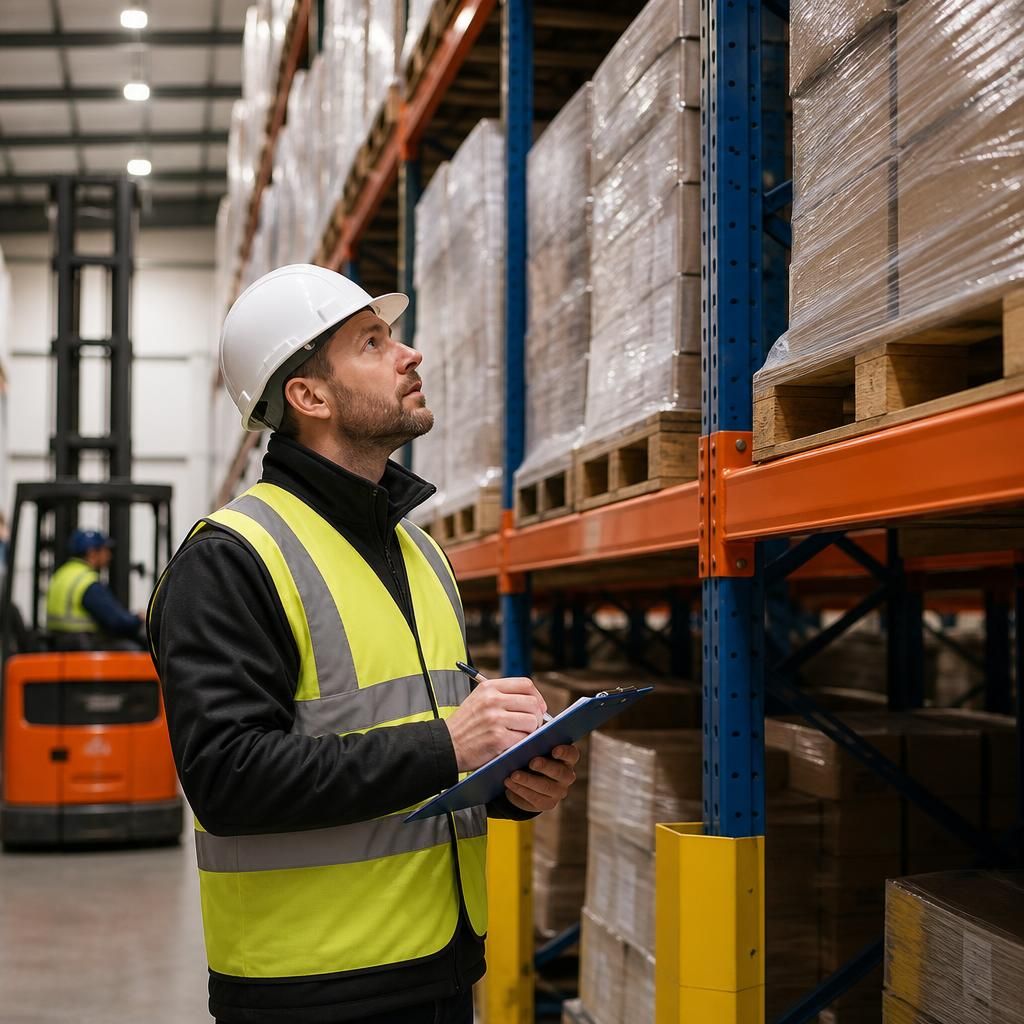
Safe warehouse racking inspections require the inspector to control personal risk while assessing storage equipment in an active working environment. Forklift trucks, pallet movements, restricted access and stored goods can make even a straightforward visual check hazardous.
SEMA training addresses this by teaching participants to plan the inspection, confirm site access arrangements, follow traffic controls and recognise when conditions are unsuitable for inspection. Practical exercises reinforce safe distances from moving equipment, the correct use of personal protective equipment and the need to stop and escalate when access is obstructed or components cannot be examined safely.
This approach also clarifies the limits of an inspection. Participants learn not to climb on warehouse racking, loads or unauthorised access equipment, and to record areas that require further investigation. That helps produce reliable findings without exposing the inspector or warehouse team to avoidable risk.
Book your warehouse racking inspection training
Book your warehouse racking inspection training with Able Racking to develop safe, consistent inspection practices and improve the quality of your findings and reports.