
What preventive measures can be implemented following an HSE warehouse racking inspection to enhance long-term safety and compliance?
Following an HSE warehouse racking inspection, implement the inspector’s corrective actions promptly, record completed repairs and continue with planned monitoring, maintenance and staff training. This may include isolating damaged areas, replacing defective components, updating load information and reviewing workplace procedures to maintain long-term safety and compliance.
Following an HSE warehouse racking inspection, the most effective preventive measures are to address recorded defects according to their risk, isolate unsafe areas, complete competent repairs, update safety information and maintain a documented programme of monitoring, training and review. The inspection report should become an active improvement plan rather than being filed without follow-up.
Prioritise and control identified risks
Review every observation with the inspector’s risk classification and recommended action. Any warehouse racking that presents an immediate risk of collapse, falling materials or instability should be taken out of use without delay. Use suitable barriers, signs or physical isolation to prevent access until the issue has been assessed and resolved. Do not rely on verbal warnings where operatives, contractors or vehicles could enter the affected area.
Lower-risk defects should still be recorded, assigned to a responsible person and given a realistic completion date. The action plan should distinguish between temporary controls, such as restricting a bay’s use, and permanent corrective work, such as replacing a damaged component or correcting an installation fault.
Complete repairs using competent personnel
Repairs should be completed by suitably competent personnel using compatible components and methods approved by the warehouse racking manufacturer, designer or another technically competent specialist. Damaged uprights, beams, bracing, safety locks, anchors and other structural parts should not be straightened, welded, drilled or improvised unless the proposed method has been properly assessed and authorised.
After repair, the affected warehouse racking should be checked to confirm that it has been restored correctly and is suitable for use. Where a defect affects the wider installation, inspect connected bays and similar components rather than treating the visible damage in isolation.
Maintain clear records of corrective action
Keep the inspection report with an action register showing:
- the location and nature of each defect;
- the risk category and required control;
- the person responsible for the action;
- the date the area was isolated or otherwise controlled;
- the repair, replacement or other work completed;
- the person or organisation that completed the work; and
- the date and outcome of any follow-up verification.
Photographs, invoices, repair specifications and completion records can provide useful evidence that issues were dealt with properly. Records should be readily available to managers, employees, contractors and anyone responsible for future inspections or maintenance.
Check load information and operating controls
Confirm that load notices remain accurate, legible and visible to forklift operators and other warehouse personnel. They should reflect the actual configuration, beam levels, bay arrangement and permitted loads. If the layout, components, pallets, handling equipment or stored goods have changed, obtain a competent review before continuing to use the installation in the revised arrangement.
Make sure warehouse procedures cover safe loading and unloading, pallet positioning, damaged loads, access restrictions, vehicle movements and the reporting of impacts. Loads should be placed centrally and securely, with clearances and operating practices consistent with the system design and the equipment in use.
Prevent vehicle and handling-equipment damage
Where impact damage has been identified, review the cause rather than simply replacing the damaged part. Preventive controls may include suitable end-of-aisle protection, upright guards, barriers, revised traffic routes, improved visibility, speed controls and separation between pedestrians and handling equipment. The suitability of any protection should be assessed against the warehouse layout and the type of equipment operating nearby.
Forklift operators and other users should understand the consequences of striking frames, beams or protection. All impacts should be reported immediately, and the affected area should be assessed before it is returned to service.
Strengthen routine monitoring and housekeeping
Introduce regular visual checks by trained warehouse personnel, supported by a clear reporting process. These checks should look for new impacts, leaning frames, missing or displaced components, loose fixings, damaged pallets, overloaded bays, falling objects and changes to the condition of floors or surrounding areas. The frequency should reflect the level of use, traffic, previous damage and the competent inspector’s recommendations.
Good housekeeping also reduces risk. Keep aisles, escape routes and access points clear; remove damaged pallets from service; prevent goods from protruding into traffic routes; and deal promptly with spills, poor lighting or uneven floor conditions that could affect safe operation.
Provide suitable information, instruction and training
Explain the inspection findings and any changes to warehouse procedures to employees, agency workers, contractors and visiting drivers where relevant. Training should cover safe loading, damage reporting, exclusion zones, load notices, pedestrian controls and the actions to take following an impact or structural concern.
Supervisors should know who can authorise a bay’s return to service and who must be contacted when a defect is found. Training records and refresher arrangements should be retained, particularly where inspection findings identify repeated operator errors or weaknesses in site controls.
Review the installation after changes
Apply formal change control whenever warehouse racking is altered, relocated, extended or loaded differently from the inspected configuration. Changes to aisle widths, beam levels, pallet types, vehicle routes, floor conditions or surrounding equipment can affect stability and safe capacity. Obtain competent advice and update drawings, load information, risk assessments and operating procedures before the changed arrangement is used.
Use inspection findings to improve the wider safety system
Look for recurring patterns in the report. Repeated impact damage may indicate inadequate traffic management or training; recurring missing safety locks may indicate poor maintenance or unsuitable components; and overloaded bays may indicate inaccurate load information or ineffective supervision. Correcting these underlying causes is more effective than repeatedly repairing the same symptoms.
Managers should review completion of actions, outstanding risks and recurring defects at planned intervals. A further competent inspection or verification may be appropriate after significant repairs, a serious impact or a substantial alteration. Continuing with documented monitoring and maintenance demonstrates that warehouse racking safety is being managed as an ongoing responsibility rather than a one-off compliance exercise.
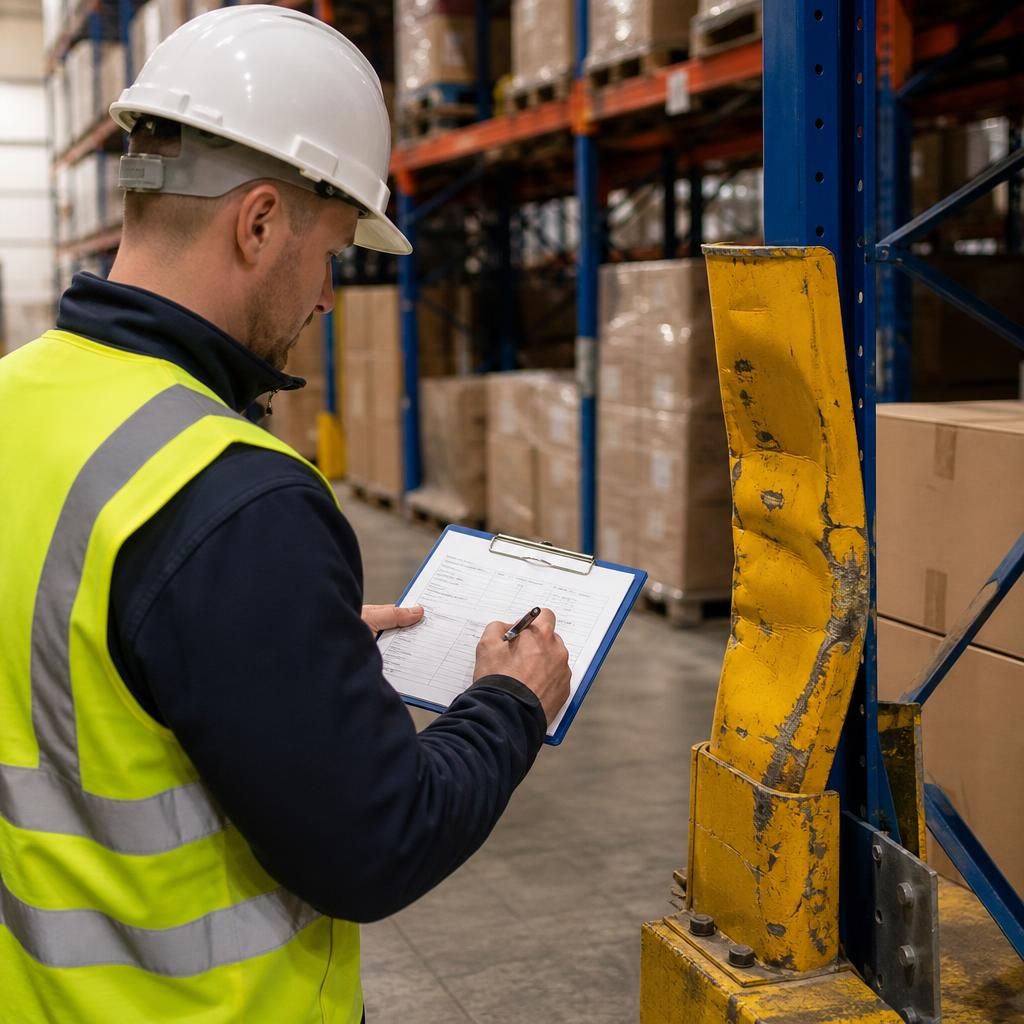
The most effective preventive measure after an HSE warehouse racking inspection is to convert every finding into a documented corrective action. Record the defect, risk level, required control, responsible person and target completion date, then verify that the work has been completed before the affected area is returned to service.
Keep supporting evidence with the inspection report, including photographs, repair details and follow-up checks. This creates a clear record for managers and future inspectors, while helping identify recurring problems such as vehicle impacts, missing components or poor loading practices. Reviewing these patterns allows the underlying cause to be addressed rather than repeatedly treating the same damage.
Plan Your Follow-Up Warehouse Racking Safety Review
Arrange a follow-up warehouse racking safety review with Able Racking to verify completed corrective actions, reassess outstanding risks and confirm that your storage system remains safe and compliant.