
What maintenance requirements are essential for pallet racking systems?
Essential maintenance for pallet racking systems includes scheduled inspections, prompt repair or replacement of damaged components, checks on load notices and protective equipment, and regular housekeeping to keep aisles and access routes clear. Staff should also receive appropriate training so they can identify damage, report concerns and use the system within its specified load limits.
Essential maintenance for pallet racking systems consists of regular visual checks, scheduled inspections by a competent person, prompt control of damage, correct loading, secure components, clear access routes and accurate maintenance records. These measures help identify risks before they affect stability, protect employees and keep the storage system operating within its design specification.
Carry out routine visual checks
Warehouse staff should look over pallet racking during normal operations and report any signs of damage or unsafe use immediately. Checks should cover upright frames, beams, bracing, safety pins, column guards, anchors, decking and other load-bearing or protective components. Particular attention is needed after an impact from a forklift truck or other handling equipment.
Staff should also look for:
- Bent, twisted, split or visibly deformed uprights and beams.
- Missing, displaced or damaged beam locking pins.
- Loose or missing anchors, bolts, bracing and protective components.
- Damaged pallets, uneven loads or goods protruding into aisles.
- Signs that loads exceed the stated capacity or are stored incorrectly.
- Obstructed aisles, emergency routes, sprinklers, fire equipment or access points.
Routine checks do not replace a formal inspection. They provide an early-warning system so concerns can be isolated and escalated without delay.
Arrange formal inspections
A competent person should complete a more detailed inspection at appropriate intervals, taking account of the warehouse environment, traffic levels, previous damage and the manufacturer’s instructions. HSE guidance and BS EN 15635 support regular expert inspections, with the interval for an expert inspection not exceeding twelve months unless a shorter period is appropriate for the risks present.
The inspection should assess the condition, alignment and stability of the complete warehouse racking installation. It should include the surrounding floor and operating environment, as movement, settlement, poor housekeeping or repeated vehicle impacts can affect system safety. The findings should be recorded in a written report, with clear actions, priorities and timescales.
Act promptly on damage
Damaged components should not simply be straightened, welded or put back into service without a suitable assessment. The affected bay or area may need to be unloaded, isolated and clearly marked until a competent person confirms the appropriate action.
Repairs should use compatible components and follow the original design, manufacturer’s instructions and relevant safety requirements. Where a component has lost its structural integrity, replacement is generally preferable to an improvised repair. After work is completed, the installation should be checked before loads and warehouse operations are resumed.
Inspection findings can be prioritised according to the severity of the risk. Serious damage requires immediate action, while less severe defects still need a planned repair and follow-up check. Keeping evidence of the defect, repair and close-out decision creates a useful audit trail and helps identify recurring impact points.
Check loading and system information
Every warehouse racking installation should display clear, legible and current load notices. These should reflect the actual configuration, including beam levels, bay arrangement, pallet positions and permitted loads. Notices must be reviewed if the system is altered, relocated or reconfigured.
Operators should understand that the stated capacity applies only when the system is used as designed. Loads should be stable, suitable for the pallet type and positioned correctly. Changes to beam levels, pallet dimensions, load distribution or the handling equipment used can affect capacity and may require a technical review before implementation.
Maintain protective equipment and the surrounding environment
Upright guards, end-of-aisle protection and other impact protection help reduce the consequences of vehicle contact, but they do not make damaged warehouse racking safe. Protective equipment should be inspected for displacement, cracking, looseness and deterioration, then repaired or replaced when necessary.
Good housekeeping is also part of maintenance. Keep aisles, working areas and escape routes clear. Remove loose packaging and damaged pallets, control spills promptly and prevent stock from resting against frames or obstructing access. Suitable lighting and clearly defined vehicle and pedestrian routes make damage and unsafe behaviour easier to identify.
Control alterations and additions
Do not add, remove or reposition beams, bracing, decking or other components without checking the effect on the system design. An apparently minor alteration can change load capacity, clearances or the way forces are transferred through the structure.
Any change should be reviewed by a suitably competent person and reflected in the load notices, layout drawings, inspection information and staff instructions. New handling equipment, different pallet types, changes in stock weight and altered traffic routes should also be considered as part of the review.
Train staff and record maintenance
Employees who load, unload, inspect or work around pallet racking should receive suitable instruction. Training should cover safe loading, load limits, damage reporting, pedestrian awareness, correct use of handling equipment and the procedure for isolating an unsafe bay. Refresher instruction is appropriate when systems, equipment, layouts or working practices change.
Maintain records of routine checks, formal inspections, reported damage, repairs, component replacements, load notices, alterations and training. Records should identify the location and nature of a defect, the action taken, who completed the work and when the area was returned to service. This documentation supports accountability and makes it easier to spot repeated damage or weaknesses in warehouse procedures.
A planned maintenance programme combining daily operational awareness, regular housekeeping, periodic expert inspections, competent repairs and effective staff training provides the most reliable protection for pallet racking systems. If damage affects a structural component or there is uncertainty about the system’s condition, stop using the affected area and arrange an assessment rather than relying on visual reassurance.
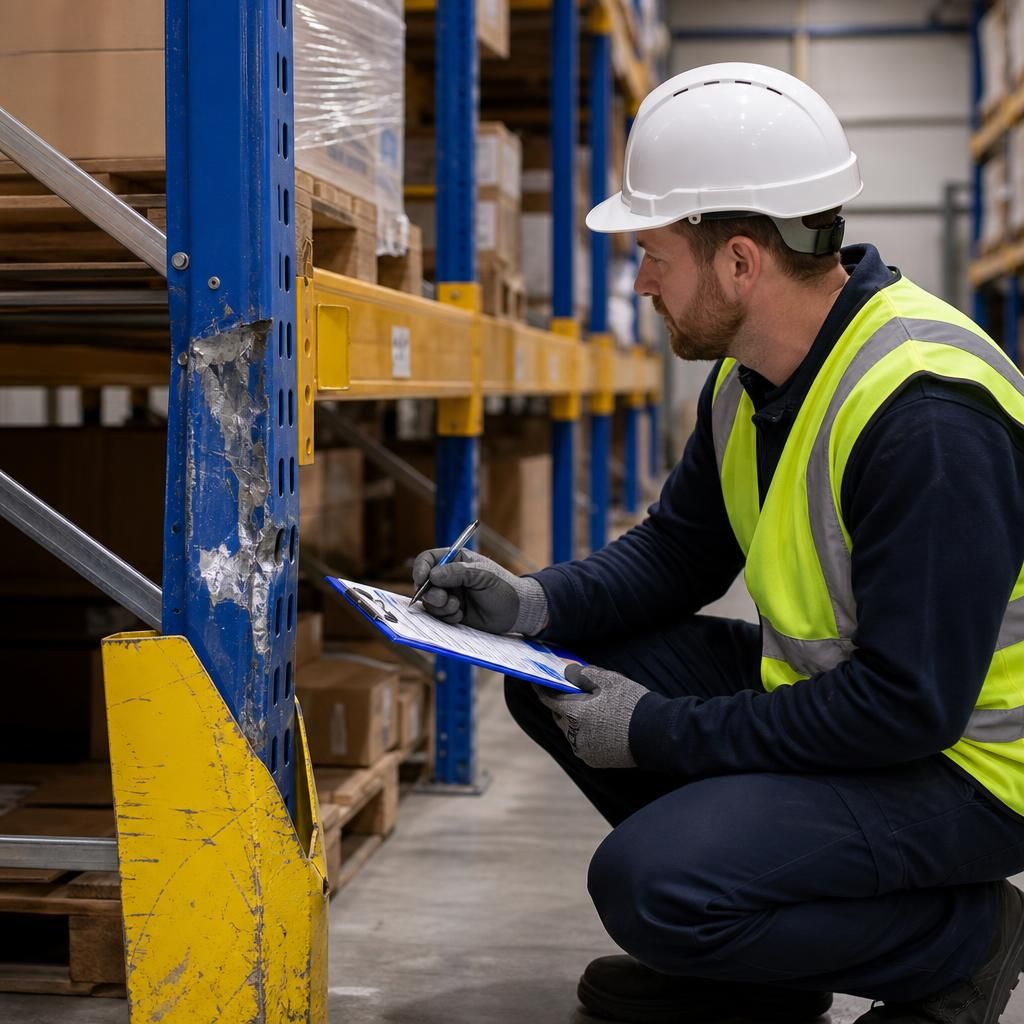
Essential maintenance for pallet racking systems is a controlled process of identifying defects, isolating unsafe areas and completing suitable repairs before the installation is returned to service. Routine visual checks can identify bent uprights, damaged beams, missing locking pins, loose anchors, displaced protection and impact damage. Any concern should be reported immediately rather than left for a scheduled inspection.
Following vehicle impact or significant damage, unload and isolate the affected bay where necessary. Do not straighten, weld or reuse a structurally damaged component without assessment by a competent person. Repairs or replacements must be compatible with the original design and manufacturer’s requirements, followed by a check confirming that the warehouse racking is safe to use.
Keep records of reported defects, inspection findings, repairs and return-to-service decisions. This creates a clear audit trail and can reveal recurring impact points, poor loading practices or weaknesses in warehouse traffic arrangements that require preventative action.
Arrange a Pallet Racking Maintenance Inspection
Arrange a pallet racking maintenance inspection with Able Racking to identify defects, assess system condition and plan any necessary repairs or replacements.