
What factors should be considered when installing mezzanine loading gates?
Installing mezzanine loading gates requires careful consideration of the gate design, load-handling process, available space, edge protection, access routes and relevant workplace safety requirements. The installation should be planned around the building structure and day-to-day warehouse operations so goods can be transferred safely without creating gaps, collision risks or avoidable delays.
Installing a mezzanine loading gate requires coordinated planning of the structure, gate design, load-transfer process, edge protection, access arrangements and workplace risks. The gate must prevent people and materials falling from the loading edge while allowing authorised operators to move goods efficiently. Its design and installation should be based on the building, the mezzanine structure, the loads being handled and the way the area is used each day.
Structural suitability and site assessment
Before selecting a gate, the supporting structure should be assessed by a suitably competent person. The assessment should confirm that the floor, supporting beams, columns and fixing points can accommodate the gate, its operating forces and the loads placed within the transfer area. The condition of the structure, floor level, surrounding obstructions and available headroom should also be checked.
Site measurements need to be accurate because small differences in opening width, platform depth or floor level can affect safe operation. The installation plan should identify services, lighting, sprinkler systems, overhead doors, conveyors and other equipment that could interfere with the gate or the movement of goods.
Gate type and operating method
The gate should match the way materials are transferred. Common considerations include whether goods are moved by forklift truck, pallet truck, hoist, crane or by hand, and whether the gate needs to operate from one side or both sides. A hinged, vertical, pallet or dual-action arrangement may be suitable depending on the available space and handling method.
The chosen design should provide a clear loading opening without creating an unprotected edge when the gate is open. It should be possible to operate the gate in a controlled manner, without excessive force, awkward reaching or the need for an operator to stand in a hazardous position. Where the gate is counterbalanced or assisted, the mechanism should be correctly adjusted and protected against unintended movement.
Load characteristics and handling process
Installation should take account of the size, weight, shape and stability of the items being transferred. Pallets, stillages, cages and long or irregular loads may need different clearances and handling controls. The gate must not be used as a storage barrier or as a support for loads unless it has been specifically designed for that purpose.
The operating sequence should be agreed before installation. For example, the load should be positioned securely before the gate is opened, and the gate should be closed before the operator leaves the protected area. Clear instructions should explain who controls the operation, how communication is maintained and what happens if a load becomes unstable or the gate cannot close correctly.
Fall prevention and edge protection
Fall protection is the primary consideration at any open loading edge. The gate should work with the surrounding guardrails, toe boards, barriers and access points to maintain continuous protection. It should not leave gaps large enough for a person, pallet or loose item to pass through unintentionally.
Where the gate opens, the design should prevent simultaneous access to the exposed edge unless the operating procedure specifically controls that risk. The protected side should remain secure while materials are being positioned, and the gate should provide a clear visual indication of whether it is correctly closed. Any gap beneath, beside or above the gate should be assessed for the risk of people or objects falling through.
Interlocks and control measures
Depending on the risk assessment, an interlock or other control may be appropriate to prevent the gate and adjacent access protection from being opened in an unsafe sequence. Interlocks should be selected and installed so that they cannot be easily bypassed during normal work. They should also be accessible for inspection and maintenance.
Controls, handles and release mechanisms should be positioned away from the fall hazard where practicable. If powered operation is used, the system should include suitable guarding, isolation, emergency controls and protection against unexpected movement. The installation should comply with the manufacturer’s instructions and the applicable workplace equipment requirements.
Access, vehicle movements and surrounding space
The area below and around the gate should be planned as carefully as the platform itself. There should be sufficient room for vehicles and equipment to approach, turn, stop and move away without striking the gate, structure or people. Collision protection may be required where trucks or other mobile equipment operate close to the installation.
Pedestrian routes should be separated from vehicle movements wherever possible. The floor should be even and suitable for the handling equipment in use, with adequate lighting and visibility at the transfer point. Warning signs, floor markings and physical barriers can reinforce the operating rules, but they should support rather than replace sound design and supervision.
Compliance and risk assessment
The installation should be supported by a documented risk assessment and method statement covering delivery, assembly, work at height, lifting operations, temporary openings and the final operating process. Relevant requirements may include the Work at Height Regulations, the Provision and Use of Work Equipment Regulations, the Lifting Operations and Lifting Equipment Regulations where lifting equipment is involved, and the Workplace (Health, Safety and Welfare) Regulations.
The exact requirements depend on the gate, the equipment used and the workplace layout. A competent installer should confirm the applicable design, installation and inspection requirements rather than relying on a standard arrangement. Where the gate forms part of a wider structural alteration, suitable engineering information and approval should be obtained before work begins.
Installation quality and commissioning
The gate should be installed on suitable, sound fixing points using the specified fixings and installation method. Fixings should not be substituted without approval, and the supporting steelwork or floor should not be altered in a way that weakens the structure. Installation work should be coordinated to prevent unauthorised use before the gate is complete.
After installation, the gate should be checked for alignment, smooth operation, secure closure, clearances, guarding and correct interaction with adjoining barriers. Any catches, hinges, counterbalances, interlocks and warning devices should be tested under normal operating conditions. The surrounding area should also be inspected to confirm that the completed installation has not introduced trip hazards, collision points or restricted access.
Training, documentation and future maintenance
Operators should receive practical instruction on the gate’s operating sequence, load limits, prohibited uses, fault reporting and emergency arrangements. Training should reflect the actual equipment and workplace rather than relying solely on general guidance. Only authorised and competent people should operate or adjust the gate.
The handover information should include installation records, manufacturer instructions, structural details where relevant, operating procedures, inspection requirements and any limitations on use. Routine checks should look for loose or damaged fixings, distortion, corrosion, worn hinges, damaged barriers, faulty latches and changes in floor or structural condition. Defects should be reported immediately, and the gate should be taken out of service if it no longer provides reliable protection.
By assessing the structure, selecting a gate suited to the load-handling process, maintaining effective fall prevention and commissioning the installation properly, the loading point can support efficient goods movement without compromising workplace safety. A site-specific assessment by an experienced professional is the appropriate final step where the layout, loads or operating conditions are complex.
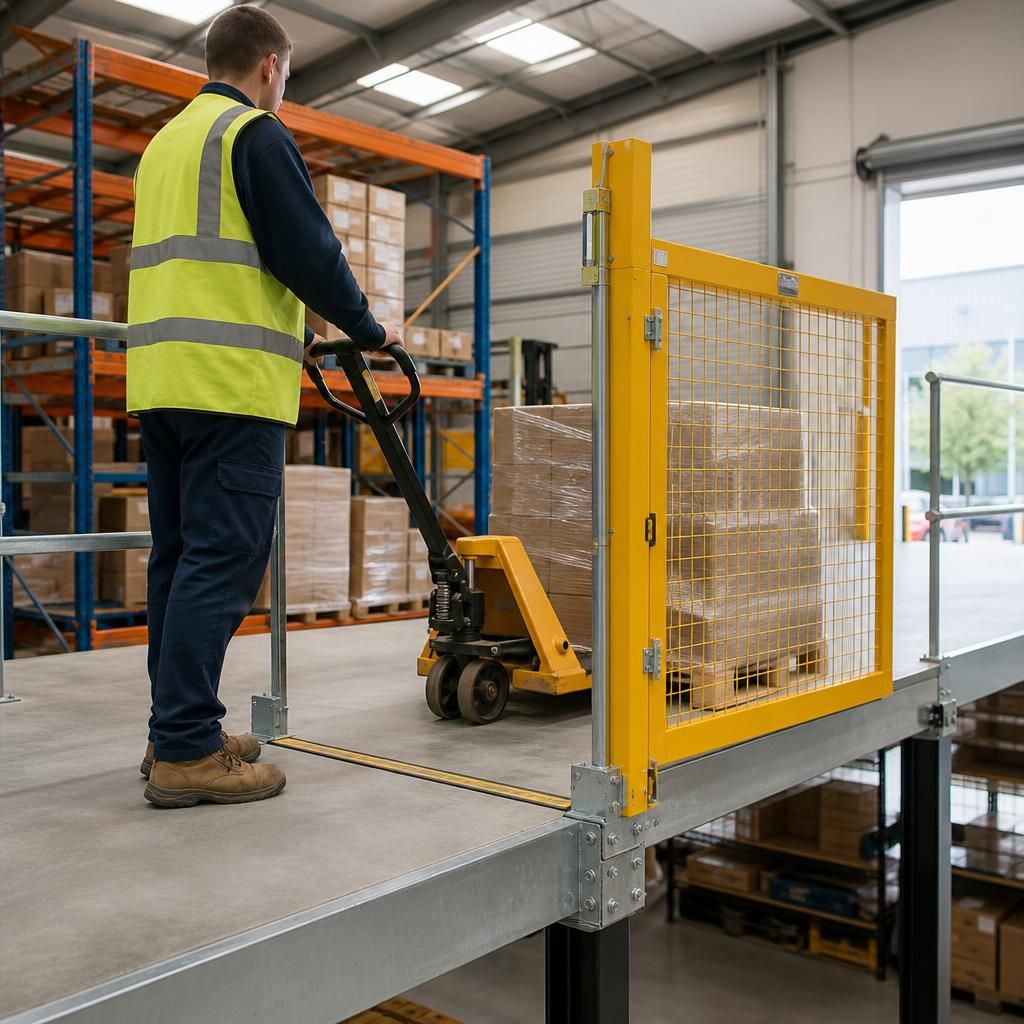
A site assessment confirms that the supporting structure, available space and operating area are suitable for the proposed mezzanine loading gate. Before installation, a competent person should check the floor, beams, columns and fixing points against the gate design, operating forces and loads handled at the transfer point.
Accurate measurements are essential. The assessment should record the opening width, platform depth, floor levels, headroom and nearby obstructions, including lighting, sprinklers, conveyors and doors. It should also consider vehicle approach routes, pedestrian access and the risk of impact from handling equipment. These checks help ensure the gate can operate without restricting movement or creating unprotected edges.
Where the existing structure or layout is unsuitable, the design should be amended before work begins. Installation should not proceed until the fixing method, load requirements and surrounding protection have been confirmed and documented.
Arrange a site assessment for your mezzanine loading gate
Arrange a site assessment for your mezzanine loading gate to confirm the structure, measurements, fixing points and operating area are suitable before installation. Contact our experienced team to discuss your requirements and plan the appropriate assessment.