
What are the maintenance requirements for mezzanine edge protection systems?
Maintenance requirements for mezzanine edge protection systems include scheduled inspections, checks after impact or alteration, prompt repair of damage, and verification that gates, fixings, rails and toe boards remain secure and correctly aligned. Keep inspection and repair records, and remove or restrict access to any unsafe section until it has been made safe by a competent person.
Maintenance requirements for mezzanine edge protection systems include planned inspections, checks after impact or alteration, prompt repair of defects and confirmation that rails, gates, toe boards, fixings and supporting connections remain secure and correctly aligned. Any damaged or unsafe section should be isolated or access restricted until a competent person has assessed and made it safe.
A suitable maintenance arrangement should be based on the system’s design, the working environment, the level of use and the manufacturer’s instructions. It should also reflect the findings of the site’s risk assessment and any applicable legal or technical requirements. Maintenance is not limited to repainting or replacing visibly damaged components; it must confirm that the complete edge protection system continues to prevent falls and withstand foreseeable use.
Routine visual checks
Routine checks should look for obvious changes or damage, including:
- loose, missing, bent or distorted guardrails and posts;
- gaps, displaced sections or changes in the alignment of the edge protection;
- loose, missing or damaged bolts, welds, brackets, base plates and other fixings;
- toe boards that are missing, damaged, lifted or no longer securely attached;
- safety gates that do not close fully, latch correctly or return to the intended safe position;
- hinges, counterbalances, springs, catches or other moving parts that are worn or obstructed;
- corrosion, impact damage, cracking, buckling or signs of deterioration; and
- changes to the floor, deck, supporting structure or surrounding equipment that could affect stability or create a fall risk.
Checks should be carried out by people who understand what the system should look like and know how to report defects. A visual check is useful for identifying immediate problems, but it does not replace a more detailed inspection by a competent person.
Detailed inspections by a competent person
Detailed inspections should assess the condition, security and performance of the whole system. This includes examining the posts, rails, toe boards, gates, fixings, connections and supporting surfaces rather than focusing only on the most accessible components. The inspector should consider whether any part has been modified, overloaded, struck by equipment or affected by building movement, corrosion or changes in the working environment.
The inspection frequency should be determined through risk assessment, manufacturer guidance and the conditions on site. A system in a busy area exposed to frequent vehicle movements, harsh substances or heavy handling may need closer monitoring than one in a controlled environment. Inspections should also be repeated after events that could affect safety, such as an impact, fire, flooding, structural alteration, change of use or installation of nearby equipment.
Gates and access points
Safety gates need particular attention because they are moving components and are frequently used. Check that the gate is correctly positioned, opens and closes smoothly, cannot be easily bypassed and remains secure when closed. Latches, hinges, springs, counterweights and other operating parts should be kept clear of obstructions and maintained in line with the manufacturer’s instructions.
Where a gate is designed to protect an open loading side, its operation must continue to prevent an unprotected opening during normal handling activities. Do not leave a gate tied open, wedged aside or altered to make access easier. If the closing or locking action is unreliable, the access point should be taken out of service until the defect has been rectified.
Cleaning, corrosion control and minor adjustment
Accumulated dust, packaging, spilled materials and debris can hide defects and interfere with gates, catches and floor-level connections. Components should be cleaned using methods that are suitable for the finish and material. Corrosion should be investigated rather than simply covered, particularly where it affects a fixing, weld, post or connection.
Only adjustments permitted by the system design or manufacturer should be carried out. Drilling new holes, welding additional parts, removing toe boards, relocating posts or changing gate mechanisms can reduce the system’s performance and may require a formal design review. Any replacement component should be compatible with the existing system and installed by a suitably competent person.
Responding to damage
Damage should be reported as soon as it is identified. The affected area should be clearly identified and, where necessary, isolated with suitable temporary controls. Do not rely on warning signs alone where people could still fall through or over the protection.
Repairs should establish the cause of the defect as well as replacing the damaged part. For example, an impact-damaged post may indicate a vehicle-control problem, while repeated loosening may point to an unsuitable fixing, vibration or movement in the supporting surface. Following repair, the affected section should be re-inspected to confirm that it is secure, correctly aligned and suitable for use.
Temporary repairs should not become a permanent arrangement. If a repair changes the original design, affects load paths or requires additional fixings, obtain appropriate technical advice before returning the area to service.
Inspection records and review
Keep clear records of inspections, defects, repairs and follow-up actions. Records should identify the area inspected, the date, the person carrying out the inspection, the findings, any restrictions applied and the date on which corrective work was completed. Photographs can help demonstrate the condition before and after repair.
Review the maintenance arrangement when inspection findings show recurring defects or when the use of the mezzanine changes. New access routes, handling activities, equipment, loads, processes or building work may alter the risks and require the edge protection to be reassessed.
Practical maintenance checklist
- Inspect the system at a frequency supported by the risk assessment and manufacturer’s guidance.
- Check rails, posts, toe boards, gates, fixings, welds and supporting surfaces.
- Test gates for smooth movement, reliable closing and secure latching.
- Look for impact, corrosion, distortion, looseness and unauthorised alterations.
- Carry out additional checks after impact, structural work or any significant change.
- Restrict access to unsafe areas immediately and arrange competent assessment.
- Use suitable, compatible replacement parts and record completed repairs.
- Review recurring defects and update the risk assessment or operating controls where needed.
Regular, documented maintenance helps demonstrate that the mezzanine edge protection remains suitable for use. It also allows defects to be addressed before they develop into a fall hazard, while ensuring that gates and protective components continue to function as intended.
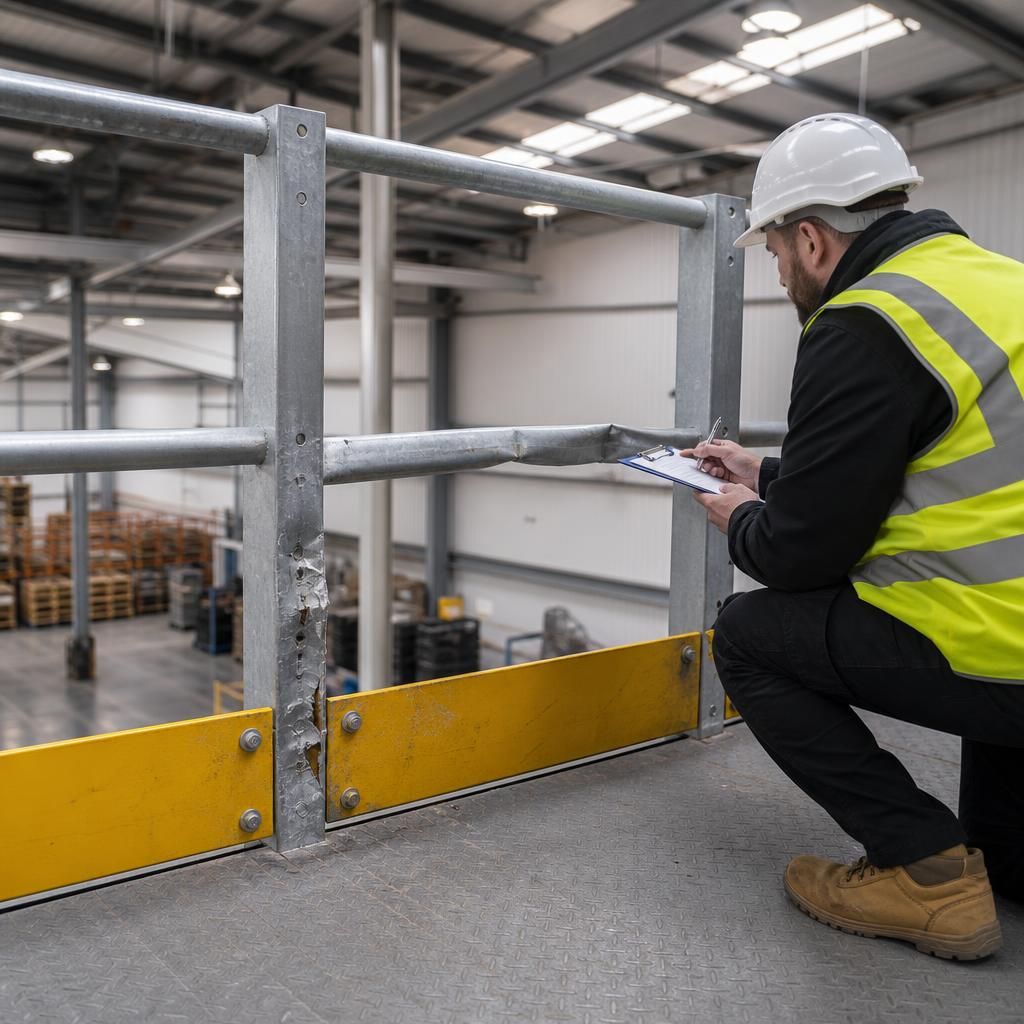
Prompt action after impact is a critical maintenance requirement for mezzanine edge protection systems. If a post, rail, toe board, gate or fixing is struck by handling equipment, the affected area should be isolated or access restricted immediately. A competent person should assess the complete section, identify any damage to connections or supporting surfaces, and confirm that repairs have restored alignment, security and protection before it is returned to use.
Arrange a mezzanine edge protection inspection
Arrange a professional mezzanine edge protection inspection to identify defects, confirm the system remains secure and support ongoing compliance. Contact our experienced team to book an assessment.