
What measures can be taken to ensure compliance with safety standards during warehouse rack maintenance?
To ensure compliance during warehouse rack maintenance, follow the manufacturer’s instructions and relevant UK health and safety requirements, supported by a documented risk assessment, suitable access equipment, controlled work areas and competent personnel. Record inspections, defects and repairs, isolate unsafe storage areas where necessary, and only return them to service after a competent person has confirmed that the system is safe.
Compliance during warehouse racking maintenance depends on planning the work, applying the correct UK safety requirements, using competent personnel and keeping a clear record of every inspection, defect and repair. The process should be based on a suitable risk assessment and method statement, the warehouse racking manufacturer’s instructions, the storage system’s design limits and recognised guidance such as HSE guidance for warehousing and storage and BS EN 15635, where applicable.
Maintenance should never be treated as an isolated repair task. It can affect the stability of loaded warehouse racking, the safety of nearby workers and the operation of warehouse vehicles. A controlled process is therefore needed before work starts, while the work is taking place and before the affected area is returned to service.
Use a documented risk assessment and method statement
Before maintenance begins, identify the hazards associated with the warehouse racking, its stored loads, the work area and the equipment needed to complete the task. The assessment should consider issues such as:
- Damaged or displaced frames, beams, bracing, baseplates and protective components.
- The possibility of falling goods, loose components or stored loads being disturbed.
- Vehicle movements, pedestrian access and interaction with warehouse operations.
- Working at height and the suitability of ladders, access platforms or other equipment.
- Manual handling, lifting operations and the weight of replacement components.
- Potential instability caused by removing, loosening or replacing structural parts.
- Emergency arrangements, fire routes and access for other workers.
The method statement should explain the safe sequence of work, the equipment to be used, the people responsible, the required controls and the circumstances in which work must stop. It should be communicated to everyone involved, not left as paperwork that is only available to management.
Appoint competent people
Warehouse racking inspections, repairs and alterations should be carried out or supervised by people with suitable training, knowledge and practical experience. Competence includes understanding the relevant storage system, recognising defects, interpreting manufacturer information and knowing when a problem requires specialist engineering advice.
Routine maintenance staff should not improvise structural repairs or replace components with items that merely appear similar. Where damage affects load-bearing parts, the repair method should be confirmed by the manufacturer, supplier or another suitably qualified storage equipment specialist. Any contractor should be briefed on site rules, emergency arrangements and the warehouse’s traffic management controls before starting work.
Follow the manufacturer’s instructions and approved specifications
Replacement beams, frames, bracing, fixings, safety locks and other warehouse racking components should be compatible with the original system and installed in accordance with the manufacturer’s instructions. Do not drill, weld, cut, straighten or modify structural components unless the work has been specifically designed and approved by a competent authority.
Load notices must remain accurate after maintenance or alteration. If the configuration, beam levels, component type or permissible load has changed, the information displayed on the warehouse racking should be reviewed and updated before the system is used. Any change that could affect structural performance should be assessed rather than assumed to be safe.
Control the work area
The affected warehouse racking should be emptied or safely unloaded where the risk assessment shows that stored goods could fall, move or overload the structure during the work. Establish a clearly marked exclusion zone around the work area and prevent unauthorised access. Where the work is close to vehicle routes, use suitable barriers, signs, banksman arrangements and temporary traffic controls.
Unsafe warehouse racking should be identified clearly and taken out of service where necessary. It must not be used for storage while repairs are pending. If only part of a run is affected, the boundaries of the restricted area should be unambiguous so that operators cannot inadvertently place loads in a damaged or isolated location.
Use suitable equipment for access and lifting
Access equipment must be selected for the task, the working height, the ground conditions and the duration of the work. Equipment used at work should be suitable, maintained and inspected in line with the relevant requirements, including the Provision and Use of Work Equipment Regulations where applicable. Work at height must be planned and carried out using appropriate controls under the Work at Height Regulations.
Where lifting equipment or lifting accessories are used to position heavy warehouse racking components, they should be suitable for the load and used by trained personnel. The requirements of the Lifting Operations and Lifting Equipment Regulations apply where relevant. Loads should be secured, lifting routes controlled and people kept clear of suspended loads.
Personal protective equipment may include safety footwear, head protection, gloves, eye protection and high-visibility clothing, depending on the risk assessment. PPE is an additional control and should not replace isolation, barriers, safe access or good working practices.
Isolate unsafe warehouse racking and prevent premature use
Where a defect presents an immediate risk, stop use of the affected warehouse racking and isolate the area. Tags, barriers or other site controls should identify its status and prevent loads from being placed back into the location. Isolation should remain in place until the repair has been completed and a competent person has confirmed that the system is safe to use.
It is important to control the handover as well as the repair. Warehouse staff should know which locations are unavailable, what work has been completed and whether any temporary restrictions remain. Verbal assurances alone are not a reliable substitute for a recorded release-to-service check.
Inspect the completed work before returning it to service
After maintenance, check that all components, fixings, safety locks, anchors, bracing and protective measures have been correctly installed. Confirm that the repaired warehouse racking is aligned, stable and free from tools, loose materials and avoidable obstructions. Check that loads can be stored in accordance with the approved configuration and that load notices remain visible and correct.
A competent person should decide whether the warehouse racking can be returned to service. If the repair does not fully resolve the defect, further engineering assessment or replacement may be required. Do not conceal damage with paint or make a cosmetic repair where the component’s strength or stability may have been affected.
Keep complete maintenance records
Records should identify the warehouse racking inspected, the date of the work, the person or company completing it, defects found, photographs where useful, actions taken, replacement components and the person authorising return to service. Record any areas that remain restricted and the date for follow-up action.
These records support ongoing compliance and help identify recurring problems, such as repeated impact damage, unsuitable loading practices or ineffective traffic controls. They should be retained with inspection reports, risk assessments, repair documentation, manufacturer information and training records so that the history of the warehouse racking can be reviewed when required.
Support maintenance with training and routine monitoring
Operators should understand load limits, correct loading methods, prohibited practices and the procedure for reporting damage. They should know not to use damaged warehouse racking, remove safety components or make unauthorised alterations. Supervisors should monitor the system after maintenance and ensure that new damage or unsafe behaviour is reported promptly.
Routine visual checks by trained warehouse personnel do not replace a formal inspection by a competent person. They are an important preventative measure that can identify impact damage, leaning frames, missing components, displaced loads and other issues before they become more serious.
For an effective compliance process, treat maintenance as a controlled safety activity: assess the risks, isolate the area, use competent people and suitable equipment, follow approved specifications, record the work and obtain competent confirmation before reuse. This approach helps demonstrate that warehouse racking is being maintained responsibly while reducing the likelihood of falling loads, structural failure and avoidable disruption.
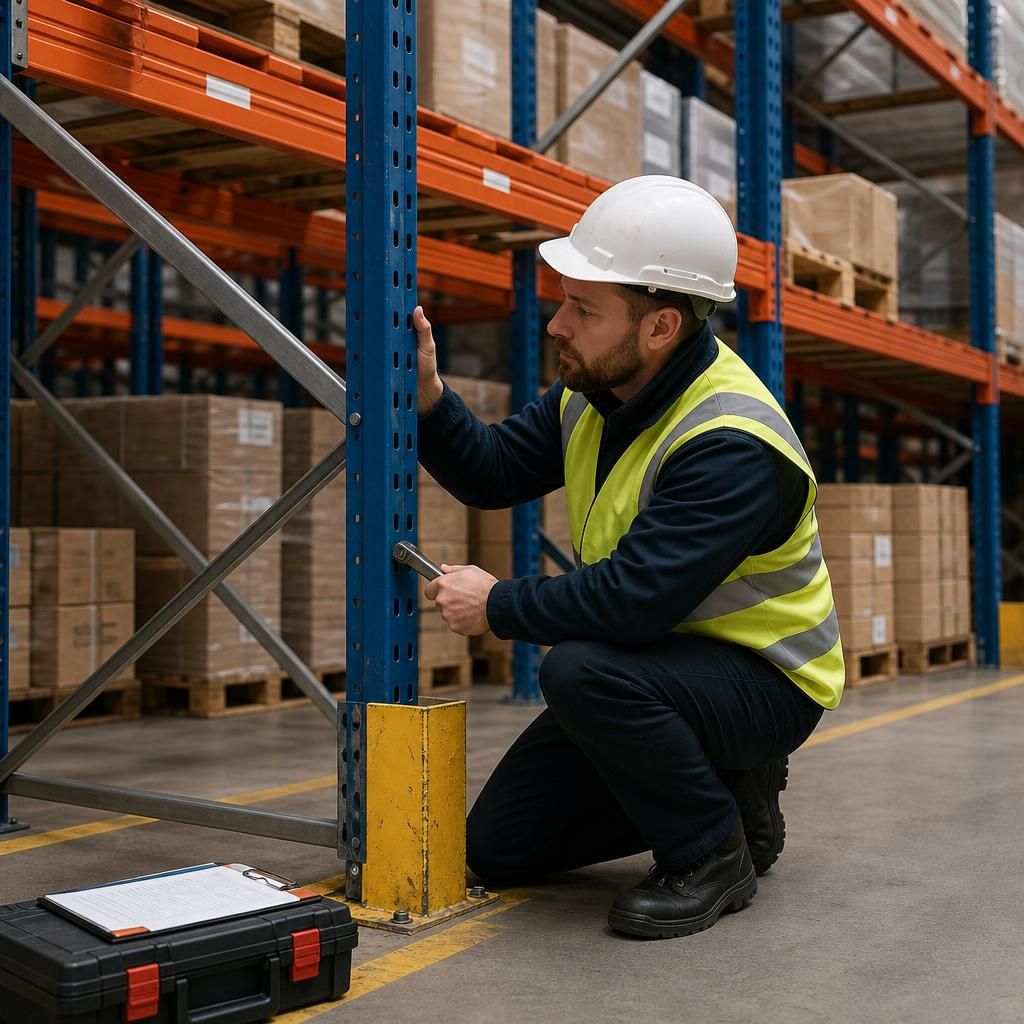
Compliance during warehouse racking maintenance means controlling the work from the initial risk assessment through to the documented release of the affected area. A competent person should confirm that the repair follows the approved specification, that all components and fixings are secure, and that the warehouse racking is safe to return to use.
Before work starts, isolate damaged warehouse racking, unload it where necessary and establish a clearly marked exclusion zone. Once maintenance is complete, check alignment, bracing, anchors, safety locks, protective components and load notices. Record the defect, repair, replacement parts and release-to-service decision so there is a clear audit trail and warehouse staff understand any remaining restrictions.
Speak to our experts about warehouse racking maintenance compliance
Speak to our experts for practical guidance on maintaining warehouse racking in line with UK safety requirements, including inspections, repairs and compliance records.