
What qualifications and certifications should repair technicians hold for handling warehouse rack repairs?
There is no single statutory qualification for warehouse racking repairs, but technicians should be demonstrably competent through relevant industry training, practical experience and knowledge of current UK safety requirements. They should understand SEMA guidance, manufacturer instructions, risk assessment and safe systems of work, and be trained to identify damage, specify suitable repairs and verify that the system is safe to return to service.
Warehouse racking repair technicians should be demonstrably competent through relevant training, supervised practical experience and a sound understanding of current UK safety requirements. There is no single statutory qualification that automatically authorises a person to repair every type of warehouse racking. Competence depends on the technician’s ability to assess damage, select an appropriate repair method, follow the system or component manufacturer’s instructions, and verify that the repaired installation is safe to use.
Relevant competence normally includes:
- Training in warehouse racking safety, damage assessment and repair procedures.
- Practical experience with the relevant racking types, components, loading arrangements and repair systems.
- Knowledge of the principles in BS EN 15635, the SEMA Code of Practice and HSE guidance on the safe use of storage equipment.
- Ability to interpret risk assessments, method statements, load notices, inspection records and manufacturer information.
- Training in safe working practices, including work at height, manual handling, exclusion zones and the control of workplace traffic where applicable.
- Knowledge of when a damaged component must be isolated, unloaded, replaced or referred to a suitably qualified engineer.
Inspection qualifications and repair competence are related but different. A person trained to inspect warehouse racking may be qualified to identify damage and recommend action, but that does not automatically demonstrate competence to carry out every repair. Conversely, a repair technician may have extensive installation and repair experience but still need appropriate inspection training if they are responsible for formally assessing the wider system. Businesses should check that the technician’s training matches the work being undertaken.
A SEMA-approved or similarly recognised inspection qualification can provide useful evidence of competence for racking inspections. It should be considered alongside practical repair experience, knowledge of the particular repair system and the ability to follow the repair manufacturer’s instructions. It is not, by itself, a universal licence for structural alterations, engineering design or specialist repair work.
Technicians should also hold suitable site-safety training for the conditions in which they work. Depending on the warehouse and the task, this may include training for work at height, use of access equipment, abrasive wheels, lifting equipment, hot work, or site-specific traffic management. CSCS or another site-access card may be requested by a principal contractor, but a card alone does not prove competence in warehouse racking repair.
Specialist work requires additional qualifications or controls. For example, welding or other structural fabrication should only be undertaken by personnel with appropriate welding competence, supported by a properly designed and approved repair specification. Electrical, lifting-equipment or access-equipment work may require separate specialist qualifications. Where a repair involves non-standard components, changes to the original design or uncertainty about load capacity, it should be reviewed by a suitably competent structural or storage-equipment engineer rather than improvised on site.
A competent repair technician should be able to:
- Make the area safe by controlling access and preventing use of affected bays or frames.
- Assess the damage against the relevant inspection criteria and determine whether the component is repairable, requires replacement or needs further engineering review.
- Confirm the proposed repair is suitable for the rack design, loading requirements and damage mechanism.
- Install the approved repair correctly, using the specified components, fixings, torque settings and installation method.
- Check adjacent components and connections for secondary damage or conditions that could cause the problem to recur.
- Record the work completed and communicate any restrictions, outstanding actions or changes to the responsible person.
Evidence of competence should be current and verifiable. Useful records include training certificates, manufacturer or repair-system training, inspection qualifications, site-safety certificates, previous repair experience, toolbox-talk records and documented supervision or assessment. The employing company should also maintain procedures for equipment checks, calibration where relevant, quality control and continuing professional development.
Qualifications are only one part of a safe repair service. The technician must work within a documented safe system of work, use suitable personal protective equipment, follow the agreed risk assessment and keep people away from falling-object or vehicle-impact hazards. The responsible person for the warehouse racking should receive clear completion records and should not return an affected area to service until the repair has been completed and any required inspection or engineering approval has been obtained.
When arranging repairs with Able Racking, it is reasonable to ask which qualifications and manufacturer training apply to the proposed work, who will assess the damage, what repair system will be used and what documentation will be supplied afterwards. Able Racking’s experienced operatives combine practical installation and repair knowledge with structured safety procedures, detailed assessments and an understanding of the standards governing warehouse racking. This ensures that repairs are based on evidence and approved methods rather than a temporary or cosmetic fix.
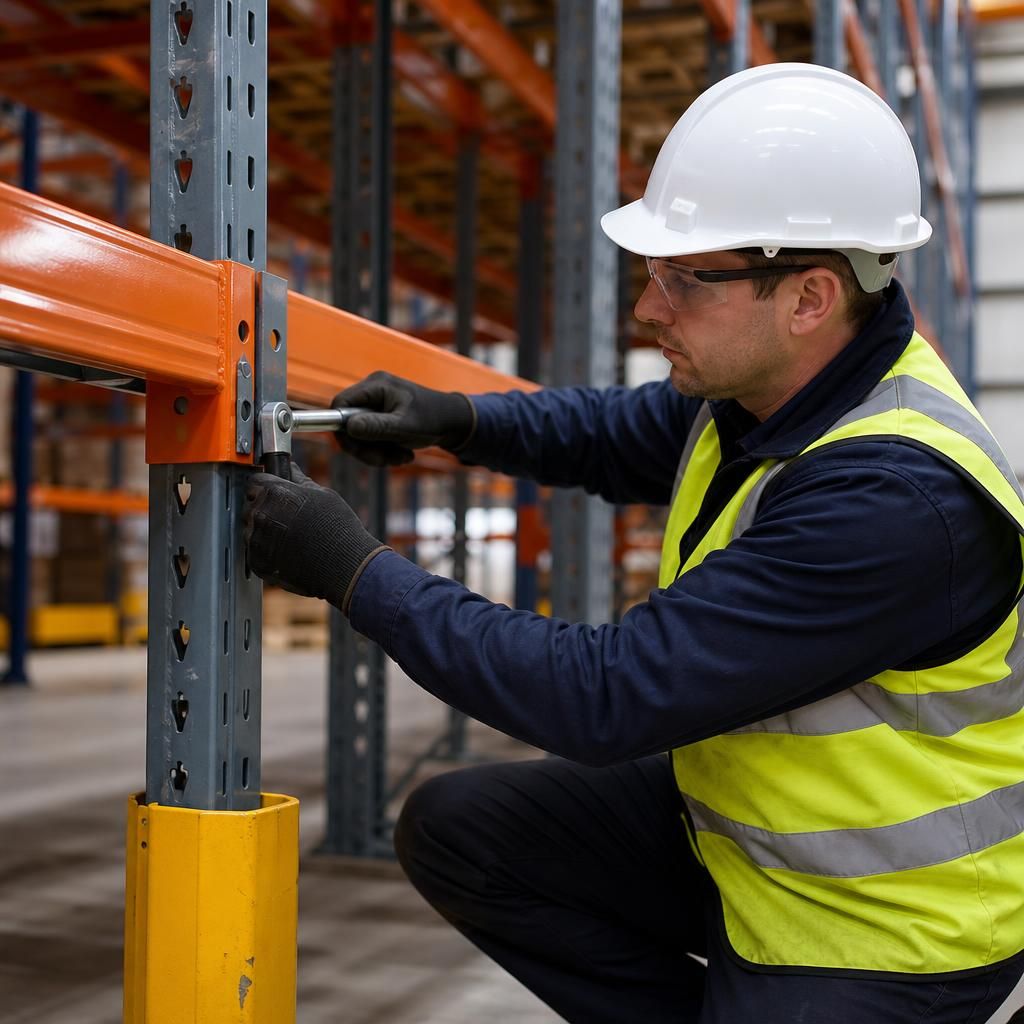
Repair technicians should be able to demonstrate competence through relevant warehouse racking training, practical experience and knowledge of current safety requirements. A qualification or inspection certificate can support this evidence, but it does not automatically authorise a technician to undertake every type of repair.
Before work begins, confirm that the technician understands the affected system, the proposed repair method, manufacturer instructions and the principles of BS EN 15635 and the SEMA Code of Practice. They should also be able to assess whether a component can be repaired, must be replaced or requires engineering review.
Ask for clear records of the assessment, repair completed and any restrictions on returning the area to service. This helps demonstrate that the work was carried out by competent personnel using an approved method, rather than providing a temporary or cosmetic fix.
Ask about our warehouse rack repair technicians’ qualifications
Contact Able Racking to confirm which qualifications, practical experience and repair-system training apply to your warehouse rack repairs. We can explain the proposed method and provide the relevant completion records once the work is finished.