
What are the benefits of using mobile racking systems in warehouses? Mobile racking systems maximise storage capacity by moving shelving along floor-mounted rails, reducing the need for fixed aisles while keeping stored goods accessible. They can improve space utilisation, support more organised warehouse operations and adapt to changing storage requirements when properly designed, installed and maintained.
Mobile racking systems increase warehouse storage capacity by moving storage units along floor-mounted rails, reducing the number of fixed aisles required while keeping goods accessible when needed. They can improve space utilisation, support more organised warehouse operations and adapt to changing storage requirements when properly designed, installed and maintained.
Mobile racking systems improve warehouse storage by moving storage units along floor-mounted rails, allowing operators to open an access aisle only where it is needed. This reduces the amount of space occupied by permanent aisles while retaining direct access to stored goods. The result can be higher storage density, better use of available floor area and a more adaptable warehouse layout when the system is correctly designed, installed and maintained.
The main benefits of mobile racking systems include:
- More effective use of warehouse floor space
- Increased storage capacity within the existing building
- Direct access to stock when required
- Greater flexibility as storage needs change
- Improved organisation and stock control
- Potentially lower building and operating costs compared with expanding the premises
- Better control over access, safety and working conditions
Improved space utilisation
Conventional warehouse racking layouts generally require a fixed aisle between each row. Mobile racking systems remove the need for most of these permanently open aisles. The units can be positioned together when access is not required and moved apart to create a working aisle at the selected location.
This arrangement can make more of the available building footprint usable for storage. It may be particularly helpful where floor space is limited, expansion space is unavailable or the warehouse needs to hold a larger range of products without relocating. A properly planned layout must still allow for operating clearances, emergency routes, loading requirements and safe access for handling equipment.
Higher storage capacity without moving premises
By reducing space given over to fixed aisles, mobile racking systems can accommodate additional storage positions within an existing warehouse. They may also allow stored goods to be arranged more efficiently by product type, turnover, size or handling requirements.
The actual capacity gain depends on factors such as the building dimensions, rack height, load sizes, access frequency, floor condition, handling equipment and fire protection arrangements. A site survey is therefore important before specifying a system. Increasing storage density without checking these factors can create operational or safety problems rather than a genuine improvement.
Access to every storage location
Unlike some high-density storage arrangements that require goods to be accessed through other stored items, mobile racking systems can provide direct access to the selected aisle. Operators can move the relevant units, open the required aisle and retrieve or place stock using suitable equipment.
This supports more controlled stock handling and can reduce unnecessary movement around the warehouse. The system should be configured around the way goods are picked, replenished and dispatched. If stock is accessed frequently, the layout and control settings must allow aisles to be opened efficiently without creating congestion.
Greater flexibility for changing requirements
Mobile racking systems can be useful where product ranges, stock volumes or operational priorities change over time. Storage units can often be reorganised within the planned layout, subject to the system design and load limits. This provides more flexibility than a fixed arrangement in which aisle positions and storage zones are largely permanent.
Flexibility does not mean that units can be altered or loaded without control. Changes to beam levels, load configurations, operating procedures or handling equipment should be assessed by a competent person. Any change that affects the system’s design assumptions should be documented and followed by appropriate checks.
Better organisation and stock control
Mobile racking systems can support clearer storage zoning because goods can be arranged according to their use, condition, size or access frequency. Consistent labelling, defined locations and suitable inventory procedures help operators find stock accurately and reduce avoidable searching.
Improved organisation can also support stock rotation and reduce the risk of goods being left in unsuitable locations. The benefit depends on combining the physical layout with reliable warehouse procedures, accurate records and regular housekeeping. A dense storage system should never be allowed to become difficult to inspect or navigate.
Potential cost and building benefits
Where a warehouse has sufficient structural capacity and suitable floor space, increasing storage density may delay the need for a larger premises or building extension. Consolidating storage into a better-planned area can also reduce the amount of space that needs to be heated, lit or maintained. These potential benefits need to be assessed against the purchase, installation, control, inspection and maintenance requirements of the mobile system.
Mobile racking is not automatically the most economical option for every warehouse. A fixed layout may be more appropriate where goods require constant simultaneous access, where the floor is unsuitable for rails or where rapid movement between all locations is essential. The right choice depends on the warehouse’s operational pattern rather than storage density alone.
Support for safer and more controlled operations
Modern mobile racking systems can include controls and safety devices designed to prevent movement when an aisle is occupied, detect obstructions and limit access during operation. Emergency stop controls, warning systems and defined operating procedures can help reduce foreseeable risks when they are correctly specified and maintained.
These features do not replace training, supervision or routine inspections. Operators need to understand how to open and close aisles safely, how to respond to alarms and what to do if a control or safety device appears defective. Loads must remain within the stated limits, be positioned securely and be suitable for the storage equipment.
Efficient use of handling equipment
A well-designed mobile racking layout can help reduce unnecessary travel for picking and replenishment. It can also ensure that the aisle widths, rack positions and load levels are compatible with the warehouse’s handling equipment. This may support smoother workflows and reduce the risk of contact damage caused by unsuitable manoeuvring.
Handling equipment must never be used beyond the clearances or operating conditions for which the system was designed. Any change of vehicle, attachment, pallet type or operating method should be reviewed before use. Rack protection, traffic management and operator training remain important even where the system is automated or power-assisted.
What is needed to obtain these benefits?
The advantages of mobile racking systems depend on competent planning throughout their service life. Before installation, the warehouse should be assessed for floor flatness, load-bearing capacity, rail positioning, building constraints, fire safety provisions, electrical requirements, access routes and the intended method of operation.
After installation, the system should be commissioned properly and supported by clear instructions, suitable training and documented safe working procedures. Regular visual checks by warehouse staff can identify obvious damage or faults, while scheduled inspections by a competent person provide a more detailed assessment of structural condition, safety devices, rails, controls, fixings and operating areas.
Damage, unusual movement, faults, missing components or changes in condition should be reported promptly. Mobile racking should be taken out of service where necessary until a suitable assessment and repair have been completed. Repairs and alterations should be carried out by appropriately qualified specialists, using components and methods suitable for the original system.
For warehouses considering a mobile racking installation or reviewing an existing arrangement, Able Racking can help assess the storage layout, identify safety considerations and plan inspection or maintenance requirements. An experienced assessment ensures that the expected space and efficiency benefits are balanced with safe access, reliable operation and ongoing compliance.
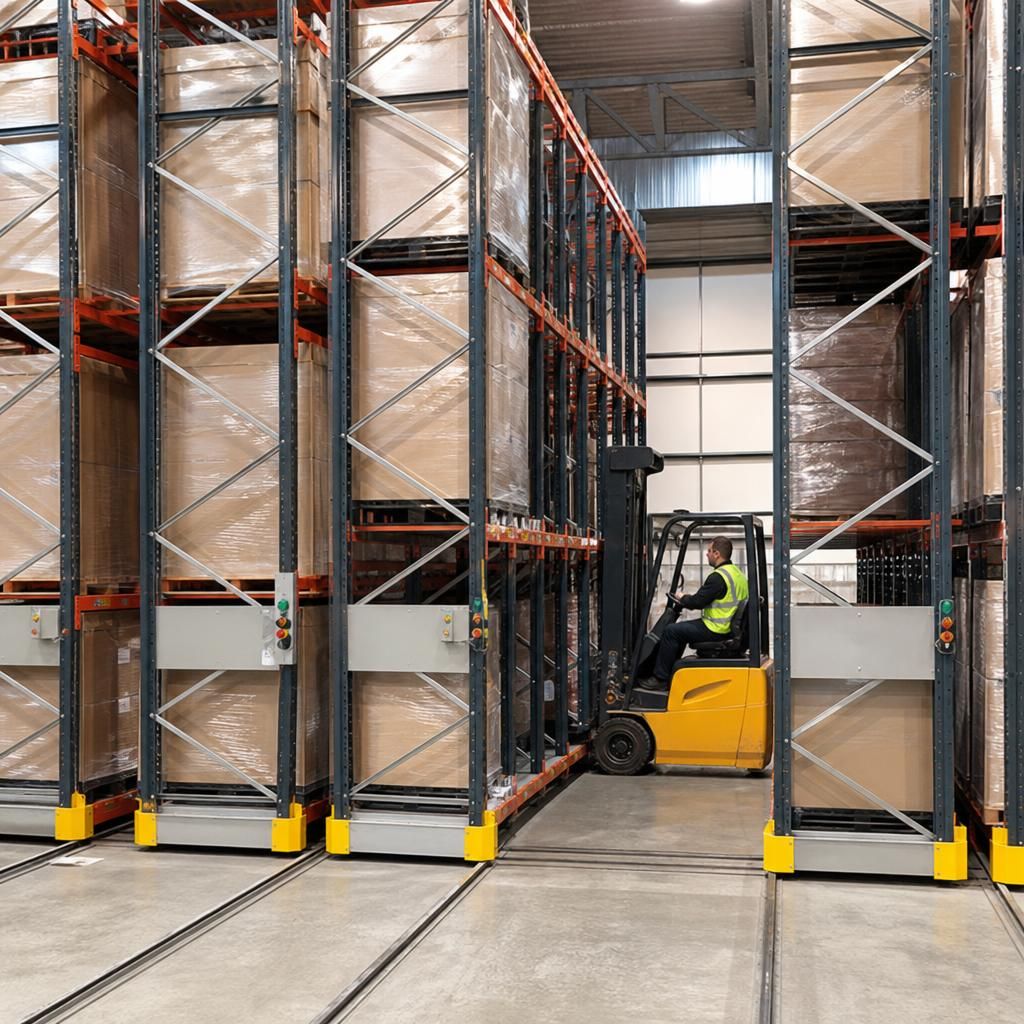
Mobile racking systems improve warehouse space utilisation by moving storage units along floor-mounted rails. Units can be positioned close together when access is not required, with an aisle opened only where stock needs to be retrieved or replenished. This can create additional storage capacity within the existing building without removing direct access to individual locations.
The available space must still accommodate safe operating clearances, emergency routes, handling equipment and fire protection requirements. A competent site assessment is essential to confirm that the floor, layout and proposed loads are suitable before installation.
Arrange an expert mobile racking assessment
Arrange an expert mobile racking assessment with Able Racking to review your layout, operating requirements and ongoing safety needs. Contact our experienced team for practical advice on installation, inspection and maintenance.