
What maintenance is necessary for narrow & high-bay longspan warehouse racking systems to ensure safety and efficiency?
Maintenance for narrow and high-bay longspan warehouse racking systems should include scheduled visual inspections, checks for damage or instability, tightening or replacement of defective components, and prompt repair of any safety-critical faults. Keep load notices and protection equipment in place, maintain clear access routes, and record all inspections and remedial work to support safe, compliant and efficient operation.
Maintenance for narrow and high-bay longspan warehouse racking systems should combine routine operator checks, planned inspections by a competent person, prompt control of damage, and documented repairs. The objective is to keep frames, beams, bracing, decking, connections, protection and load information in a safe working condition while preserving clear access and reliable storage capacity.
Because narrow-aisle and high-bay installations can be vulnerable to impact from handling equipment, even apparently minor defects require assessment. Damage at height can also be difficult to identify from floor level, so inspections should cover the full structure and not just the most accessible areas.
Routine checks during warehouse operations
Operators should remain alert to changes in the condition of the warehouse racking during normal work. A routine check should look for:
- Uprights, beams, bracing and connections that are bent, cracked, twisted, loose or displaced.
- Missing, damaged or incorrectly fitted beam locking devices.
- Damaged decking, support bars, shelf panels or load-support components.
- Protectors, end guards, barriers and guide components that have moved or no longer provide effective protection.
- Loads that are unstable, overhanging, incorrectly positioned or unsuitable for the stated storage level.
- Obstructed aisles, damaged floor surfaces, poor visibility or conditions that make vehicle movement unsafe.
- Missing, illegible or inaccurate safe working load notices.
Any suspected safety-critical damage should be reported immediately. The affected location should be taken out of use or unloaded where this can be done safely, with suitable controls in place to prevent further loading until a competent person has assessed it.
Planned visual inspections
A formal visual inspection should be completed at a frequency determined by the risk assessment, operating conditions, traffic levels and previous damage history. Narrow aisles, high-level storage, frequent vehicle movements and poor visibility may justify more frequent checks than a lightly used installation.
The inspection should cover every accessible part of the system, including areas behind stored goods where practicable. It should assess the condition of structural members, connections, locking pins, bracing, decking, protection, aisle clearances and signs. Inspectors should also consider whether the system is being used as designed, rather than limiting the inspection to visible physical damage.
High-bay areas need particular care. Upright frames, upper beams, bracing and stored loads should be checked from suitable safe access equipment or by another appropriate method. People must not climb the warehouse racking or access elevated locations using improvised equipment.
Periodic inspection by a competent person
A more detailed inspection by a suitably competent racking inspector should be arranged at intervals based on the risk assessment and the manufacturer’s or supplier’s information. UK guidance commonly expects a technically competent inspection at least annually, unless a documented assessment identifies a different suitable interval. The inspection should be brought forward after a significant impact, alteration, change of use or other event that could affect structural integrity.
The competent person should identify damage, assess its significance and provide clear remedial actions. Findings should distinguish between defects that require immediate isolation, defects requiring prompt repair and lower-risk issues that should be monitored and addressed within a planned maintenance programme.
Damage control and repairs
Repairs should be carried out promptly by appropriately trained and experienced operatives using components that are compatible with the installed system. Damaged structural members should not be straightened, welded, drilled or modified on site unless the work has been specifically designed and authorised by a suitably qualified party. Unapproved alterations can change the load-bearing behaviour of the system and invalidate the original design assumptions.
Repair work should include the replacement or reinstatement of damaged beam locks, bracing, decking, supports, protectors and other safety-critical components where required. After repair, the area should be checked before it is returned to service. If the system has been altered, extended or reconfigured, it should be reassessed to confirm that its capacity, stability, clearances and protection remain suitable.
Load control and configuration checks
Safe working load notices must remain visible, accurate and consistent with the current arrangement. Maintenance should verify that beam levels, bay layouts, frame positions and component types match the documented design. Changes in pallet type, goods, load dimensions, storage height or handling equipment can affect suitability even when the structure itself appears undamaged.
Loads should be evenly supported, stable and positioned within the intended bay. The warehouse team should not exceed the stated capacity, remove structural components to create additional space or change beam levels without approval. Any uncertainty about capacity or configuration should be referred for a technical assessment before the location is used.
Protection, housekeeping and operating conditions
Maintenance is not limited to the steelwork. Upright protectors, end barriers, aisle protection, guide arrangements and other impact-control measures should be kept secure and correctly positioned. Damaged protection can leave the structure exposed to repeated contact from handling equipment.
Aisles and emergency routes should remain clear, with spillages, packaging and loose materials removed without delay. Lighting should provide sufficient visibility for vehicle operators and inspectors, particularly around high-level storage and narrow access routes. Floor defects, settlement or changes in level should be investigated because they can affect vehicle stability, clearances and the alignment of the warehouse racking.
Records and follow-up
Keep an inspection and maintenance record that identifies the area inspected, the date, the person completing the check, defects found, risk controls, recommended action and completion status. Photographs, marked-up layouts and repair certificates can help demonstrate what was identified and how it was resolved.
Records should be reviewed for recurring impacts or repeated defects. A pattern of damage may indicate insufficient protection, poor aisle control, unsuitable vehicle operation, inadequate training or a layout that no longer suits the work. Correcting the underlying cause is more effective than repeatedly replacing damaged components.
Training and review
Employees who load, unload or work around the warehouse racking should understand the safe working load information, reporting procedure, prohibited alterations and actions to take after an impact. Vehicle operators should be trained to work within the available clearances and to report contact immediately, including contact that has not left an obvious mark.
The maintenance programme should be reviewed after changes to storage patterns, equipment, operating hours, building conditions or the warehouse racking layout. Combining routine checks, competent inspections, controlled repairs and accurate records provides the most reliable way to maintain safety, compliance and efficient use of available storage space.
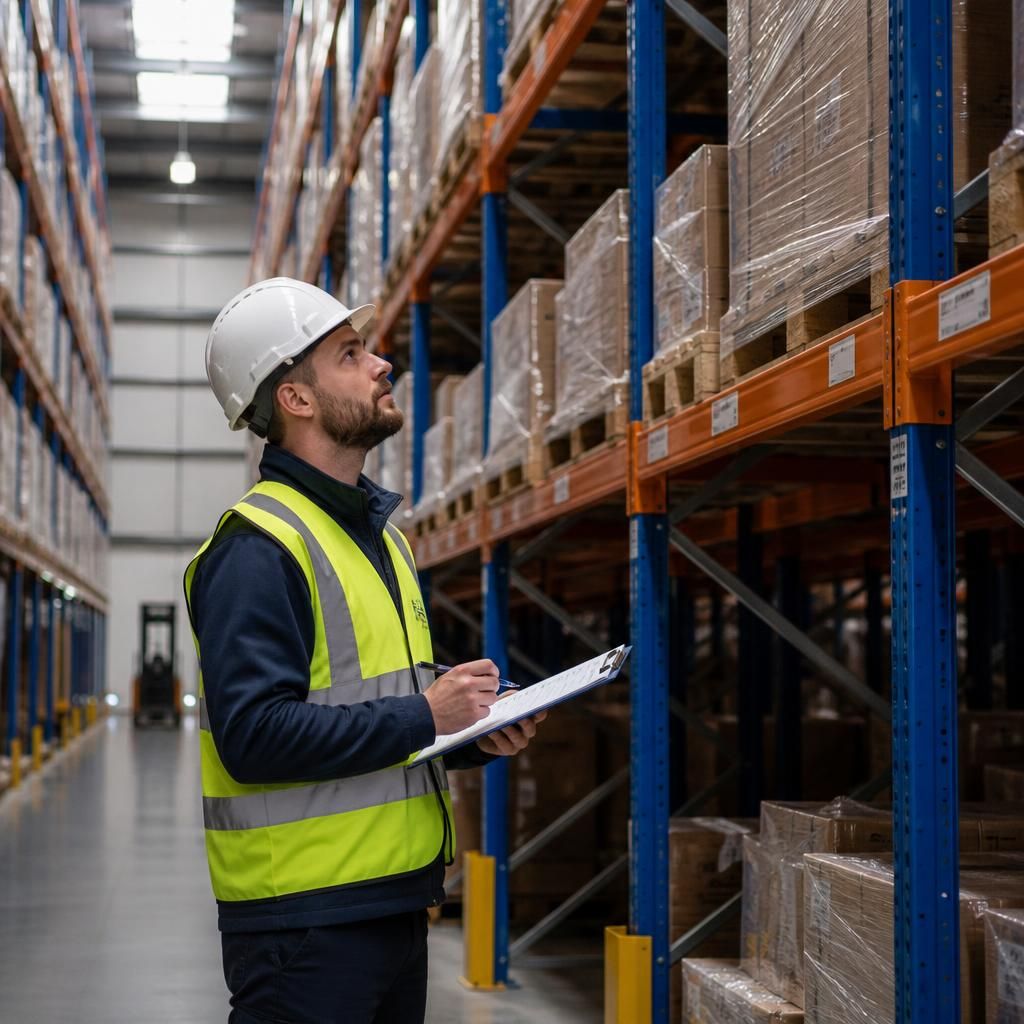
Damage control is a critical part of maintaining narrow and high-bay longspan warehouse racking systems. Any impact involving a forklift, pallet or other handling equipment should be reported immediately, even when the damage appears minor or is not clearly visible from floor level.
The affected bay should be isolated and unloaded where it is safe to do so, then assessed by a competent person. Bent uprights, damaged beams, displaced bracing, missing locking devices and compromised protection should be repaired or replaced using compatible components. Do not straighten, weld, drill or modify structural parts without specific technical approval, as unauthorised work can affect load capacity and stability. The area should only return to service after the repair has been checked and recorded.
Arrange an expert warehouse racking maintenance inspection
Arrange an expert warehouse racking maintenance inspection to identify damage, confirm safe working loads and keep your narrow and high-bay longspan system compliant and efficient. Contact Able Racking to discuss your inspection requirements.