
How does drive-in pallet racking improve warehouse storage efficiency?
Drive-in pallet racking improves warehouse storage efficiency by reducing aisle space and creating high-density storage for large quantities of uniform pallets. It is particularly effective for products managed on a last-in, first-out basis, helping maximise available floor space while keeping pallet movements organised.
Drive-in pallet racking improves warehouse storage efficiency by using the available floor area and vertical space for high-density pallet storage, while reducing the number of access aisles required. Forklift trucks enter the storage lanes to place and retrieve pallets, allowing several pallets of the same product to be stored behind one another. This makes the system particularly suitable for warehouses handling large quantities of uniform products with relatively low stock rotation.
Unlike selective pallet racking, where each pallet position is accessed directly from an aisle, drive-in pallet racking uses guided rails within each lane. Pallets are stored on these rails, and the forklift travels into the lane rather than stopping outside it. Removing access aisles between every row can increase the proportion of the warehouse dedicated to storage, helping businesses make better use of a restricted footprint or accommodate greater stock volumes without extending the building.
The main efficiency benefits include:
- Higher storage density: pallets can be stored several positions deep, reducing unused space between storage locations.
- Less aisle space: fewer operating aisles are needed than with individually accessible systems.
- Better use of warehouse height: the system can be designed around the building’s clear height, subject to the product, equipment and structural constraints.
- Grouped stock storage: identical or similar products can be consolidated into dedicated lanes, making bulk stock easier to organise.
- Reduced travel between locations: when stock is arranged in logical lanes, forklift movements can be more predictable and efficient.
Drive-in pallet racking is normally operated on a last-in, first-out basis. The most recently stored pallet is usually the first available for retrieval because pallets are loaded and removed from the same end of a lane. This arrangement works well for products that are not date-sensitive, have a long shelf life or are managed in batches. Where older stock must be dispatched first, a drive-through arrangement may be more appropriate, as loading can take place from one side and retrieval from the other.
The system is most effective where there are many pallets of each product and a limited number of product lines relative to the total stock volume. It is less suitable where every pallet contains a different product, orders require frequent access to individual pallets, or stock rotation and immediate selectivity are more important than maximum density. In those situations, the space saved by deep-lane storage may be offset by additional handling and the need to move other pallets to reach the required load.
Operational efficiency also depends on correct layout and stock planning. Lanes should be assigned so that products with similar characteristics, handling requirements and rotation patterns are stored together. Fast-moving products may need to be positioned where forklift access is simplest, while slower-moving bulk stock can be placed in deeper lanes. Clear location identification and disciplined loading procedures help prevent pallets being placed in the wrong lane or retrieved in an unsuitable sequence.
Forklift suitability is an important consideration. The truck must be capable of entering the lane safely, lifting the load to the required level and operating within the available clearances. The pallet type, load dimensions, load stability and guide-rail arrangement must all be compatible with the system. Poorly matched equipment can increase the risk of contact with uprights, rails and other structural components, reducing both safety and productivity.
Safe operation is essential because forklifts work inside the storage structure rather than solely in front of it. Operators should receive suitable instruction for the equipment and system in use, including controlled entry, correct pallet placement, speed management, reversing and procedures for dealing with damaged pallets or obstructions. Loads should be placed centrally and evenly on the rails, with no overhang that could interfere with the structure or adjacent pallets.
Regular inspections support continued efficiency as well as compliance. Damage to frames, bracing, guide rails, protection or other components can affect load stability and may restrict the safe use of a lane. A competent inspection should identify damage, displacement, overloading, unsuitable pallets and other conditions requiring action. Defects should be assessed promptly, with affected locations unloaded or isolated where necessary until suitable repairs are completed.
Installation quality has a direct effect on long-term performance. The layout should be designed using accurate information about pallet weights, dimensions, building conditions, handling equipment and the required storage method. Components must be installed to the specified configuration, protection should be provided where impact is foreseeable, and the completed system should be checked before being brought into service. Changes to beam levels, lane arrangements or operating equipment should be reviewed rather than made informally, because alterations can affect the system’s capacity and safe operation.
In practical terms, drive-in pallet racking delivers the greatest efficiency when storage density is the primary objective, stock is held in consistent batches and direct access to every pallet is not required. A properly designed system can reduce wasted space, organise bulk inventory and support dependable forklift movements. The right choice depends on balancing those benefits against selectivity, stock rotation, handling requirements, inspection needs and the available warehouse conditions.
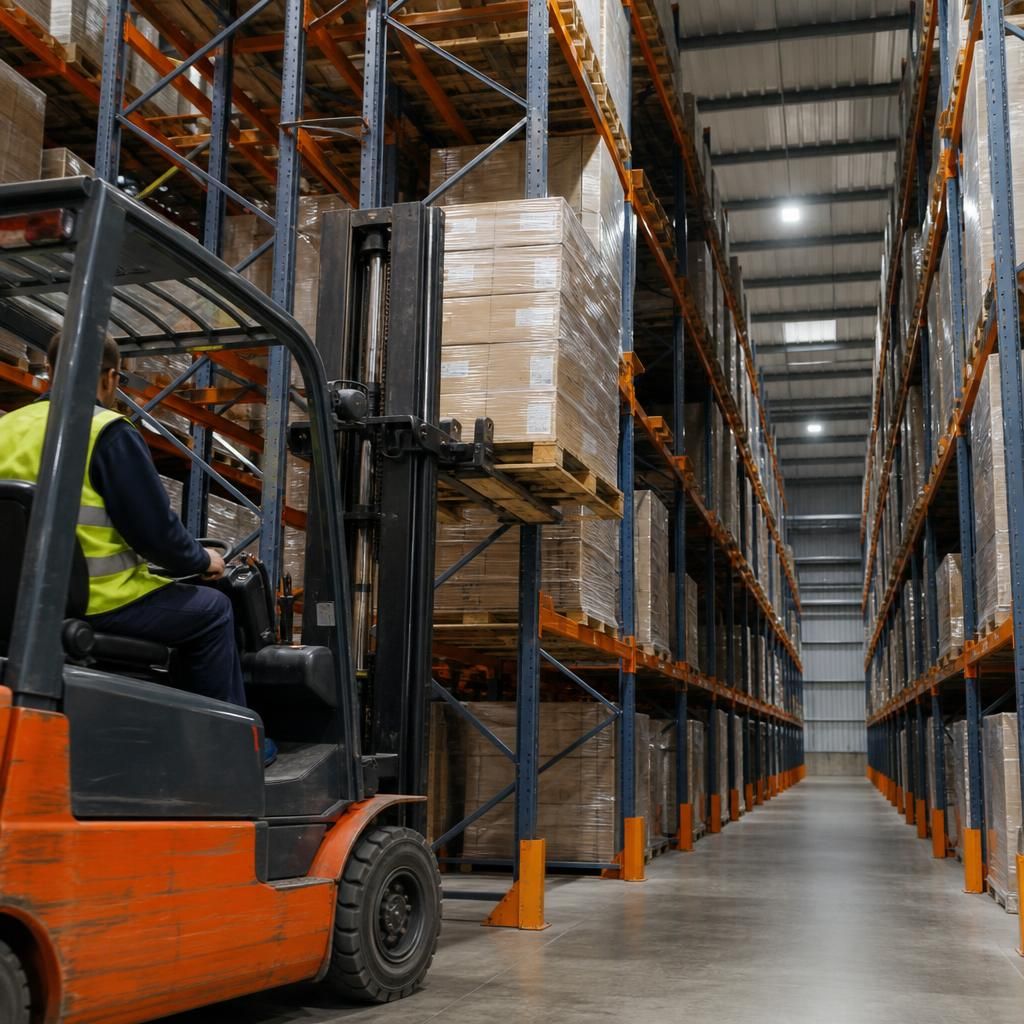
Drive-in pallet racking improves storage efficiency by allowing forklifts to enter storage lanes and place pallets several positions deep. Because pallets of the same product share a lane, fewer access aisles are needed than with directly accessible storage, increasing the proportion of floor space used for stock.
This high-density arrangement is most effective for warehouses holding large batches of consistent products with relatively low stock rotation. Pallets are normally loaded and retrieved from the same end, creating a last-in, first-out flow. Clear lane identification, compatible pallets and correctly operated forklift trucks are essential to prevent handling delays and protect the storage structure.
Discuss your drive-in pallet racking requirements
Speak to Able Racking about your drive-in pallet racking requirements, including storage density, pallet types, stock rotation and forklift access. Our experienced team can help assess your warehouse and recommend a safe, efficient solution.